OpenAI Is Buying the Bottleneck: Can Orchestra Bio Cut a 15-Year Drug Timeline?
OpenAI's Orchestra Bio acquisition moves Rosalind beyond scientific reasoning into program coordination. The opportunity is large, but faster decisions are not yet faster medicines.
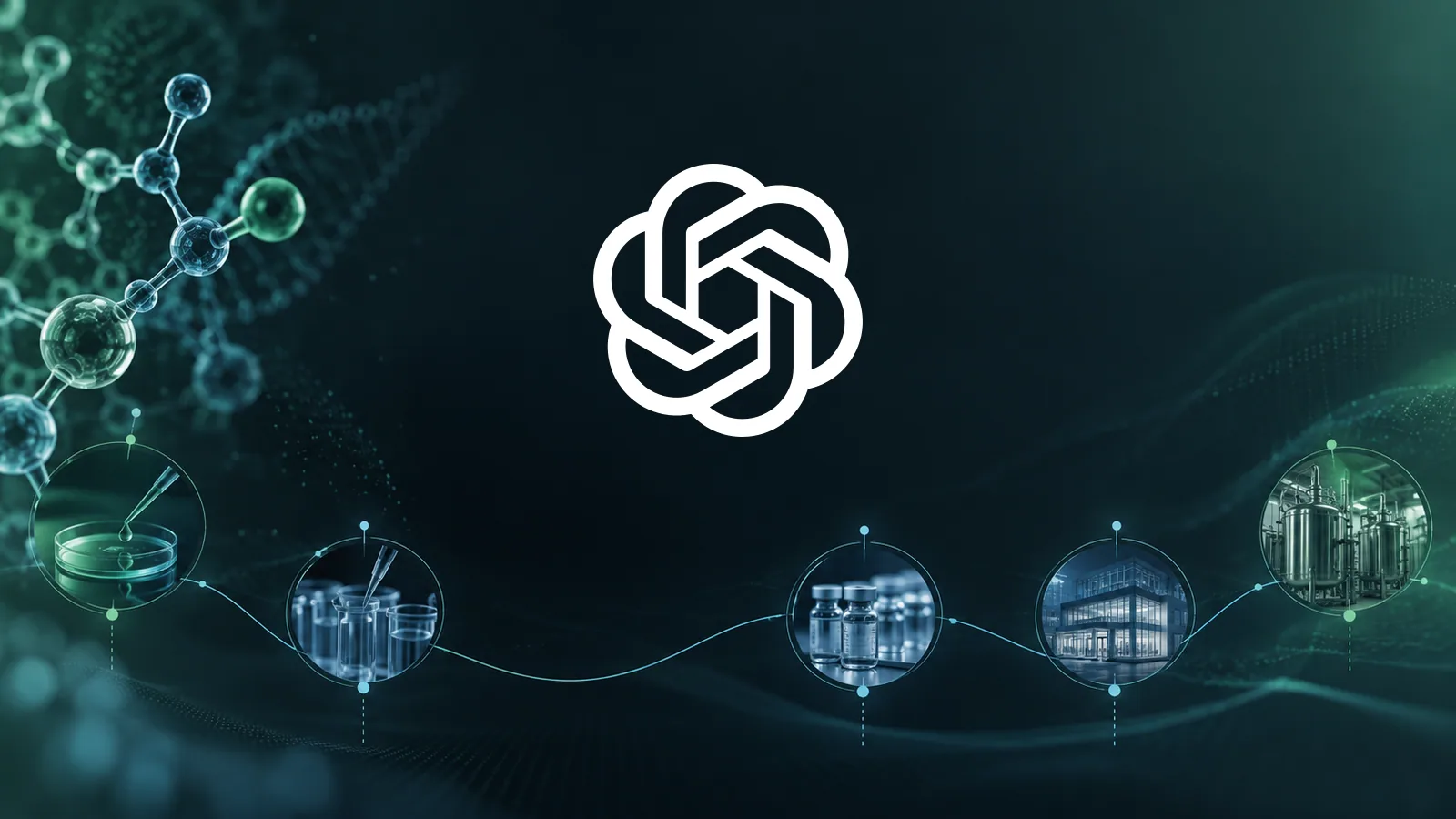
OpenAI is not buying a molecule generator. It is buying a system for coordinating the long, fragmented process that turns scientific findings into a medicine. The company has acquired Orchestra Bio and plans to integrate its team and technology with Rosalind, OpenAI’s life-sciences platform.
That distinction matters. Drug development often takes roughly 10 to 15 years from target discovery to US regulatory approval. Better biological reasoning can improve the beginning of that journey, but many delays appear later: studies depend on each other, manufacturing failures disrupt clinical timelines, external partners work in disconnected systems, and decisions arrive after problems have already spread.
OpenAI’s thesis is that agents can help manage that operational layer. The acquisition could make Rosalind more useful to biopharma teams, but it does not prove that medicines will reach patients faster. OpenAI disclosed neither the purchase price nor measured development-time reductions. For now, this is a strategic expansion backed by plausible workflow logic, not a clinical outcome.
What Orchestra Bio adds to Rosalind
Rosalind already combines specialized AI models with scientific tools and data. GPT-Rosalind is positioned as a reasoning model for biology and chemistry, while Rosalind Workbench helps researchers analyze results and plan experiments.
Orchestra Bio addresses a different problem. Its platform is designed for people and AI agents to coordinate drug programs. Scientists and program leaders can delegate monitoring and tracking work to agents, then use the collected information to make decisions.
OpenAI gives a concrete example: a failed manufacturing batch can delay a clinical trial. An Orchestra-style agent can identify which activities and timelines are affected, gather the relevant evidence, and compare response options. A human team still chooses what to do, but it may receive the operational picture sooner.
That is more than task automation. It is an attempt to connect scientific reasoning with program state. A useful drug-development agent must understand that a result in one workstream changes assumptions, deadlines and risks elsewhere. It must also preserve provenance so teams can see which documents and observations produced a recommendation.
Why the operational bottleneck is attractive
AI drug-discovery companies often focus on target identification, molecule generation or protein structure. Those capabilities can matter enormously, but a promising candidate still has to survive experiments, toxicology, manufacturing, clinical trials and regulatory review.
The work is distributed across specialized teams and outside partners. Data formats differ. Decisions may depend on old reports, current assays, vendor updates and regulatory requirements at the same time. A delay is rarely isolated.
This creates an attractive market for agents. Monitoring, reconciliation and impact analysis involve large amounts of information that humans must repeatedly assemble. If an agent can maintain an accurate map of the program, it can reduce coordination latency without pretending to replace scientific or medical judgment.
OpenAI also gains a clearer enterprise workflow for Rosalind. Instead of selling only a powerful model, it can offer a system that participates in ongoing work. That can make the product harder to replace, because value comes from integrations, permissions, audit trails and accumulated program context as well as model quality.
The evidence that is still missing
OpenAI’s announcement describes goals and examples, not controlled results. It does not report how often Orchestra’s agents catch schedule risks, how many false alarms they create, or how much time they save in a real development program.
The acquisition terms are also private. Without financial details, outsiders cannot tell how OpenAI valued the technology, team or customer relationships. Nor does the announcement explain which Orchestra capabilities are already deployed and which remain a roadmap.
The most important missing metric is downstream impact. Faster document synthesis is useful, but it is not the same as a faster clinical program. Teams need to measure decision cycle time, avoided delays, protocol deviations, manufacturing disruptions and the quality of human approvals. A system can produce more recommendations while making the organization slower if every output requires extensive verification.
Governance is part of the product
Biopharma programs contain sensitive research, patient information, commercial strategy and regulated records. An agent coordinating that work needs narrow permissions, complete audit logs and explicit human approval points.
The system must distinguish between observing a workflow, recommending an action and executing it. It should identify the evidence behind every dependency claim and expose uncertainty. A confident but incorrect link between a manufacturing event and a clinical milestone could send a program in the wrong direction.
Data boundaries also matter. Different partners may be allowed to see different parts of the same program. An agent that combines information across silos must enforce those boundaries rather than quietly flatten them.
What the acquisition signals
OpenAI is moving from providing intelligence to owning domain workflows. Orchestra Bio gives Rosalind an operational layer around scientific models, data and tools. That strategy resembles the broader enterprise-agent shift: the valuable product is not only the model that answers a question, but the system that follows work across time and coordinates the next step.
The acquisition could become important if OpenAI proves that the combined platform reduces measurable delays without weakening governance. It could also become another polished interface that helps teams summarize meetings while the real regulatory and scientific bottlenecks remain unchanged.
The correct conclusion today is narrower than the headline promise. OpenAI has identified a genuine problem in drug development and bought a team built around it. Whether that purchase shortens a 15-year timeline will be decided by validated program outcomes, not by the intelligence of a demo agent.
Sources
> Want more like this?
Get the best AI insights delivered weekly.
By subscribing, you agree to our Privacy Policy. You can unsubscribe at any time.
> Related Articles
Bedrock Claude Can Stop Broken JSON—But It Cannot Stop Hallucinations
AWS now constrains Claude outputs to JSON schemas and strict tool inputs during generation. That removes parsing failures, not factual errors or unsafe business decisions.
COBOL Migration at 97.9% Accuracy? Why Banks Should Not Trust OpenAI's Number Alone
OpenAI reports near-saturation on a hidden-test COBOL migration eval. The result is meaningful, but production modernization still requires business-rule tests, experts and staged cutovers.
One Line of Code to Trainium: Can Amazon Cross CUDA's Moat?
TorchNeuron promises to run existing PyTorch code on AWS Trainium with almost no rewrite. We examine whether it can reduce the software migration cost behind CUDA's moat.
Most Read
- 1 1,068 Tokens Per Second: Can Mercury 3 Change How LLMs Generate Text?
- 2 Same Price, Better Coding: How Good Is DeepSeek V4.1 Flash 1017?
- 3 Used OpenCode? Should You Rotate Your API Key After the Console Breach?
- 4 Code Output Rose 5x—So Why Did Anthropic's Junior Hiring Collapse?
- 5 Meta SparkMuse Goes Open: Can Two Mac Studios Make It Free Forever?




Latest News
- Bedrock Claude Can Stop Broken JSON—But It Cannot Stop Hallucinations
- COBOL Migration at 97.9% Accuracy? Why Banks Should Not Trust OpenAI's Number Alone
- One Line of Code to Trainium: Can Amazon Cross CUDA's Moat?
- 1,068 Tokens Per Second: Can Mercury 3 Change How LLMs Generate Text?
- AI Agents Are the New Insiders: Microsoft's Plan to Control Them
- Why Is Anthropic Putting 5% of Its Equity Into a Public Benefit Fund?
Tags
> Stay in the loop
Weekly AI tools & insights.