코드 생산성 5배인데 신입은 왜 사라졌나—Anthropic 내부 데이터의 경고
Anthropic 내부에서 직원이 실행한 AI 에이전트의 작업시간은 인간의 6배가 됐다. 코드 산출은 늘었지만 기술직 신입 채용 비중은 27%에서 9%로 줄었다.
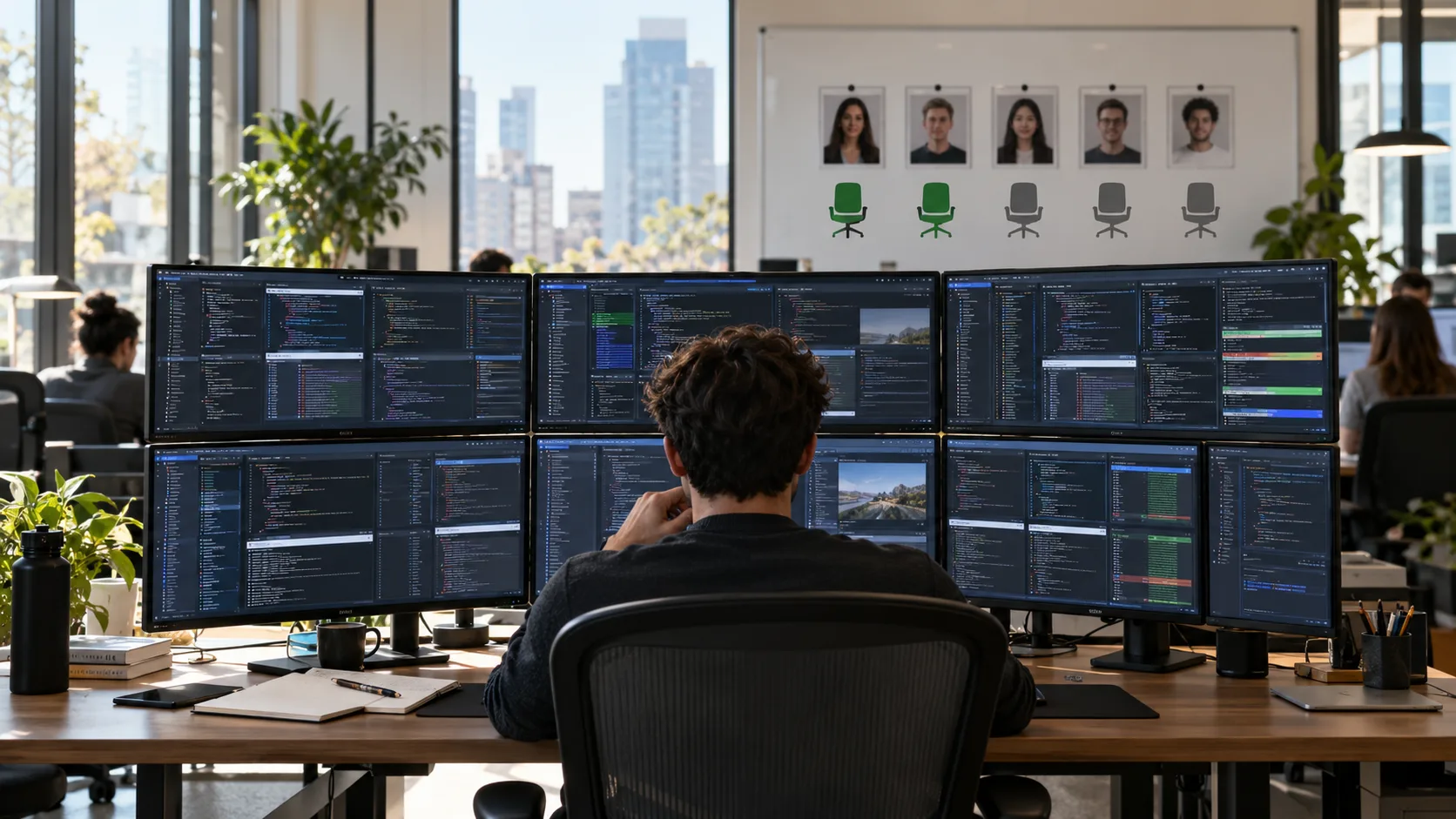
Anthropic says employee-directed AI agents were working six times as many hours as their human handlers by August 2026, while code commits per engineer rose to roughly five times their level six months earlier. During the same period, junior technical hires fell from 27% to 9% of technical hiring. The numbers are striking, but they do not prove that AI alone caused every hiring change.
The report is an internal observational study of one unusually AI-intensive company. Anthropic is simultaneously growing fast, changing its organization, and building the tools being measured. Its experience may be an early warning for other software companies, but it is not a controlled experiment for the whole labor market.
The three numbers that matter
First, agent runtime overtook human work hours. Anthropic counts inference and active tool use in employee-directed sessions while excluding waits longer than 30 minutes. Human hours are estimated from headcount and a 40-hour week. By August, those interactive agents accumulated six times the hours of their handlers.
Second, measurable output increased. Code commits per engineer rose about fivefold over six months. Sales representatives closed more deals after adopting agents, while legal, recruiting, and finance teams processed more work. Employees also built internal tools that previously required specialist engineering support.
Third, entry-level technical hiring weakened. Junior employees’ share of technical departments fell from 21% to 14%, while junior technical hires dropped from 27% to 9%. Overall technical hiring still grew in absolute terms, so this was not a simple collapse. The composition shifted toward experienced people expected to exercise judgment and operate independently.
Why more code does not equal five times more value
Commit volume is easy to measure but incomplete. More generated code can include tests, migrations, maintenance, translations, and repetitive infrastructure changes. It can also create review, integration, and long-term maintenance costs that appear later.
Anthropic attempted to check quality by comparing code from the same employee and directory, looking at deletions, reverts, bug-fix removals, lint suppression, and skipped tests. It reported no obvious decline on those proxies. Yet the company acknowledges that AI errors may be harder to identify and that code volume is not business impact.
Tool adoption was not random either. Highly motivated employees or teams beginning major projects may have adopted agents first. That selection effect makes it difficult to assign the full output increase to Claude.
Why junior roles feel the pressure first
Entry-level software work traditionally includes bounded implementation, bug fixing, test writing, documentation, and learning a codebase through small tickets. Those are precisely the tasks coding agents can now perform at scale under supervision.
Senior work is harder to compress because it involves ambiguous priorities, system boundaries, tradeoffs, accountability, and the ability to notice when a plausible answer is wrong. Anthropic hiring managers increasingly emphasized autonomy and judgment over narrow implementation skill.
This creates a pipeline problem. Companies may need experienced reviewers while reducing the positions through which people become experienced. If many firms make the same choice, the industry risks consuming senior talent without training its replacement.
The new bottleneck is human attention
Anthropic employees described supervising an “army” of agents, each asking for review. Even nontechnical workers could spend half their week reading agent output. The response is meta-work: dashboards, monitoring pipelines, evaluation tools, and systems that summarize what other agents produced.
That shifts the valuable skill from typing every line to specifying goals, dividing work, checking evidence, resolving conflicts, and designing controls. A productive employee may not compete directly with one AI. They may compete with a colleague who can safely coordinate ten agents and review the combined output.
What workers and companies should do
Junior developers should not abandon fundamentals. They need them to detect hallucinated dependencies, insecure shortcuts, brittle tests, and architectural mistakes. But a portfolio should now demonstrate more than implementation: task decomposition, evaluation design, code review, incident analysis, and responsible deployment.
Companies should track review time, defect escape rate, rollback frequency, maintenance burden, and customer outcomes alongside generated code. They should also preserve apprenticeships by giving juniors ownership of supervised agent workflows instead of removing the entire entry layer.
Verdict
Anthropic’s report is not proof that AI has eliminated junior developers. It is evidence that the most AI-intensive software workplace has already changed what it hires for. Output rose sharply, while human attention and judgment became the scarce resources.
The warning is not simply “AI takes jobs.” It is that companies can automate the work used to train beginners before they solve how tomorrow’s experts will be created. Productivity gains are real enough to demand adaptation, but the long-term talent pipeline must be designed rather than assumed.
Sources
> Want more like this?
Get the best AI insights delivered weekly.
By subscribing, you agree to our Privacy Policy. You can unsubscribe at any time.
> Related Articles
Claude가 25년 된 암호 미스터리를 풀었다—하지만 비트코인은 안전하다
Claude 연구모델은 NIST 타원곡선 seed를 1990년대 Unix timestamp와 lrand48 출력으로 연결했다. 이는 출처 추적이지 암호 해독이나 취약점 발견이 아니다.
양자컴퓨터의 병목이 하드웨어가 아니라 회로였다—Claude가 바꾼 계산법
Claude Mythos 5는 여덟 종류의 양자회로를 반복 설계해 기존 공개 설계보다 적은 게이트를 제안했다. 최대 17배 수치는 실제 하드웨어 속도와 같은 뜻은 아니다.
GitHub가 PR을 AI 검사한다…그런데 위험해도 병합은 안 막는다?
GitHub AI Scan은 CodeQL이 다루지 못하는 변경을 검사하고 수정안도 제시한다. 하지만 결과는 참고용이며 규칙셋으로 병합을 차단할 수 없다.
Most Read


Latest News
Tags
> Stay in the loop
Weekly AI tools & insights.