GitHub가 PR을 AI 검사한다…그런데 위험해도 병합은 안 막는다?
GitHub AI Scan은 CodeQL이 다루지 못하는 변경을 검사하고 수정안도 제시한다. 하지만 결과는 참고용이며 규칙셋으로 병합을 차단할 수 없다.
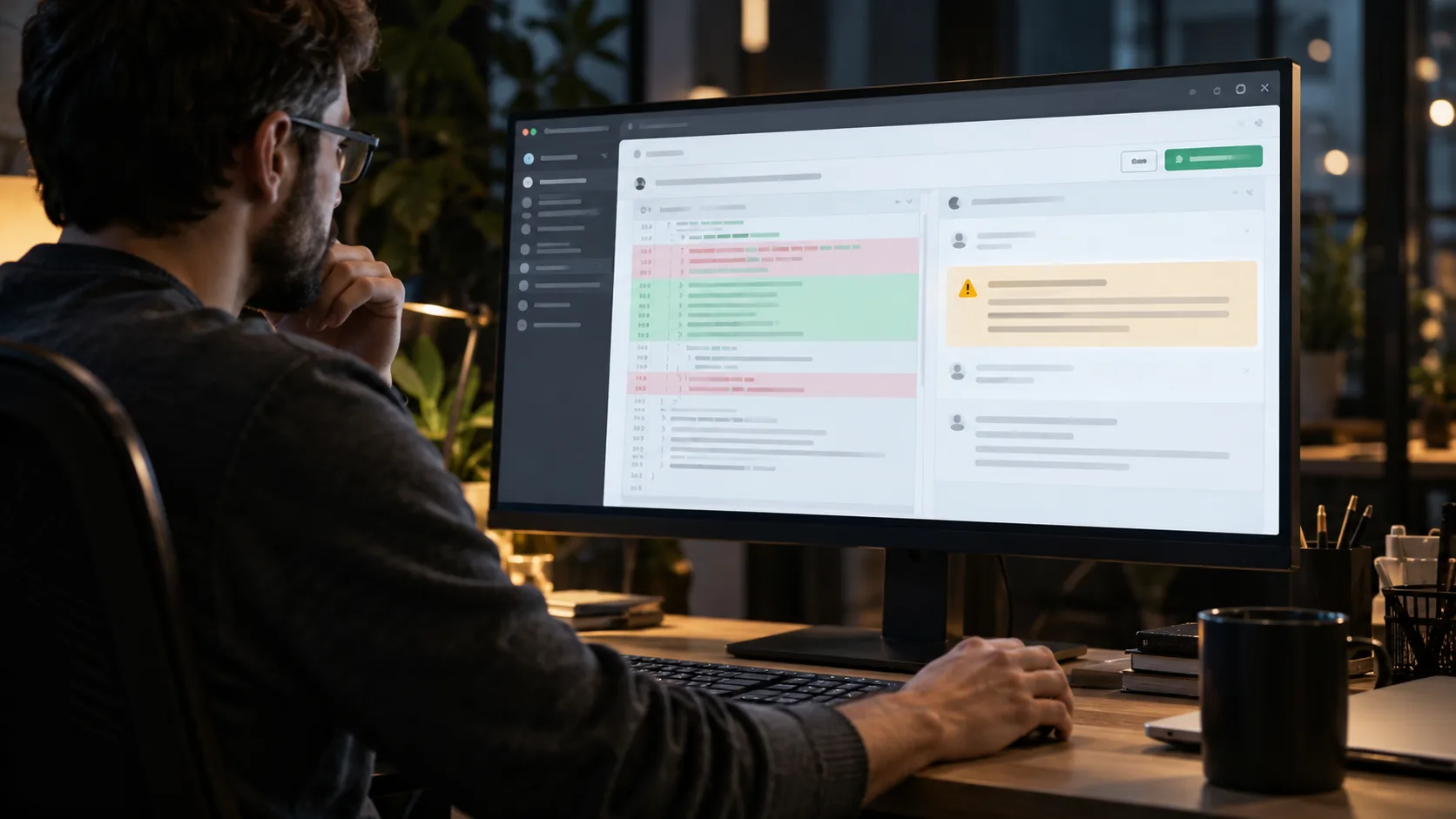
GitHub’s AI Scan for pull requests is now generally available. It can inspect changed code, explain a suspected vulnerability, and sometimes propose an autofix. Yet the headline’s tension is real: GitHub explicitly says AI Scan findings are advisory, do not fail the code-scanning check, and cannot block a merge through repository rulesets.
That is not necessarily a defect. It is a boundary between a probabilistic reviewer and an enforcement mechanism. The problem begins when a team sees an AI security badge and assumes it has become a mandatory gate.
What AI Scan adds
AI Scan complements CodeQL by looking for vulnerabilities in pull-request changes, including languages and formats CodeQL may not currently cover. GitHub lists PHP, Shell and Bash, Terraform configuration, Dockerfiles, JSP for Java, and Blazor for C# among the supported examples.
When code scanning and the repository’s effective AI Scan setting are enabled, the system runs automatically on eligible pull requests. Findings appear beside CodeQL results in the conversation and changed-files views, marked as AI-generated. The result can include a risk explanation and a suggested fix.
This creates a useful second lens. Deterministic rules and semantic analysis remain strong at known vulnerability classes, while a language model can reason about surrounding intent and suspicious data flows that do not fit an existing query cleanly.
Why it cannot block a merge
Security gates need predictable behavior. A check that blocks deployment must have a stable status, clear severity rules, an auditable exception process, and an acceptable false-positive rate. GitHub has chosen not to make AI Scan findings satisfy that role.
The official announcement says the alerts do not fail the code-scanning check. Repository administrators therefore cannot add a ruleset requirement that automatically prevents merging solely because AI Scan reported a finding.
The conservative design limits damage from hallucinated or context-poor findings. An AI reviewer may misunderstand a sanitizer, ignore configuration outside the diff, or flag code that is unreachable. Automatically freezing every pull request on such evidence could turn security tooling into a denial-of-service mechanism against development.
But the same design creates a human-process risk. A severe-looking finding can remain visible while someone with merge authority proceeds anyway. Teams must decide who triages the alert and which independent control will enforce the final decision.
Important coverage gaps
AI Scan does not run on pull requests from forks or those created by Dependabot. That matters for open-source projects, which commonly receive outside contributions through forks, and for repositories that rely on automated dependency updates.
The feature is available on public repositories owned by people or organizations. Private and internal organization repositories require GitHub Code Security or GitHub Advanced Security. A Copilot license is not required, but the scans consume Code Security AI Credits, making budgets and usage monitoring part of deployment planning.
AI Scan is also not described as comprehensive. It should not replace dependency scanning, secret scanning, CodeQL, conventional tests, manual review, or runtime controls. A clean AI report means only that this tool did not surface an advisory finding on the eligible change.
How teams should use it
Start with a defined triage policy. Decide who owns AI alerts, how quickly high-risk findings must be reviewed, and what evidence is needed to dismiss one. The reviewer should inspect the full data flow and relevant configuration, not merely accept or reject the generated explanation.
If a finding is validated, convert it into an enforceable control: a CodeQL query, static-analysis rule, regression test, policy check, or required human approval. This turns a probabilistic discovery into a repeatable guardrail for future pull requests.
Teams should also track usefulness. Measure confirmed findings, false positives, duplicate alerts, time to triage, and vulnerabilities found by other tools after AI Scan passed. Without those metrics, AI review can create activity without proving risk reduction.
What developers should not assume
Do not assume an AI-suggested autofix is secure merely because it compiles. The patch may move the vulnerability, break expected behavior, or create a new edge case. Treat it as a proposed change that requires the same tests and review as code written by a person.
Do not assume “generally available” means eligible for every repository or PR source. Fork and Dependabot exclusions should be visible in the team’s security documentation so maintainers know which changes need alternative checks.
Finally, do not confuse advisory findings with branch protection. If a repository needs blocking security checks, keep deterministic scanners and required reviews in the ruleset.
Verdict
GitHub AI Scan is best understood as a new source of evidence, not a security gate. Its value lies in extending review into languages and change patterns that existing queries may miss, then giving humans a faster starting point for investigation.
The inability to block merges is deliberate and defensible, but it transfers responsibility back to the organization. A mature team will use AI Scan to discover risks and then encode confirmed lessons into enforceable tests and policies. A careless team may display more warnings while continuing to merge exactly as before.
Sources
> Want more like this?
Get the best AI insights delivered weekly.
By subscribing, you agree to our Privacy Policy. You can unsubscribe at any time.
> Related Articles
Meta SparkMuse 공개 모델 등장…Mac Studio 두 대면 집에서 영원히 무료?
Meta의 816B 오픈웨이트 모델은 두 대의 고급 Mac Studio에서 로컬 실행할 수 있다. API 요금은 사라지지만 하드웨어·전기·운영비까지 무료가 되는 것은 아니다.
209M 모델이 대형 예측 AI를 이겼다? Mistral Timestral의 미확인점
Timestral-209M은 세 공개 시계열 벤치마크에서 선두를 주장하며 CPU에서도 실행된다. 하지만 기술보고서와 실제 산업 데이터 검증은 아직 남아 있다.
Can Google AI Studio Really Install an Android App From a Prompt?
Google now lets people generate, test, and install native Android projects from AI Studio. The workflow is real, but deployment, security, and source ownership still require human judgment.
Most Read
- 1 Meta SparkMuse 공개 모델 등장…Mac Studio 두 대면 집에서 영원히 무료?
- 2 209M 모델이 대형 예측 AI를 이겼다? Mistral Timestral의 미확인점
- 3 Can Google AI Studio Really Install an Android App From a Prompt?
- 4 GPT-4o API Shuts Down in Three Months—Will Delaying Really Break Your Service?
- 5 What Breaks When 10,000 AI Agents Run for 48 Hours?




Latest News
- Meta SparkMuse 공개 모델 등장…Mac Studio 두 대면 집에서 영원히 무료?
- 209M 모델이 대형 예측 AI를 이겼다? Mistral Timestral의 미확인점
- Can Google AI Studio Really Install an Android App From a Prompt?
- GPT-4o API Shuts Down in Three Months—Will Delaying Really Break Your Service?
- What Breaks When 10,000 AI Agents Run for 48 Hours?
- Did Seven People Replace Git in Five Months? What Anthropic's Internal Numbers Really Mean
Tags
> Stay in the loop
Weekly AI tools & insights.