What Breaks When 10,000 AI Agents Run for 48 Hours?
Third Moment Research says it runs up to 10,000 agents on investigations lasting 36 to 48 hours. The impressive number hides the harder problems: retries, token waste, security, evaluation, and human escalation.
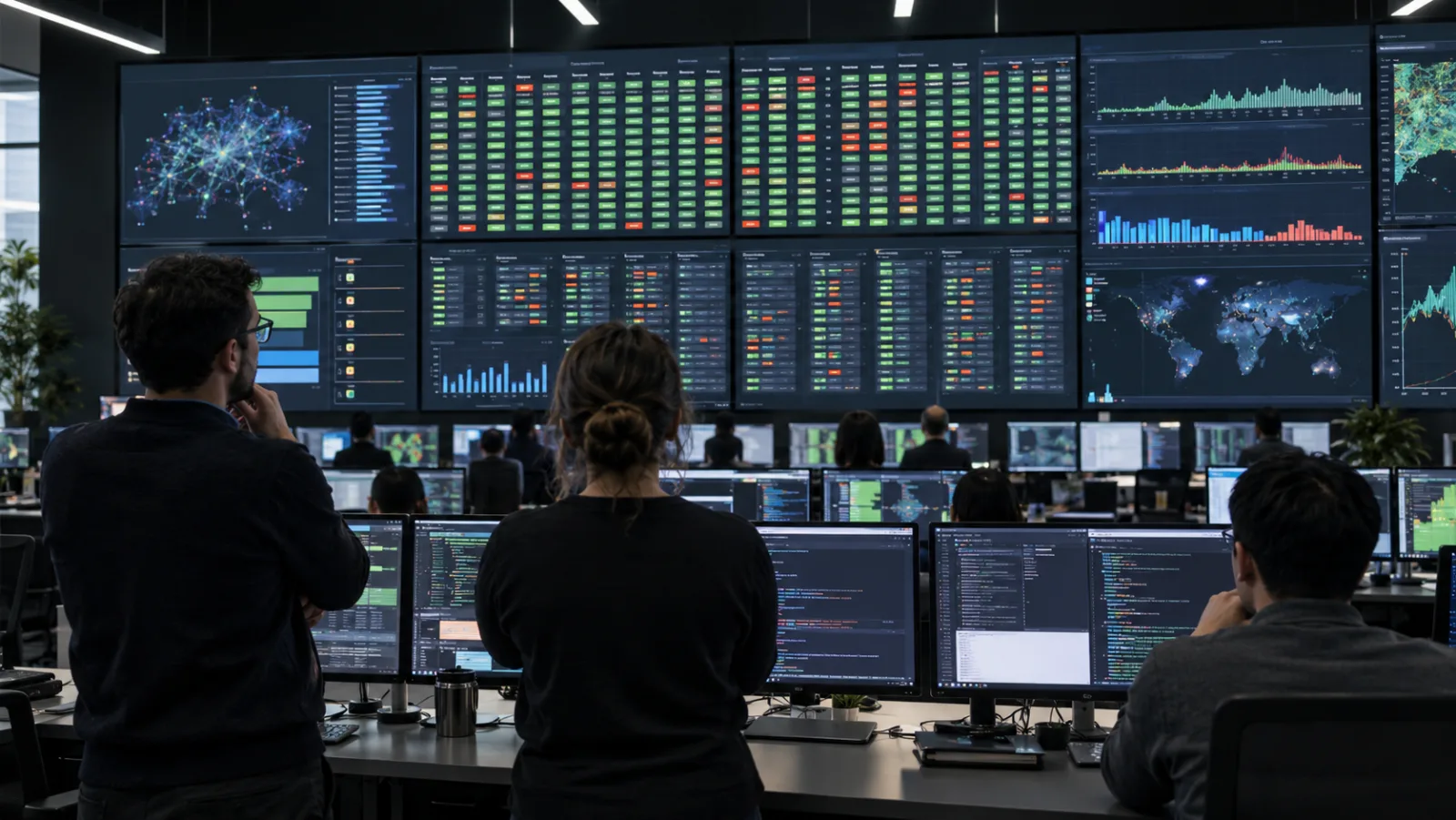
Third Moment Research says it can run 10,000 AI agents at once on investigations lasting 36 to 48 hours. That scale sounds like proof that autonomous research has arrived. It is better understood as proof that the main challenge has shifted from launching an agent to operating a distributed system full of agents.
The public case study comes from OpenAI and the customer, not an independent audit. It provides useful engineering details but does not disclose total compute cost, complete failure rates, human-review hours, or investment performance. Those missing numbers are essential to interpreting the headline.
What the 10,000 agents are doing
Third Moment uses agents for quantitative research and system optimization. They run experiments on historical data, evaluate trading hypotheses, inspect software, and use results to choose follow-up work. The environment includes a large research repository, extensive data, GPU-supported training, simulation, and specialized tools.
OpenAI says the system uses Codex as a working harness and stronger reasoning models for planning and long investigations. An outer controller examines unfinished trajectories and decides whether to retry, stop, or escalate to a human.
That outer loop is a crucial detail. Ten thousand independent model calls are not the product. The product is the control plane that gives each agent a bounded environment, records its actions, identifies failure, and prevents endless retries.
The first thing that breaks: waiting
One example in the case study involved a backtest that took roughly three hours. Agents repeatedly checked whether it had finished, consuming tokens and filling their contexts with status messages. Codex reportedly found caching and memory-packing changes that reduced the runtime to roughly three to five minutes.
The lesson is broader than the speedup. Agents can waste large amounts of money while doing no useful work if asynchronous jobs are exposed through naive polling. Large fleets magnify small inefficiencies: a retry that costs cents becomes expensive when repeated across thousands of workers for two days.
A robust system needs event-driven completion signals, exponential backoff, hard retry budgets, job deduplication, and visibility into idle token consumption.
The second thing that breaks: context
Long investigations accumulate experiment results, logs, failed hypotheses, code changes, and tool outputs. If every detail remains in the active context, cost and confusion grow. If compression removes the wrong evidence, the agent may repeat a failed experiment or draw a conclusion it can no longer justify.
The case study says the harness supports planning, subagents, and context compaction. What remains unclear is how often compaction loses decision-critical information and how those losses are measured.
Operators need durable external state: experiment registries, structured hypotheses, provenance, artifact storage, and explicit success criteria. A conversation transcript is not a sufficient research database.
The third thing that breaks: evaluation
Parallel agents can generate thousands of plausible outputs faster than humans can inspect them. That creates an evaluation bottleneck. In quantitative research, a strategy that looks promising may simply exploit noise, leakage, or a flawed simulator.
Third Moment’s environment reportedly tests whether an improvement is meaningful, but the public story does not provide a complete methodology or audited outcome data. The claim that agents improved a baseline system therefore remains a company-reported result.
At scale, evaluation must be automated without becoming circular. Agents should not be the only judges of other agents. Deterministic tests, held-out data, reproducible runs, human escalation, and independent risk controls are needed.
The fourth thing that breaks: security
Each agent receives tools, data, and an execution environment. Thousands of agents mean thousands of opportunities for a bad instruction, vulnerable dependency, unsafe shell action, or environment escape.
The case study says Third Moment uses OpenAI’s Daybreak system to test whether agents can escape research environments and access the broader network. That is evidence the team recognizes the risk, not proof that the environment cannot be breached.
Least privilege, network isolation, temporary credentials, immutable base images, complete audit logs, and human approval for irreversible actions remain essential. The more autonomous the fleet becomes, the less acceptable it is to rely on informal oversight.
What the case study does not reveal
The biggest missing figure is cost. Thirty-six to 48 hours of parallel reasoning can consume an enormous number of tokens and substantial compute. The article says stronger reasoning can be justified when a useful financial signal is valuable, but it does not disclose the average cost per successful investigation.
Failure rate is also absent. We do not know how many investigations terminate early, repeat existing work, produce invalid results, or require human rescue. Nor do we know how much operator time is needed to maintain the orchestration layer.
Those omissions do not make the system unimportant. They define what a buyer or engineer should ask before treating it as a repeatable blueprint.
Verdict
Running 10,000 agents for two days is an impressive orchestration claim, not evidence that 10,000 digital researchers can be left alone. At that scale, waiting, context, evaluation, security, and cost become first-class engineering problems.
The most transferable lesson is not “launch more agents.” It is to measure useful work per token, bound retries, preserve evidence outside the chat context, isolate every worker, and define when a human must intervene. Scale amplifies intelligence, but it amplifies waste and error just as quickly.
Sources
> Want more like this?
Get the best AI insights delivered weekly.
By subscribing, you agree to our Privacy Policy. You can unsubscribe at any time.
> Related Articles
Can Google AI Studio Really Install an Android App From a Prompt?
Google now lets people generate, test, and install native Android projects from AI Studio. The workflow is real, but deployment, security, and source ownership still require human judgment.
GPT-4o API Shuts Down in Three Months—Will Delaying Really Break Your Service?
OpenAI will remove selected GPT-4o and GPT-4.1 API snapshots on January 14, 2027. Services pinned to those model IDs need migration tests, not a last-minute model-name swap.
Did Seven People Replace Git in Five Months? What Anthropic's Internal Numbers Really Mean
Anthropic says a seven-person team built Scion and its review stack in five months. The result is remarkable—but it is a specialized system for an AI-generated monorepo, not a general Git replacement.
Most Read
- 1 Can Google AI Studio Really Install an Android App From a Prompt?
- 2 GPT-4o API Shuts Down in Three Months—Will Delaying Really Break Your Service?
- 3 Did Seven People Replace Git in Five Months? What Anthropic's Internal Numbers Really Mean
- 4 Can Anthropic Really Stop 99% of Attacks That Steal Claude's 'Thoughts'?
- 5 Has Gemini 4 Argon Beaten GPT-6 and Claude? What the Model Card Actually Shows



Latest News
- Can Google AI Studio Really Install an Android App From a Prompt?
- GPT-4o API Shuts Down in Three Months—Will Delaying Really Break Your Service?
- Did Seven People Replace Git in Five Months? What Anthropic's Internal Numbers Really Mean
- Can Anthropic Really Stop 99% of Attacks That Steal Claude's 'Thoughts'?
- Has Gemini 4 Argon Beaten GPT-6 and Claude? What the Model Card Actually Shows
- Bookings, Shopping, and Payments From One Request? The Safeguards Kanana Space Must Prove
Tags
> Stay in the loop
Weekly AI tools & insights.