209M 모델이 대형 예측 AI를 이겼다? Mistral Timestral의 미확인점
Timestral-209M은 세 공개 시계열 벤치마크에서 선두를 주장하며 CPU에서도 실행된다. 하지만 기술보고서와 실제 산업 데이터 검증은 아직 남아 있다.
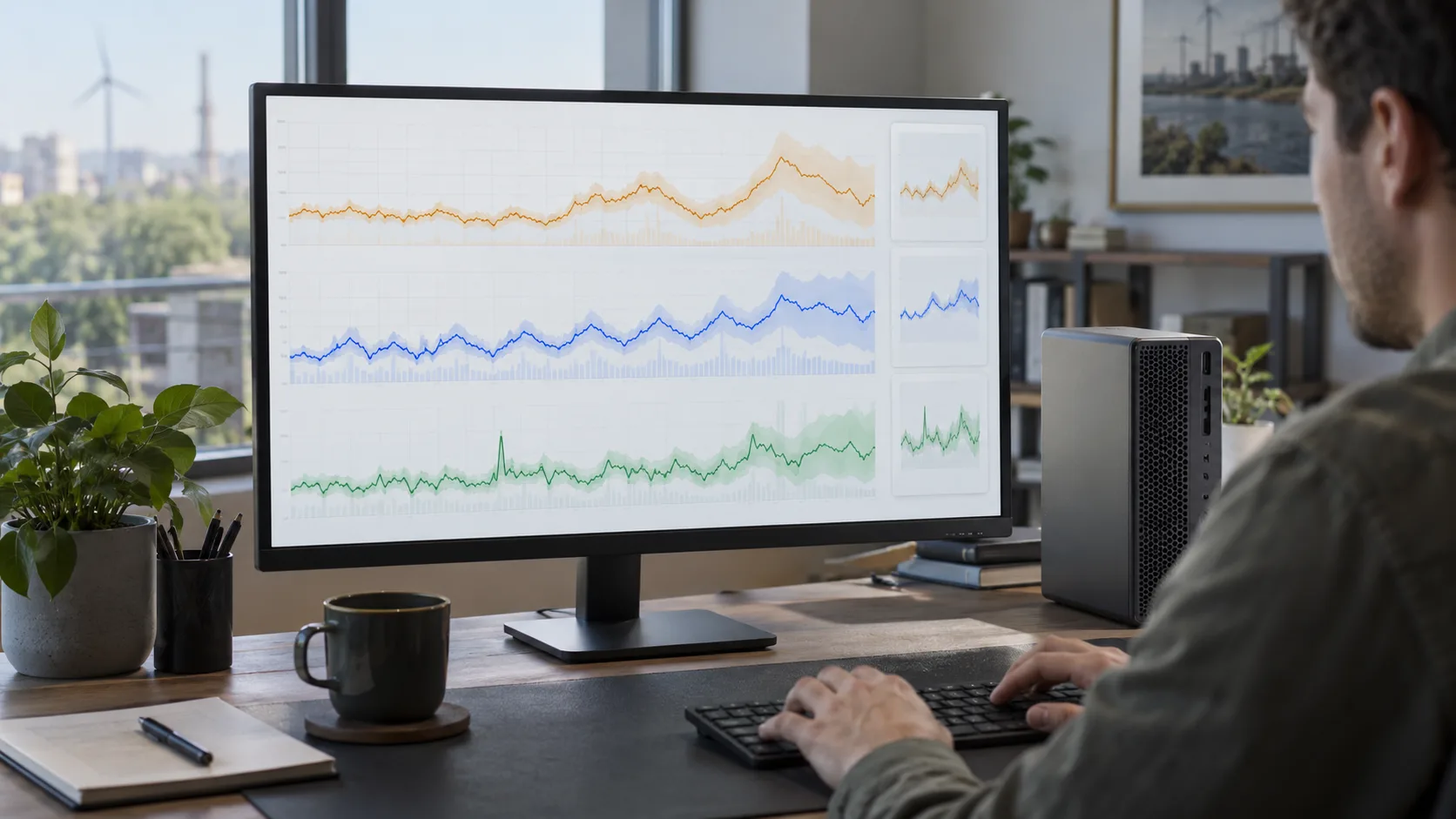
Mistral says its 209-million-parameter Timestral model ranks first among pretrained zero-shot systems on three public forecasting benchmarks, beating models with far more parameters while running on a CPU. The result is notable, but it does not prove that Timestral will beat every larger forecasting model on a company’s real data. The full technical report is still forthcoming, and the launch comparisons cover a defined benchmark class.
Timestral is not a chatbot. It is a family of time-series foundation models designed to forecast numerical sequences such as energy demand, inventory, sensor readings, cash flow, capacity, or equipment behavior. The family comes in 5M, 28M, 123M, and 209M sizes.
What the benchmark claim means
Mistral reports that Timestral-209M ranks first among pretrained and zero-shot entries on GIFT-Eval, TIME, and fev-bench. Zero-shot means the checkpoint is evaluated without retraining it specifically for each target dataset. That matters because many older forecasting systems must be fitted separately to every series or organization.
According to the published model card, Timestral supports univariate and multivariate forecasts, past-only and known-future covariates, and probabilistic outputs across 21 quantiles. It can use up to 32,768 historical steps and predict up to 1,024 steps in a single forward pass.
Those capabilities fit real planning problems better than a single best-guess line. A power operator may know tomorrow’s weather, a factory may know its production schedule, and a retailer may know holidays. Timestral can incorporate such known-future variables while producing a distribution rather than pretending that one exact number is certain.
How a small model can beat a larger one
Parameter count is not a universal measure of forecasting quality. A specialized architecture trained for numerical sequences can outperform a bigger general model on a narrow task. Timestral uses patch-based processing, attention across time and variables, and a forecasting design that preserves historical context while generating future blocks.
Mistral also says most pretraining data was synthetic, followed by post-training on a mixture of real and synthetic series. This can expose the model to varied trends, seasonal patterns, noise, missing data, and cross-variable relationships without depending entirely on scarce proprietary datasets.
The result is efficiency. Mistral reports that the 209M model can forecast one day from three weeks of 15-minute observations in about 140 milliseconds on a standard eight-thread server CPU. The smallest 5M model reportedly does the same class of task in about 10 milliseconds.
What remains unverified
First, the benchmark framing is narrower than “best forecasting AI.” The rankings apply to pretrained, zero-shot models under specified evaluation rules. A domain-specific model trained on a company’s own history may perform better. Classical systems such as ARIMA or gradient-boosted models can also remain competitive when data is stable, limited, or strongly understood.
Second, Mistral has published code, checkpoints, and score tables, but says a full technical report will follow. Independent teams still need to reproduce the results, inspect data overlap risks, and test whether the model’s uncertainty estimates remain calibrated under distribution shifts.
Third, the Modified MIT license on model weights is not identical to the Apache 2.0 license covering the repository code. Commercial teams should read the weight license instead of assuming the package and checkpoint share the same terms.
Where Timestral could be useful
The strongest immediate use cases are environments with many related series: industrial sensors, server observability, energy loads, retail demand, financial flows, and maintenance signals. Multivariate forecasting can capture relationships between pressure, vibration, and temperature instead of treating every signal independently.
CPU inference also lowers deployment friction. A team can test the model on premises or in an air-gapped network without provisioning a GPU cluster. The 837MB full-precision 209M checkpoint is small enough for ordinary servers, and smaller variants offer lower latency when accuracy requirements permit it.
Still, deployment should begin as a shadow forecast. Run Timestral beside the existing model, record errors by horizon and regime, test rare events, and verify that uncertainty bands correspond to actual outcomes. Replacing a planning system solely because of a leaderboard would repeat the mistake that the small-model story is supposed to challenge.
Verdict
Timestral makes a strong case that architecture, data, and task fit matter more than raw model size. A 209M forecasting model leading three public zero-shot benchmarks and running on CPUs is genuinely useful progress.
The missing piece is broad independent validation on messy production data. The right headline is not “small AI defeats every large model.” It is that specialized, open-weight forecasting has become cheap enough to test almost anywhere—and the burden now shifts to operators to prove that the public benchmark advantage survives contact with their own data.
Sources
> Want more like this?
Get the best AI insights delivered weekly.
By subscribing, you agree to our Privacy Policy. You can unsubscribe at any time.
> Related Articles
GitHub가 PR을 AI 검사한다…그런데 위험해도 병합은 안 막는다?
GitHub AI Scan은 CodeQL이 다루지 못하는 변경을 검사하고 수정안도 제시한다. 하지만 결과는 참고용이며 규칙셋으로 병합을 차단할 수 없다.
Meta SparkMuse 공개 모델 등장…Mac Studio 두 대면 집에서 영원히 무료?
Meta의 816B 오픈웨이트 모델은 두 대의 고급 Mac Studio에서 로컬 실행할 수 있다. API 요금은 사라지지만 하드웨어·전기·운영비까지 무료가 되는 것은 아니다.
Can Google AI Studio Really Install an Android App From a Prompt?
Google now lets people generate, test, and install native Android projects from AI Studio. The workflow is real, but deployment, security, and source ownership still require human judgment.
Most Read

Latest News
- GitHub가 PR을 AI 검사한다…그런데 위험해도 병합은 안 막는다?
- Meta SparkMuse 공개 모델 등장…Mac Studio 두 대면 집에서 영원히 무료?
- Can Google AI Studio Really Install an Android App From a Prompt?
- GPT-4o API Shuts Down in Three Months—Will Delaying Really Break Your Service?
- What Breaks When 10,000 AI Agents Run for 48 Hours?
- Did Seven People Replace Git in Five Months? What Anthropic's Internal Numbers Really Mean
Tags
> Stay in the loop
Weekly AI tools & insights.