Gemini Decisions API can score a photo. When should your app act?
Google’s new Gemini endpoint scores predefined choices across text, images, audio, video, and PDFs. Its confidence estimates give developers a way to decide which results to automa
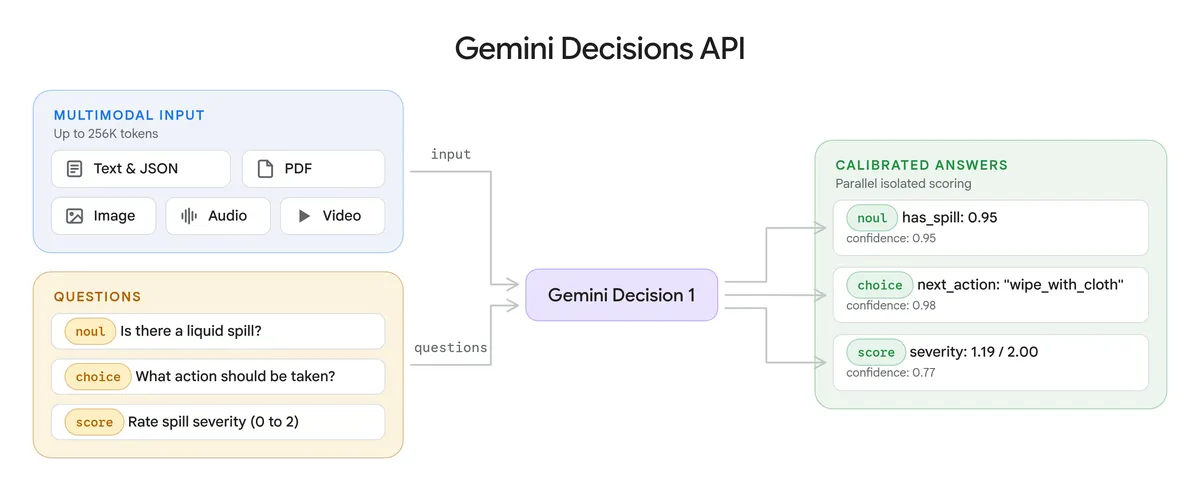
Google has introduced the Gemini Decisions API, an endpoint powered by Gemini Decision 1 that scores predefined answers against text, images, audio, video, and PDFs. Consider a support ticket with a customer’s note and a photo of a damaged package. An app could ask whether the photo shows visible damage and which support queue should get the case. The API returns structured results that the app can use to choose its next step. Google is pitching speed and calibrated probabilities, giving teams that already automate decisions from mixed media a new endpoint to evaluate. Google’s announcement
What the application decides
The endpoint supports three question types. A yes-or-no check estimates whether a statement holds. A multiple-choice question selects from labels the developer supplies and returns their probabilities. An ordered score rates the input against levels in a defined rubric. Those distinctions matter when designing a workflow. Checking whether a package is visibly damaged, selecting the support queue, and rating the quality of the photo are three different tasks. Each can use the same ticket and attachment while returning a value that application code can handle directly. Decisions API documentation
Questions in one request are evaluated independently against the same input. A routing question cannot use the result of the damage check as evidence, even when both are submitted together. The application can combine the answers after the response arrives. In the support example, it could send a ticket to the returns queue only when the routing result and the damage check satisfy separate criteria. It could also ask for a clearer photo when the visibility score is low. Google’s codelab demonstrates the same pattern with support routing and checks over photos and PDF invoices. API documentation, Google Codelabs
The wording of a check determines which evidence can satisfy it. A customer who writes that a mug arrived broken and attaches a photo of the sealed carton has supplied a report of damage. The photo may show whether the carton is dented, but it leaves the condition of the mug unresolved. If a support team needs to distinguish those cases, it can ask separately what the customer reports and what the image shows. A ticket can then reach the right team with its evidence status intact. An agent opening the case can see that the next step is to request a photo of the item, even if the reported problem was clear enough to route immediately.
An ordered rubric can make that follow-up more specific. For a photo-quality question, the levels might describe whether the item is out of frame, visible with the relevant area obscured, or shown clearly enough to inspect. A broad instruction to rate photo quality could reward a sharp, well-lit picture of the shipping label. A rubric tied to the inspection gives that picture a low score because the item is missing from the frame. If reviewers regularly disagree on adjacent levels, the team can look at the examples they disputed and revise the descriptions before using the score to trigger a customer message. Decisions API documentation
Measuring the time to act
Google reports median end-to-end latency of 150 to 250 milliseconds across its measured multimodal workloads, with model compute accounting for 50 to 100 milliseconds. The company says latency was nearly flat from one to 100 questions per request in those measurements. Gemini Decision 1 scores the options in one pass without generating an answer token by token, so the endpoint bills zero output tokens. For a team comparing it with an existing workflow, the figure to measure is the time between receiving a case and acting on the result. Uploading a large attachment, retrying a request, or waiting for a downstream service can all affect that interval. Google’s benchmark results
The timing comparison depends in part on where the attachments are when the clock starts. A support app that already has the customer’s photo can start its check as soon as the ticket is ready. An app that must retrieve a PDF from another service waits for that file before it can ask a question that depends on the contents. A replay with every attachment already on hand can measure the scoring step cleanly while missing the delay the live workflow has to absorb. Measuring the same interval for the existing process and the proposed one gives the team a fairer comparison. It also helps locate cases that drag past the median, such as tickets that wait on a file or go through a retry.
The flat latency Google measured is most relevant when checks share evidence and can run as soon as that evidence arrives. An app could send a photo and an invoice together, ask whether each is usable, and ask where the case belongs. If the app needs information that only becomes available after routing, that judgment belongs to a later step. For instance, the returns queue might retrieve an earlier inspection report before asking whether the new photo shows the same defect. That second decision adds time to the workflow even if each request is fast. Timing the handoff to the queue and timing the later decision separately shows which part of the process benefits from the endpoint. API documentation, Google’s benchmark results
Where to set the threshold
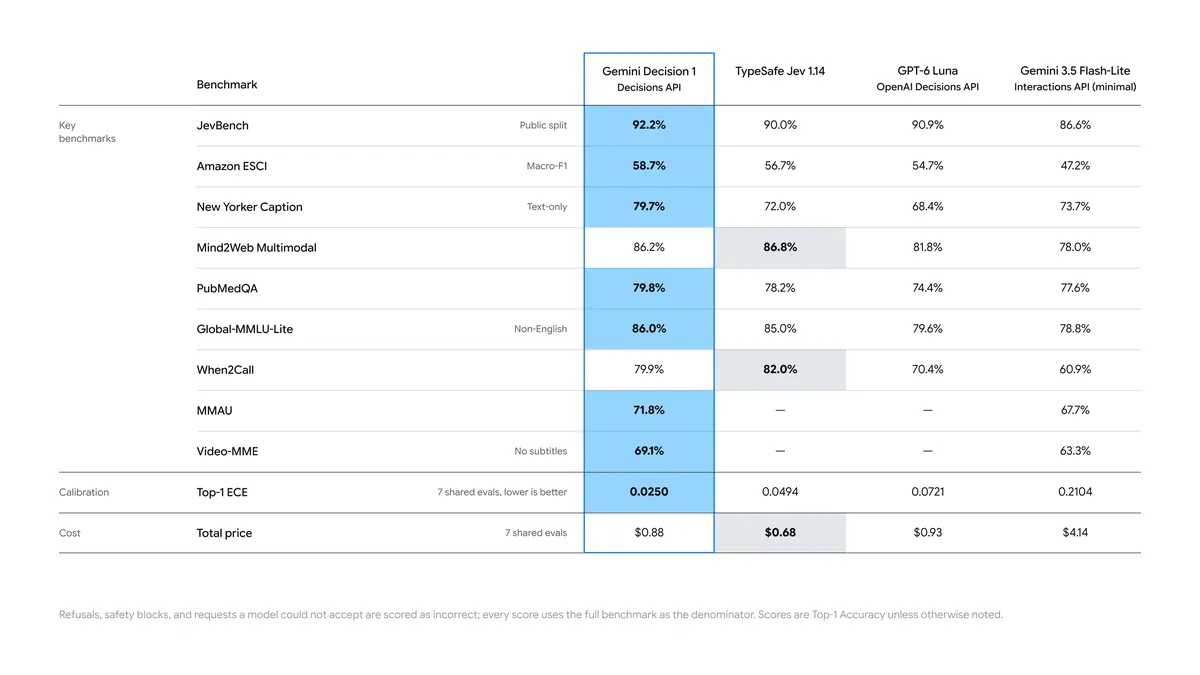
Calibration addresses how closely estimated probabilities track observed outcomes. If a system assigns a 90 percent probability to a set of similar predictions, good calibration would mean roughly nine in ten prove correct across that set. Google reports that Gemini Decision 1 had the lowest calibration error among the systems in its benchmark suite. Whether its estimates behave similarly on a particular team’s data remains an empirical question. A workflow that routinely receives blurry photos, for example, can check how often the model’s high-confidence calls agree with human labels on those photos before using the scores to automate routing. Google’s calibration benchmarks, API documentation
The labels available to the model also shape the outcome. If a team supplies only billing, shipping, and returns, a ticket about a locked account still has to compete for one of those choices. A general-review option gives the workflow a place for cases outside that list. A confidence threshold can serve a different purpose by catching cases that plausibly fit more than one queue. The two mechanisms can send work to the same person while preserving the reason for review, which helps distinguish gaps in the list of categories from ambiguity in the input. Decisions API documentation
The consequences of a wrong call should shape where the team sets that threshold. Sending a ticket to the wrong internal queue might cost an agent a transfer. Asking a customer to resend a usable photo adds a round trip and leaves the case waiting for a reply. The team can set a separate rule for each action and use its replay to count wrong transfers and unnecessary photo requests. It can also check who bears the extra work at each setting. Sending more tickets to an agent consumes review time. Sending more photo requests shifts some of that work to customers. The trade-off is easier to judge when those effects are visible alongside the share of decisions made automatically.
A team evaluating the API this week could run it alongside its current process on previously reviewed cases. The comparison can track how often the two systems agree, how many cases would need manual review at different thresholds, and where incorrect decisions would create rework. Including cases with unreadable attachments or conflicting evidence helps show what happens when the model has less to go on. For the routing comparison, the team can use the queue that ultimately handled the case as a reference when the original assignment was later corrected. For the photo check, reviewers can judge the image the model actually received, without relying on a clearer image that arrived later. That test shows how much work this endpoint can safely take on in that particular workflow, a result the launch benchmarks cannot supply on their own. Google Codelabs
Can one request include a photo and a PDF? Yes. The API supports mixed media in a shared input, so questions can evaluate both attachments together alongside any text supplied in the same request. Input documentation
Does the API explain why it picked an answer? The endpoint returns typed results and associated probabilities or confidence values. Its documented response does not include a written rationale. Response documentation
Where can developers try it? Google points developers to Google AI Studio for access and provides Python, JavaScript, and REST examples in its documentation. Decisions API quickstart
> Want more like this?
Get the best AI insights delivered weekly.
By subscribing, you agree to our Privacy Policy. You can unsubscribe at any time.
> Related Articles
Google’s Decisions API Can Read the Photo. What If the Ticket Disagrees?
Google’s Gemini Decisions API can read a support ticket and its photo in one call. A swapped attachment exposes the product decision your app still has to make.
Decision 1 Can Read Video—Will It See the Frame That Matters?
Google’s Decisions API can score a video clip in one pass. For builders, the sharper test is whether the clip actually delivers the frame that settles the question.
Interactions API Can Defer Tool Schemas—Which Ones Earn a Spot Up Front?
Google’s Tool Retrieval preview loads function schemas on demand. The test for agent builders is whether smaller prompts still deliver the right calls.
Most Read
- 1 Kimi K3.1 Pro: China's Open-Weight Model Just Caught the Frontier
- 2 OpenAI Is Buying the Bottleneck: Can Orchestra Bio Cut a 15-Year Drug Timeline?
- 3 1,068 Tokens Per Second: Can Mercury 3 Change How LLMs Generate Text?
- 4 Same Price, Better Coding: How Good Is DeepSeek V4.1 Flash 1017?
- 5 Used OpenCode? Should You Rotate Your API Key After the Console Breach?





Latest News
- ChatGPT Is Merging Chat and Work. Will Your Last Run Fit?
- Google’s Decisions API Can Read the Photo. What If the Ticket Disagrees?
- Google’s DeepCrossAttention Has a 3× Claim. What Did the Clock Measure?
- Gmail’s MCP Send Tool Is Listed. Can Your App Use It?
- iFood Has 15,000 Repositories. Who Decides If a Fix Is Done?
- Decision 1 Can Read Video—Will It See the Frame That Matters?
Tags
> Stay in the loop
Weekly AI tools & insights.