Strata Puts a 125B Qwen Model on Consumer PCs—With Important Memory Tradeoffs
The open-source Strata engine routes a sparse Qwen model across GPU, RAM, CPU, and SSD. Its launch drew more than 11,000 GitHub stars, but the headline speed needs configuration-level scrutiny.
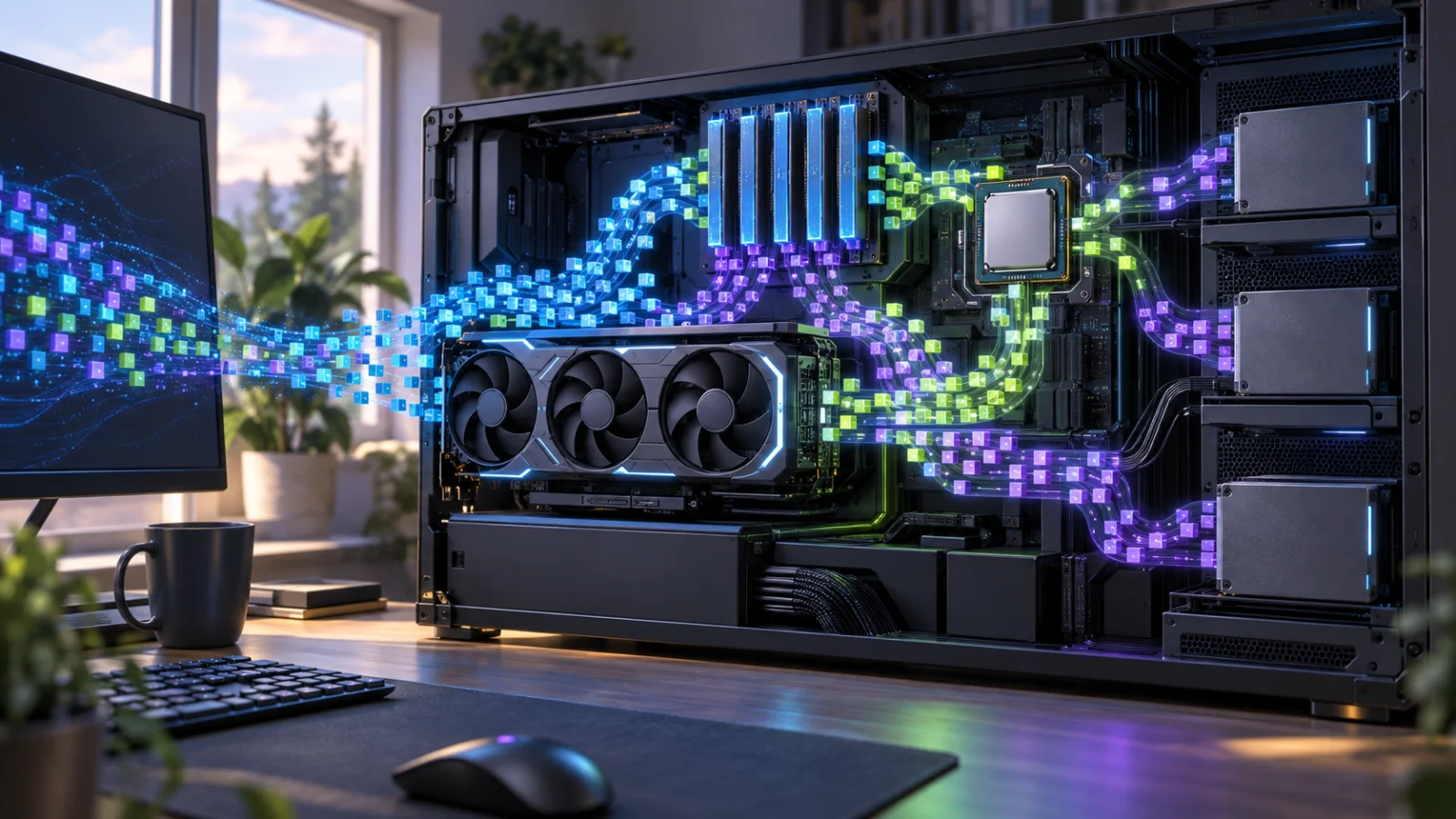
Strata, a newly released open-source inference engine, claims to make Qwen3.8-Flash-Next—a 125-billion-parameter sparse model—usable on an ordinary gaming PC. The project was created on September 24 and had reached 11,543 GitHub stars and 1,005 forks when checked at 1:05 p.m. Malaysia time on October 5. A Hacker News submission linked to the repository had 674 points and 311 comments.
Those are strong discovery signals, not independent performance validation. The interesting engineering idea is how Strata divides work among a graphics card, system memory, processor, and solid-state drive. The practical question is whether that division preserves enough speed and quality for a user’s actual workload.
What happened
The official README says Strata runs Qwen3.8-Flash-Next on Windows or Linux with supported NVIDIA or AMD graphics hardware, at least 12 GB of VRAM, at least 32 GB of system memory, and roughly 80 GB of free disk space. It exposes local OpenAI-compatible, Anthropic-compatible, and Responses-style endpoints, which can let existing chat or coding clients point at a machine-local service.
The model is a mixture-of-experts system. Strata’s explanation says the full model contains 24,576 small experts while each token uses only 10. Frequently selected experts can remain on the GPU, the complete set can sit in system RAM, and a lookup structure can live on SSD. A speculative helper proposes tokens for the larger model to verify in batches.
The repository reports, for an RTX 5070 with 12 GB VRAM and 64 GB RAM, output rates from 53 to 94 tokens per second across listed quantizations and prompt ingestion above 1,600 tokens per second for several configurations. An AMD RX 9070 XT system is reported at 44 to 60 output tokens per second. These numbers come from the project maintainers and depend on exact engine versions, quantization, prompt length, hardware, and answer length.
Why it matters
Local inference normally forces a blunt choice: use a much smaller model that fits cleanly in VRAM, or accept slow offloading for a larger model. Sparse routing creates a third possibility. If only a small fraction of experts are active for each token, a system can attempt to keep the hottest computation on the GPU while using cheaper memory tiers for the rest.
That matters for privacy and availability. A local endpoint can keep prompts, code, and retrieved documents on the user’s machine. It can also remove a per-token API bill and continue working without a cloud model provider. Strata’s MIT-licensed code and published setup documentation lower the experimentation barrier.
The release also reflects a broader shift from “Can this model fit entirely on my graphics card?” to “Can this workload be scheduled acceptably across the whole computer?” Gaming PCs often have far more system RAM and storage than VRAM. Software that treats those resources as a hierarchy can expand the models that enthusiasts and small teams can test.
Evidence
The official repository is the primary source for requirements, architecture, features, and benchmark tables. The linked Qwen model card identifies the underlying model and should be consulted separately for its license, training description, and benchmark claims. GitHub exposes public popularity and development activity. Hacker News and GeekNews show that the launch reached technical communities, but comments and votes are reaction signals rather than verification.
The evidence has limits. The speed tables are maintainer measurements, not a standardized independent benchmark. A short output rate does not predict long-context latency, parallel users, coding-agent success, or quality loss from aggressive quantization. The README says some 32 GB configurations use a coding variant with half of the experts removed and reports that it reaches 91 percent of the full model’s SWE-bench Verified score according to its authors. That is not the same system as the complete 125B model.
Practical takeaway
Treat Strata as a promising local-serving experiment, not as proof that a 125B model now behaves like a native 12 GB model. Before installing it on a work machine, read the setup script, release provenance, security notes, model licenses, and disk requirements. Use a dedicated account or test computer if the workload is sensitive.
Benchmark the exact configuration you can run. Record cold-start time, peak RAM and VRAM, disk traffic, prompt-ingestion speed, output speed, answer quality, and stability over a long agent session. Compare at least one smaller model that fits more cleanly in memory. A slower large model is not automatically better than a responsive smaller one.
For network access, do not expose the local endpoint without authentication and firewall controls. The project itself warns users to set a key when listening beyond localhost. “Runs locally” improves one privacy boundary; it does not eliminate risks from clients, plugins, downloaded weights, or a broadly exposed API.
Limitations
EgoistAI did not reproduce the benchmark on the listed hardware. GitHub stars can grow quickly after a prominent discussion and do not measure reliability. The project is young, has hundreds of open issues, and may change rapidly. Performance, supported hardware, model weights, and compatibility should be rechecked against the current repository before deployment.
Sources
> Want more like this?
Get the best AI insights delivered weekly.
By subscribing, you agree to our Privacy Policy. You can unsubscribe at any time.
> Related Articles
Local-First AI Is Becoming a Control Stack, Not Just a Model Download
Strata, OpenMuse, and RemoveMacAI expose three layers of personal AI control: where inference runs, what tools an agent can use, and which operating-system capabilities remain enabled.
RemoveMacAI Turns macOS 27's Local AI Footprint Into an Explicit User Choice
The open-source utility disables optional Apple Intelligence features, removes downloaded model assets, and offers a reversible path back—while raising the usual risks of system-level tools.
Aleph Alpha Releases Kolibri as an Apache-2.0 English–German MoE Model
Kolibri activates 3.46B of 78.1B parameters per token, publishes weights under Apache 2.0, and makes data control, German efficiency, and deployment cost part of the model specification.
Tags
> Stay in the loop
Weekly AI tools & insights.