OpenAI Just Raised $40B — Here's What It Means
The largest private funding round in history signals a new era for AI. We break down where the money came from, where it's going, and what it means for the entire AI industry.

Let’s put $40 billion in perspective. That’s more than the GDP of over half the countries on Earth. It’s more than the annual revenue of Netflix, AMD, or Spotify. It’s roughly the cost of building 10 aircraft carriers.
And it just went to a single AI company.
OpenAI’s latest funding round isn’t just a big number — it’s a statement about where the world’s most powerful investors believe the future is heading. And the implications extend far beyond one company’s balance sheet. If you’re a developer, a founder, or an investor, this changes the calculus on almost every decision you’re about to make.

The Numbers
OpenAI’s Series C (yes, they’re calling it Series C despite the absurd size) values the company at over $300 billion post-money. To put that in context:
| Company | Valuation / Market Cap |
|---|---|
| OpenAI | $300B+ (private) |
| Intel | ~$120B |
| AMD | ~$200B |
| Uber | ~$170B |
| Salesforce | ~$260B |
| Netflix | ~$280B |
OpenAI is now more valuable than most of the tech companies that existed before it was founded. And it’s still private.
The round was led by SoftBank’s Vision Fund, with significant participation from Microsoft (increasing its already enormous stake), Thrive Capital, Andreessen Horowitz, Sequoia Capital, and several sovereign wealth funds from the Middle East and Asia.
Where the Money Is Going
Sam Altman has been transparent about the primary use of funds: compute infrastructure. Building and training the next generation of AI models requires staggering amounts of processing power, and that processing power costs real money.
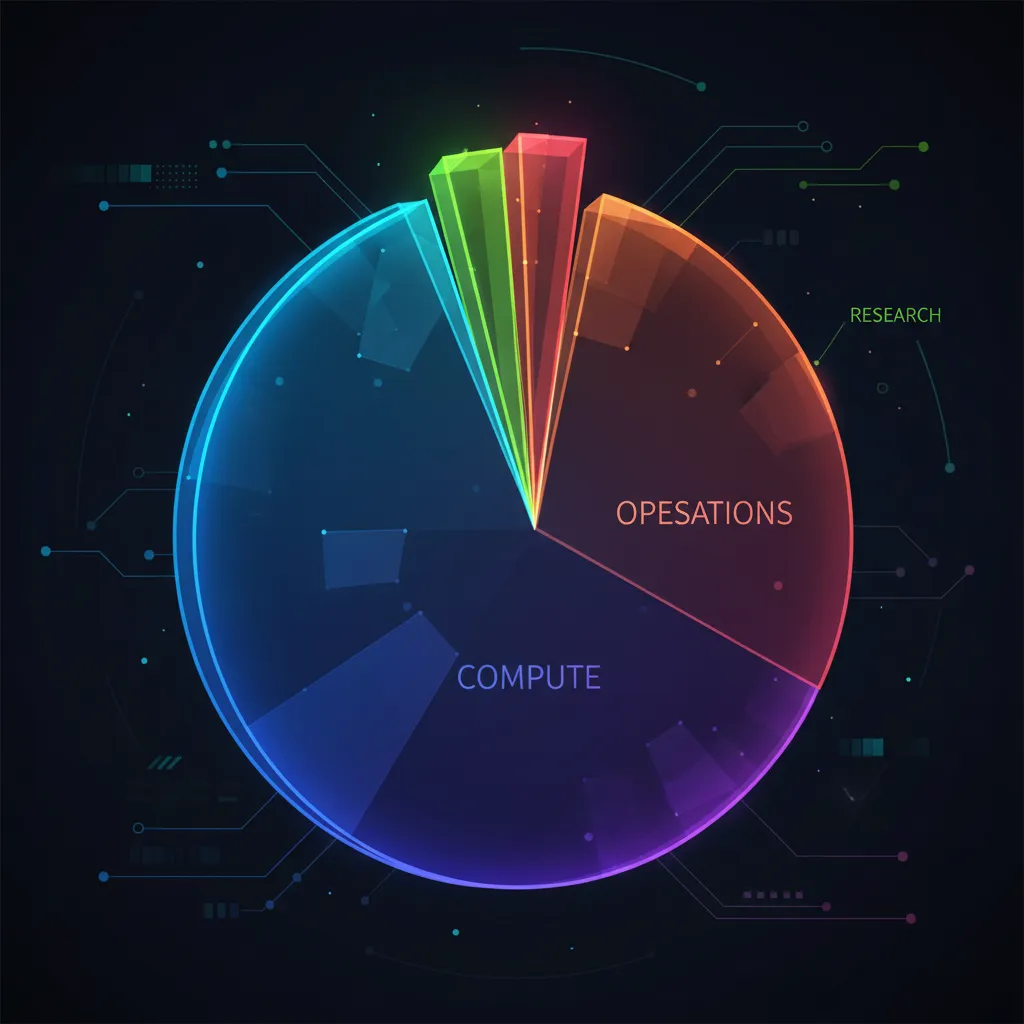
Here’s the rough breakdown of how the $40 billion is expected to be allocated:
Data Centers and GPU Clusters ($20-25B)
The largest chunk will go toward building and expanding data centers packed with the latest AI accelerators. OpenAI is reportedly planning several new “gigawatt-scale” data center campuses, each consuming as much electricity as a small city.
This isn’t vanity spending. The scaling hypothesis — the idea that making models bigger and training them on more data continues to yield improvements — has held up remarkably well. The next generation of models will require 10-100x more compute than current ones, and OpenAI wants to be ready.
Custom Chip Development ($5-8B)
OpenAI is investing heavily in designing its own AI chips, similar to how Google developed TPUs and Amazon developed Trainium. The dependence on Nvidia for AI hardware is a strategic vulnerability that every major AI company is trying to address.
Custom chips optimized for OpenAI’s specific model architectures could provide significant performance and cost advantages. But chip development is expensive, time-consuming, and uncertain. This is a long-term bet.
Research and Talent ($5-7B)
AI researchers are the most expensive talent in the world right now. Top researchers command compensation packages in the millions, and OpenAI is competing with Google DeepMind, Anthropic, Meta, and dozens of well-funded startups for a limited pool of experts.
The funding also supports OpenAI’s increasingly ambitious research agenda, which now extends beyond language models into robotics, scientific discovery, and fundamental AI safety research.
Product Development and Expansion ($3-5B)
ChatGPT and the API platform generate significant revenue, but OpenAI has ambitions far beyond chatbots. Product development spending covers enterprise features, new product categories (hardware, specialized tools), and international expansion.
What This Means for API Pricing — A Developer’s Real Talk
Here’s what most coverage of this round completely ignores: the direct impact on your monthly API bill.
OpenAI has already slashed prices aggressively over the past two years. GPT-4 Turbo launched at roughly half the cost of the original GPT-4 API. GPT-4o cut prices again. And every few months, there’s another round of reductions. With $40 billion in fresh infrastructure investment, that trend is about to accelerate — but it’s more nuanced than “everything gets cheaper.”
The Pricing Trajectory
Here’s the pattern we’ve seen and where it’s likely heading:
| Model | Input (per 1M tokens) | Output (per 1M tokens) | Release |
|---|---|---|---|
| GPT-4 (original) | $30.00 | $60.00 | Mar 2023 |
| GPT-4 Turbo | $10.00 | $30.00 | Nov 2023 |
| GPT-4o | $5.00 | $15.00 | May 2024 |
| GPT-4o-mini | $0.15 | $0.60 | Jul 2024 |
| Next-gen (projected) | $2.00-3.00 | $8.00-12.00 | Late 2026 |
| Economy tier (projected) | $0.05-0.10 | $0.20-0.40 | 2027 |
Why prices will keep falling: Custom silicon. When OpenAI’s in-house chips come online — likely 2027 or 2028 — the cost-per-inference drops dramatically because they’re no longer paying Nvidia’s margin. Google’s TPUs already demonstrated this: Google can offer Gemini at aggressive price points because they control the entire hardware stack.
Where prices might actually rise: Frontier reasoning models. OpenAI’s o-series models (o1, o3) that do extended chain-of-thought reasoning consume 10-50x more compute per query. As these become the default for complex tasks, your effective cost per useful output could increase even as per-token prices drop. If your application relies on reasoning-heavy tasks, budget accordingly.
The practical projection: For standard chat and completion workloads, expect a 50-70% cost reduction over the next 18 months. For agent-style workloads involving tool use, multi-step reasoning, and extended context, expect costs to remain flat or increase slightly as the models doing that work become more capable but also more compute-hungry.
What This Means for Your Architecture Decisions
If you’re building on OpenAI’s API today, this funding round is both reassurance and warning. Reassurance that OpenAI will be around and investing heavily. Warning that you’re increasingly dependent on a company that just became even more powerful.
The smart move is to build abstraction layers now, before you’re locked in.
How Developers Should Position Themselves
Let’s be blunt: if your entire AI strategy is “use OpenAI for everything,” you’re building on someone else’s foundation with no backup plan. That was acceptable in 2023 when there weren’t real alternatives. It’s negligent in 2026.
The Multi-Provider Reality
The AI model market has matured. You have genuinely capable options across multiple providers:
| Provider | Strengths | Best For |
|---|---|---|
| OpenAI | Broadest product suite, strong tooling | General-purpose, enterprise features |
| Anthropic (Claude) | Extended context, safety, coding | Complex analysis, long-document work |
| Google (Gemini) | Multimodal, integration with Google services | Search-augmented, multimodal apps |
| Meta (Llama) | Open-weight, self-hostable | Privacy-sensitive, cost-optimized |
| Mistral | Efficient, EU-based, open models | European compliance, lightweight tasks |
Each provider has different failure modes, different pricing trajectories, and different strategic incentives. Betting everything on one is the AI equivalent of putting your retirement savings in a single stock.
Skills That Matter in the Post-$40B Landscape
Stop optimizing for OpenAI-specific API knowledge. The developers who thrive in this environment are the ones who understand:
-
Model evaluation and selection. Being able to benchmark which model performs best for your specific use case — not which one has the best marketing — is a high-value skill. Build evaluation harnesses. Run A/B tests across providers.
-
Prompt portability. Prompts that work great on GPT-4o may perform differently on Claude or Gemini. Understanding the behavioral differences between model families and writing prompts that degrade gracefully across providers is essential.
-
Cost optimization. Not every query needs a frontier model. Routing simple queries to cheaper models (GPT-4o-mini, Haiku, Gemini Flash) and reserving expensive models for complex tasks can cut your AI bill by 60-80% with minimal quality loss.
-
Self-hosted model deployment. With Llama 3, Mistral, and a growing ecosystem of open-weight models, running your own inference is increasingly viable. Understanding quantization, vLLM, and container orchestration for AI workloads is a career differentiator.
-
Agent architecture. The next wave isn’t chatbots — it’s autonomous agents. Understanding tool use, planning loops, memory systems, and multi-agent coordination is where the real demand is heading.
Multi-Provider Fallback Pattern: Stop Building Single Points of Failure
Here’s the pattern every production AI application should implement. This isn’t theoretical — it’s how serious teams handle provider outages, rate limits, and cost optimization in production.
import asyncio
import time
from dataclasses import dataclass
from enum import Enum
from typing import Optional

class Provider(Enum):
    OPENAI = "openai"
    ANTHROPIC = "anthropic"
    GOOGLE = "google"

@dataclass
class ProviderHealth:
    provider: Provider
    failures: int = 0
    last_failure: float = 0.0
    circuit_open: bool = False

    def record_failure(self):
        self.failures += 1
        self.last_failure = time.time()
        if self.failures >= 3:
            self.circuit_open = True

    def record_success(self):
        self.failures = 0
        self.circuit_open = False

    def is_available(self, cooldown: float = 60.0) -> bool:
        if not self.circuit_open:
            return True
        # Auto-reset circuit after cooldown
        if time.time() - self.last_failure > cooldown:
            self.circuit_open = False
            self.failures = 0
            return True
        return False

class MultiProviderClient:
    """
    Routes AI requests across multiple providers with automatic
    failover, circuit breaking, and cost-aware routing.
    """

    def __init__(self):
        self.health: dict[Provider, ProviderHealth] = {
            p: ProviderHealth(provider=p) for p in Provider
        }
        # Priority order — adjust based on your needs
        self.priority = [Provider.OPENAI, Provider.ANTHROPIC, Provider.GOOGLE]

    async def complete(
        self,
        messages: list[dict],
        prefer: Optional[Provider] = None,
        max_retries: int = 2,
    ) -> dict:
        """
        Send a completion request with automatic failover.
        If `prefer` is set and healthy, try that provider first.
        """
        providers = list(self.priority)
        if prefer and prefer in providers:
            providers.remove(prefer)
            providers.insert(0, prefer)

        last_error = None
        for provider in providers:
            health = self.health[provider]
            if not health.is_available():
                continue

            for attempt in range(max_retries):
                try:
                    result = await self._call_provider(provider, messages)
                    health.record_success()
                    return {
                        "provider": provider.value,
                        "content": result,
                        "attempts": attempt + 1,
                    }
                except RateLimitError:
                    # Don't retry rate limits on same provider,
                    # fall through to next provider immediately
                    health.record_failure()
                    break
                except ProviderError as e:
                    last_error = e
                    if attempt < max_retries - 1:
                        await asyncio.sleep(0.5 * (attempt + 1))
                    else:
                        health.record_failure()

        raise AllProvidersFailedError(
            f"All providers exhausted. Last error: {last_error}"
        )

    async def _call_provider(self, provider: Provider, messages: list[dict]) -> str:
        """
        Normalize messages and call the appropriate provider SDK.
        Replace these stubs with your actual SDK calls.
        """
        if provider == Provider.OPENAI:
            # from openai import AsyncOpenAI
            # client = AsyncOpenAI()
            # resp = await client.chat.completions.create(
            #     model="gpt-4o", messages=messages
            # )
            # return resp.choices[0].message.content
            raise NotImplementedError("Wire up your OpenAI client")

        elif provider == Provider.ANTHROPIC:
            # import anthropic
            # client = anthropic.AsyncAnthropic()
            # resp = await client.messages.create(
            #     model="claude-sonnet-4-20250514",
            #     max_tokens=4096,
            #     messages=messages,
            # )
            # return resp.content[0].text
            raise NotImplementedError("Wire up your Anthropic client")

        elif provider == Provider.GOOGLE:
            # import google.generativeai as genai
            # model = genai.GenerativeModel("gemini-1.5-pro")
            # resp = await model.generate_content_async(messages)
            # return resp.text
            raise NotImplementedError("Wire up your Google client")

class ProviderError(Exception):
    pass

class RateLimitError(ProviderError):
    pass

class AllProvidersFailedError(Exception):
    pass
Key design decisions in this pattern:
- Circuit breaker prevents hammering a provider that’s already down. After 3 failures, the provider is removed from rotation for 60 seconds.
- Provider preference lets you route to a specific provider when you know it performs best for certain tasks, while still failing over automatically.
- Rate limit awareness immediately falls through to the next provider instead of wasting retries on a provider that’s throttling you.
- Normalization layer (in
_call_provider) handles the fact that OpenAI, Anthropic, and Google all have slightly different message formats, parameter names, and response structures.
Extend this pattern with cost-aware routing (send cheap queries to mini/flash models), latency tracking (route to the fastest available provider), and response quality scoring (detect degraded outputs and re-route).
Competitive Landscape Impact Analysis
OpenAI’s $40 billion war chest doesn’t just affect OpenAI. It sends shockwaves through the entire competitive landscape. Here’s how each major player is likely to respond — and what it means for you.
Google DeepMind: The Sleeping Giant With Deeper Pockets
Google has the deepest pockets of anyone in AI and has been spending aggressively. The Gemini model family continues to improve, and Google’s control of the entire stack — from TPU chips to cloud infrastructure to consumer products — gives it structural advantages that money alone can’t buy.
Likely response: Accelerated Gemini development, more aggressive pricing on Google Cloud AI, and potentially making Gemini Pro free or near-free for developers to prevent OpenAI from locking in market share. Google’s annual AI R&D budget already sits at $8-12B, and they can increase that from operating cash flow without raising a dime.
What this means for you: Google Cloud’s AI offerings are about to get a lot more competitive on price. If you’re evaluating cloud providers for AI workloads, Google’s integrated TPU + Gemini stack could offer significantly better unit economics than running OpenAI on Azure.
Anthropic: The “Not OpenAI” Advantage
Claude’s maker is the most direct competitor to OpenAI, and the funding gap is real. Anthropic has raised over $10 billion to date but is still outgunned financially. The company’s strategy relies on being better rather than bigger — focusing on safety, reliability, and quality rather than raw scale.
Likely response: Anthropic will lean harder into its differentiators — longer context windows, superior instruction following, and the “responsible AI” positioning that enterprise buyers increasingly care about. Expect Anthropic to announce its own major funding round within 6-12 months, likely in the $5-10B range, to maintain competitive relevance.
What this means for you: Anthropic’s existential pressure to differentiate means Claude will likely get more capable faster in specific areas (coding, analysis, extended context) even if Anthropic can’t match OpenAI’s breadth. For developers, this is excellent — competition drives quality up and prices down.
Meta: The Open-Source Wrecking Ball
Meta’s approach — open-sourcing its Llama models — creates a fundamentally different competitive dynamic. By making powerful AI models freely available, Meta undermines the premium pricing that funds OpenAI’s massive infrastructure. The Llama ecosystem has grown enormously, and many companies build on Meta’s open models rather than paying for proprietary APIs.
Likely response: Meta will accelerate Llama releases and push the quality of open-weight models closer to proprietary frontier models. Llama 4 and beyond will increasingly close the gap with GPT-4o class models, giving developers a free alternative for many use cases.
What this means for you: Meta’s open-source strategy is your insurance policy. Every improvement to Llama reduces your dependency on proprietary providers. If you’re not already evaluating self-hosted Llama for parts of your stack, the $40B round should be your wake-up call.
The Open-Source Community: The Wildcard
Perhaps the most interesting response comes from the broader open-source community. Projects like Mistral, Qwen, and the various Llama derivatives demonstrate that frontier-level AI capabilities can be developed at a fraction of the cost of the big players.
The $40 billion round may actually galvanize open-source efforts, as developers and organizations rally around the idea that AI shouldn’t be controlled by a handful of well-funded corporations. Expect more corporate sponsors for open AI development, more talent flowing to open-source projects, and faster iteration cycles.
The Energy Problem Gets Real
This might be the most underappreciated consequence. Training and running AI models at the scale OpenAI is planning requires enormous amounts of electricity. A single large data center campus can consume 500 megawatts or more — enough to power a city of 400,000 people.
OpenAI’s CEO Sam Altman has invested personally in Helion Energy, a nuclear fusion startup, and has publicly advocated for next-generation energy sources. This isn’t a coincidence. The AI industry’s energy demands are growing faster than the grid can supply, and something has to give.
In the short term, this means:
- Increased demand for natural gas and existing power sources
- Pressure on renewable energy buildout
- Potential delays in AI scaling if energy supply can’t keep pace
- Growing political scrutiny of AI’s environmental impact
The Nonprofit-to-Profit Conversion Is Complete
OpenAI’s $40 billion round effectively completes its transformation from a nonprofit research lab to a commercial juggernaut. The original nonprofit mission — to ensure AGI benefits all of humanity — is now overseen by a minority stake in a for-profit structure worth hundreds of billions.
This conversion has been controversial from the start. Critics argue that OpenAI has abandoned its founding principles. Supporters argue that the nonprofit model couldn’t raise the capital needed to compete.
Regardless of which side you’re on, the precedent is set. Other AI companies may follow a similar path, and the idea that AGI development can be guided primarily by altruistic motives rather than profit incentives looks increasingly naive.
Practical Guide: Diversifying Your AI Stack to Reduce Vendor Lock-In
Talking about diversification is easy. Actually doing it requires deliberate architectural decisions. Here’s the practical playbook.
Step 1: Audit Your Current Dependency
Before you diversify, understand what you’re diversified against. Map every place your application touches a provider-specific API:
- Direct API calls. How many endpoints call OpenAI directly? Could you swap the provider in under a day?
- Embedded features. Are you using OpenAI-specific features like function calling schemas, JSON mode, or structured outputs that don’t have exact equivalents elsewhere?
- Fine-tuned models. If you’ve fine-tuned on OpenAI, your training data and process are portable but the model itself isn’t. Document everything so you can reproduce it on another provider.
- Embeddings. Switching embedding providers means re-embedding your entire dataset. If your vector store has millions of entries, that’s a significant migration cost. Plan for it.
Step 2: Build the Abstraction Layer
Wrap every AI call in an abstraction that separates business logic from provider specifics. The multi-provider fallback pattern above is a starting point, but you also need:
- Message format normalization. OpenAI uses
role/contentdicts. Anthropic uses a different message structure with system prompts handled separately. Google has yet another format. Your abstraction should accept a single canonical format and translate. - Feature detection. Not every provider supports every feature. Your abstraction should handle graceful degradation — if provider X doesn’t support structured JSON output, fall back to prompting for JSON and parsing the result.
- Response normalization. Different providers return different response structures. Normalize to a single format before it reaches your business logic.
Step 3: Implement Cost-Aware Routing
Not every query needs a $15/million-token model. Implement a routing layer that classifies incoming requests and sends them to the appropriate tier:
| Query Complexity | Example | Route To | Approx Cost |
|---|---|---|---|
| Simple/lookup | ”What’s the capital of France?” | GPT-4o-mini / Haiku / Flash | $0.10-0.60/M tokens |
| Standard | Summarize this document | GPT-4o / Sonnet / Gemini Pro | $3-15/M tokens |
| Complex reasoning | Multi-step analysis, code generation | o3 / Opus / Gemini Ultra | $15-60/M tokens |
A well-implemented routing layer can reduce your AI costs by 60-80% while maintaining quality where it matters. The key is building good classifiers for query complexity — start with simple heuristics (input length, presence of keywords like “analyze” or “compare”) and iterate toward ML-based routing as you collect data.
Step 4: Maintain Provider-Specific Evaluation Sets
Build a test suite for each provider you support. Run it weekly. Track:
- Quality scores across your key use cases
- Latency percentiles (p50, p95, p99)
- Cost per successful query (including retries)
- Uptime and error rates
This data tells you when to shift traffic between providers and gives you early warning when a provider degrades.
Investment and Business Opportunity Analysis
The $40 billion round doesn’t just create winners at the top. It reshapes the entire AI startup landscape. If you’re building, investing, or evaluating AI business opportunities, here’s where the smart money is going.
Where the Opportunity Is Expanding
Infrastructure and tooling. OpenAI’s massive spend on compute creates downstream demand for everything that supports AI infrastructure: monitoring tools, cost optimization platforms, model evaluation frameworks, and deployment tooling. Companies like Weights & Biases, LangChain, and Helicone are riding this wave. The AI infrastructure market is projected to exceed $100B by 2028.
Vertical AI applications. As foundation models become commoditized, the value shifts to domain-specific applications. Healthcare AI, legal AI, financial AI — these verticals require specialized data, compliance expertise, and industry relationships that OpenAI doesn’t have and doesn’t want to build. The $40B round actually helps vertical AI startups because better, cheaper base models make vertical applications more viable.
AI consulting and implementation. Every dollar OpenAI spends on capability is a dollar that increases demand for people who can actually deploy AI in enterprises. The consulting and integration market is growing faster than the model market itself. McKinsey estimates the AI implementation services market will reach $40B annually by 2027.
Where the Opportunity Is Shrinking
Thin API wrappers. If your entire product is “we call OpenAI’s API and add a nice UI,” the $40 billion just made your moat even thinner. OpenAI is building enterprise features, custom GPTs, and vertical solutions that directly compete with wrapper products. The window for building a business as a thin layer on top of OpenAI is closing fast.
Generic chatbots. ChatGPT has 300+ million users and growing. Building a general-purpose chatbot that competes with that is a losing game. The funded companies surviving in this space have highly specific use cases, proprietary data, or distribution advantages.
Self-funded frontier model development. The barrier to entry for building frontier-class models has gone from “very expensive” to “essentially impossible” without major backing. If your startup’s pitch is “we’re building a foundation model,” you’d better have a very convincing technical differentiation and a path to $1B+ in funding. The era of scrappy frontier model startups is over.
The Contrarian Play: Betting on Open-Source
Here’s the opportunity most people are missing. OpenAI’s $40 billion round is actually bullish for the open-source AI ecosystem. Why?
-
Talent overflow. Not everyone wants to work at a $300B company with corporate politics. Many top researchers prefer open-source projects, academic institutions, or small teams. As the big players grow, they inevitably lose some talent to the open ecosystem.
-
Enterprise demand for alternatives. CIOs don’t want single-vendor dependency on AI any more than they wanted it on databases or cloud. The bigger OpenAI gets, the more enterprises actively seek alternatives — and open-source models are the ultimate alternative.
-
Community acceleration. Open-source communities have consistently shown they can match proprietary capabilities within 6-12 months for most tasks. The gap at the absolute frontier is real, but for 90% of commercial applications, open models are good enough.
Building products and services on the open-source AI stack — fine-tuning Llama, deploying with vLLM, building with LangChain — is a bet that the AI market follows the same trajectory as databases, web servers, and operating systems: proprietary leaders set the pace, but open-source eventually captures the majority of the market.
The Regulatory Dimension
The size of this raise will attract regulatory attention — guaranteed.
Lawmakers in the US, EU, and elsewhere are already debating AI regulation. A $40 billion private funding round that values a single AI company at $300 billion adds urgency to those debates. Expect to see:
- Antitrust scrutiny of the Microsoft-OpenAI relationship, which is already under investigation in multiple jurisdictions
- Calls for mandatory safety testing before deploying new models, similar to pharmaceutical approval processes
- Data governance requirements around how training data is sourced and used
- Transparency mandates requiring companies to disclose model capabilities and limitations
- Investment concentration concerns about whether too much capital flowing to too few companies creates systemic risk
The wild card is whether regulation helps or hurts OpenAI relative to competitors. Heavy regulation tends to favor incumbents (who can afford compliance) over startups (who can’t). If that pattern holds, OpenAI’s $40 billion war chest becomes even more valuable in a heavily regulated environment.
The Skeptic’s View
Not everyone thinks this is good news.
Is OpenAI overvalued?
$300 billion is a staggering valuation for a company with estimated annual revenue of $5-8 billion. That implies investors are pricing in massive future growth and, potentially, the assumption that OpenAI will achieve something close to AGI. If progress plateaus or competitors catch up, the valuation could prove unsustainable.
Is this a bubble?
The total investment flowing into AI companies in 2025-2026 exceeds the dot-com era when adjusted for inflation. Not every AI company will survive, and history suggests that periods of massive investment are often followed by painful corrections.
However, there’s a key difference: AI companies are generating real revenue and delivering measurable value to customers. This isn’t pets.com selling dog food at a loss. ChatGPT has over 300 million users and growing enterprise contracts. The revenue is real, even if the valuation is optimistic.
Concentration of power
Perhaps the most legitimate concern is the concentration of AI capability in a handful of well-funded companies. If building frontier AI models requires tens of billions of dollars, then the future of AI will be determined by a very small number of organizations — and the investors and governments that fund them.
This has implications for:
- Competition: Startups can’t compete at the frontier
- Safety: Fewer organizations means fewer perspectives on safety
- Access: The most powerful AI may be available only to those who can pay
- Governance: Democratic accountability is limited when private companies make civilization-scale decisions
What Comes Next — And What You Should Do About It
OpenAI has the money. Now comes the hard part: spending it wisely.
The next 12-18 months will be critical. If OpenAI can deliver meaningfully more capable models — models that justify the $300 billion valuation — then this round will look like a bargain in retrospect. If progress stalls or competitors leapfrog them, it could become a cautionary tale about throwing money at an uncertain future.
Either way, the AI industry has entered a new phase. The era of scrappy research labs and lean startups competing at the frontier is over. This is now a capital-intensive industrial race, and the players with the deepest pockets have a significant advantage.
Here’s your action list:
- Audit your AI provider dependency this week. If you can’t switch providers within 48 hours, you’re too locked in.
- Implement the multi-provider fallback pattern. Start with two providers. Add a third when you’re comfortable.
- Set up cost monitoring and routing. Stop sending trivial queries to expensive models.
- Evaluate open-weight models for at least one use case. Self-hosted inference is viable and getting better fast.
- Build your evaluation pipeline. You can’t make data-driven provider decisions without data.
- If you’re founding an AI startup, go vertical. The infrastructure layer is being absorbed by the giants. The application layer is wide open.
- If you’re investing, follow the infrastructure demand. OpenAI’s spend creates opportunities in energy, cooling, networking, and developer tooling.
The money has been placed. The bets are on the table. The question isn’t whether AI will transform your industry — it’s whether you’ll be the one doing the transforming or the one getting transformed.
Don’t be a spectator. Position yourself now.

Financial figures in this article are based on public reporting and estimates. Actual figures may differ from reported numbers.
> Want more like this?
Get the best AI insights delivered weekly.
> Related Articles
AI Inference Routing: How Smart Teams Cut Cost Without Wrecking Quality
Your AI bill does not need another heroic model. Inference routing sends easy work to cheap models and saves premium brains for prompts that earn it.
Small AI Models Are Winning: The Practical Case for Local Intelligence
Big models still get the hype, but the real AI shift is happening on laptops, phones, and edge servers where cheaper, faster models actually ship.
The Synthetic Data Boom: How Fake Data Is Building Real AI
Synthetic data now trains more AI models than real data. The industry is worth billions, and it's solving AI's biggest bottleneck.
Tags
> Stay in the loop
Weekly AI tools & insights.