Magnitude Tunes Local AI Kernels to Your Hardware—But Its Speed Claims Need Workload-Level Tests
The open-source inference engine compiles and tunes kernels on each device, targeting agent workloads across Apple-class integrated hardware, NVIDIA, AMD, and CPUs.
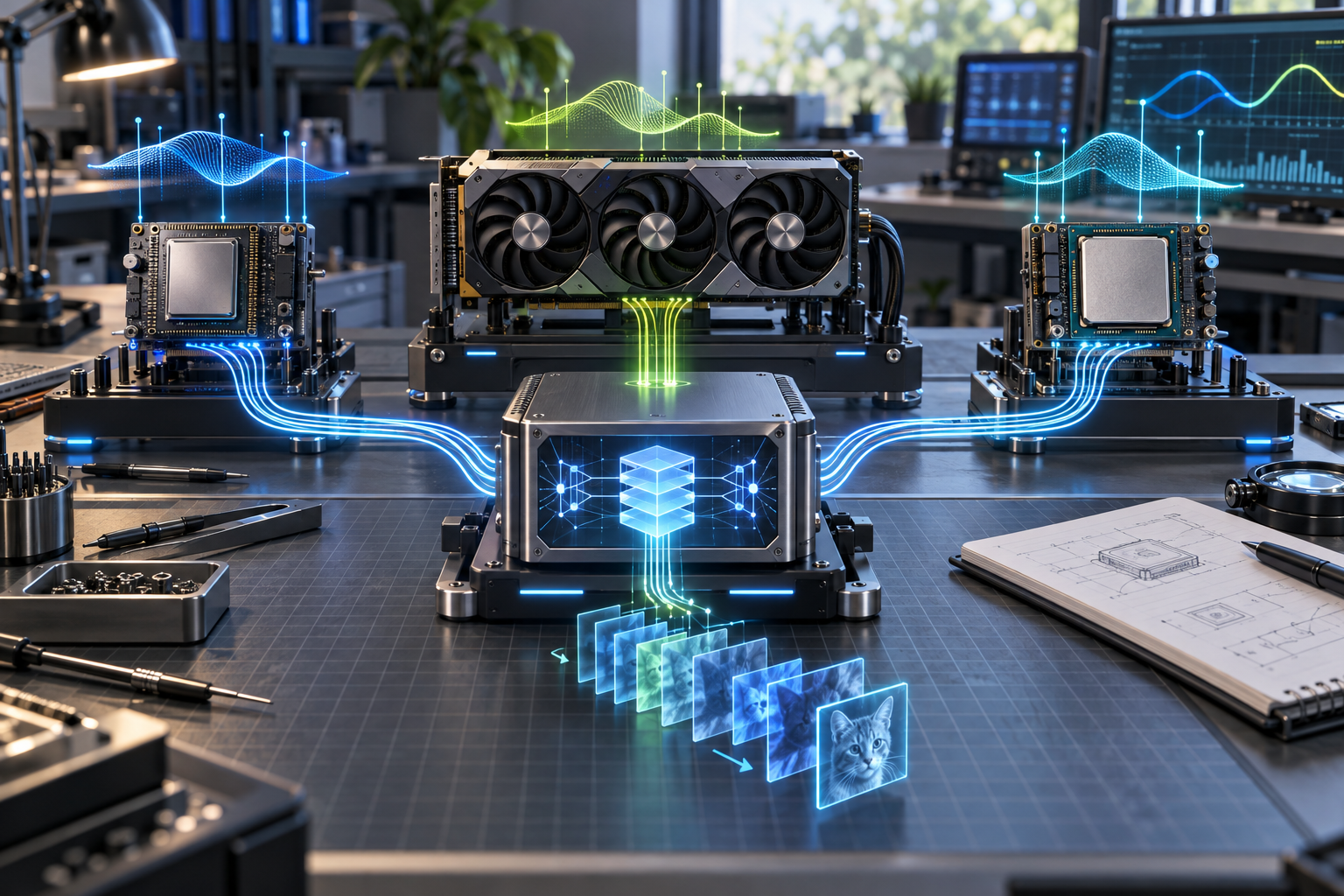
Magnitude launched publicly as an Apache-2.0 inference engine that tunes itself to the computer on which it runs. The repository says it compiles and benchmarks kernels locally, supports integrated hardware, NVIDIA and AMD GPUs, or CPU-only systems, and exposes an OpenAI-compatible interface to coding agents.
The project reports decode performance up to 92 percent faster than llama.cpp on its tested Metal configuration and 19 percent faster on its tested CUDA configuration, plus 27 percent lower memory use per concurrent agent in the highlighted setup. These figures are self-reported and configuration-specific. They make the project worth testing; they do not establish that every model, quantization, prompt, or device will be faster.
At 1:04 p.m. Malaysia time on October 1, GitHub’s public API showed 5,775 stars, 398 forks, and 29 open issues. The Hacker News launch thread had 140 points and 28 top-level comment threads. Those are meaningful developer-interest signals for a repository created in June, but they say nothing by themselves about output quality or production reliability.
What happened
Most local inference packages ship kernels selected for broad hardware families. Magnitude’s pitch is that a one-size binary leaves performance unused. On first use, its engine can compile alternatives and measure them on the actual device, then keep the best implementation for that chip, memory system, and model family.
The repository also targets concurrent agents. It describes shared prefix caches, memory released when sessions stop, and one-click connections for several coding tools. That focus distinguishes the product from a desktop chat wrapper. The intended workload is multiple long-running processes repeatedly reading a common repository or instruction prefix.
The license matters. Apache 2.0 allows inspection and modification under familiar terms. It does not automatically make the packaged desktop application, update channel, bundled dependencies, or every supported model equally auditable. Operators should review the exact artifacts they install.
Why it matters
Local models often lose adoption on operational friction rather than raw capability. A model may be adequate, but downloads are large, setup is fragile, memory pressure kills parallel work, and throughput collapses when a second agent begins. An engine that improves those constraints can make a modest model more useful without changing the model itself.
Hardware-specific tuning is a proven systems idea. Compilers, linear-algebra libraries, and databases have long selected or generated code for particular processors. Applying that idea aggressively to transformer kernels is plausible because matrix shapes, quantization formats, cache layouts, and memory bandwidth interact with the device.
The agent framing adds another layer. Decode speed affects interactive waiting, but prefill, repository indexing, tool latency, and cache reuse may dominate a real coding run. If three agents share a long prefix, cache architecture can matter more than the fastest isolated tokens-per-second number.
Evidence and how to test it
The repository’s published comparisons are the primary evidence for the performance claims. They disclose separate prefill and decode gains for selected Metal and CUDA tests, which is better than a single blended number. Still, the project controls the harness, model list, build flags, thermal state, and comparison versions.
A fair local test should pin the model file, quantization, context length, prompt, sampling settings, thread count, GPU layers, power mode, and software revisions. Run cold and warm cases. Record time to first token, prefill tokens per second, decode tokens per second, peak resident memory, energy where available, and output equality or task score.
Then run the agent workload. Give each engine the same repository, tools, and task. Measure completion time, number of retries, total generated tokens, compiler or test outcomes, and whether concurrent sessions slow one another. A faster decoder that produces a weaker patch or thrashes memory under concurrency is not the better system.
Privacy needs an empirical check too. The project says prompts, files, and models can stay on-device after models are downloaded. Verify network traffic, crash reporting, analytics, model download hosts, and update behavior in the version you install. “Local” describes where inference runs; it does not guarantee that every surrounding component is offline.
Practical takeaway
Magnitude is most interesting for developers who already know which local model meets their quality floor and are constrained by speed or concurrency. It is less compelling as a shortcut around model evaluation. An optimized engine cannot restore information removed by aggressive quantization or make a small model reliable at tasks beyond its capability.
Start with a disposable benchmark machine or isolated user account. Download one supported model, establish a baseline with the engine you already use, and keep prompts and outputs. Run the tuning stage, repeat the benchmark, then test two and three simultaneous sessions. If the gain survives those steps, evaluate integration with a real agent.
Production teams should also decide whether device-specific compiled artifacts can be reproduced and signed, how cache data is cleared, and how upgrades roll back. Self-tuning improves fit but creates state that needs lifecycle management.
Limitations
The launch evidence is early and mostly supplied by the project. GitHub popularity is volatile, open issues are not a reliability score, and benchmark results may change quickly as Magnitude and llama.cpp evolve. Hardware support also does not mean every model family has equally mature optimized kernels.
The engine’s exact advantage will depend on workload composition. CPU-only users, integrated-memory systems, discrete GPUs, short prompts, huge prefills, and concurrent agents stress different bottlenecks. The correct conclusion is not “twice as fast local AI.” It is that per-device kernel tuning has produced promising measured gains on named configurations and now deserves independent, reproducible testing.
Sources
> Want more like this?
Get the best AI insights delivered weekly.
By subscribing, you agree to our Privacy Policy. You can unsubscribe at any time.
> Related Articles
Gemini 4 Argon Starts With Cyber Defenders, a 1M-Token Output Limit, and Phased Access
Google's newest frontier model is being released first to trusted cybersecurity teams. The notable story is not only benchmark scores, but the operational burden created by million-token trajectories.
PSSA Tests a Tiny Non-Transformer Language Model in Rust
PSSA reports a parameter-matched experiment in which a 1.5M-parameter recurrent state-space model beat a small transformer on held-out WikiText and generated faster on CPU. The repository is unusually candid about why that is not yet a general architecture victory.
Mathematicians Propose Rules for Releasing AI-Generated Results
A community statement argues that AI labs should publish mathematical results with attribution, reproducibility records, formalization status, failed-attempt counts, and funding for human understanding—not as model marketing.
Tags
> Stay in the loop
Weekly AI tools & insights.