Fei-Fei Li: From ImageNet to World Labs — The Godmother of AI's Next Chapter
Fei-Fei Li isn't just an AI pioneer; she's the architect of modern computer vision. From ImageNet's genesis to World Labs' spatial future, witness the Godmother's next bold move.
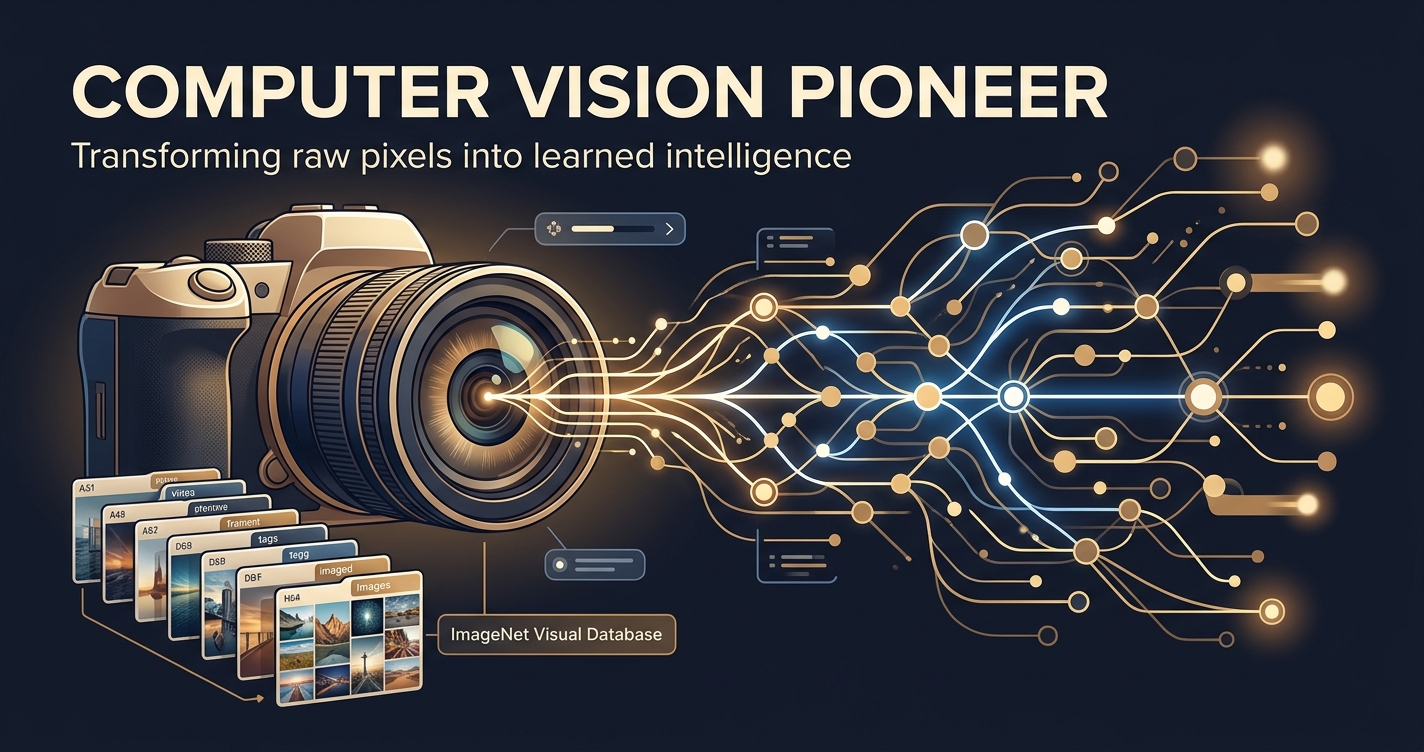
Let’s be honest. In the glittering, often overhyped realm of Artificial Intelligence, true pioneers are rare. We’ve got our rockstars, our visionary CEOs, and a whole lot of self-proclaimed gurus. But then there’s Fei-Fei Li. If AI has a pantheon, she’s not just on it; she helped build the damn thing.
You know the name, even if you don’t know the name. You interact with her legacy every single day, whether you’re unlocking your phone with your face, tagging friends in photos, or watching a self-driving car navigate traffic. That’s because Fei-Fei Li is the undisputed Godmother of AI, the architect of modern computer vision, and the force behind ImageNet – the dataset that didn’t just push AI forward; it kicked the door wide open and dragged the field, often screaming, into the deep learning era.
But Li isn’t one to rest on laurels, no matter how monumental. ImageNet was just the prologue. From her storied tenure at Stanford to her crucial advocacy for ethical, human-centric AI, and now, to her audacious new venture, World Labs, she’s constantly redefining the frontier. This isn’t just a profile; it’s an exploration of a mind that doesn’t just ask “what’s next?” but actively builds it. Prepare to dive deep into the journey of a woman who understands that the future of AI isn’t about bigger models, but about smarter, more spatially aware intelligence.
Who is Fei-Fei Li, Really? Unpacking the Legend.
Before she was a titan of tech, before she was a Stanford professor, before she was orchestrating data revolutions, Fei-Fei Li was, well, a person. A person with a hell of a story, one that shapes her vision for AI more than any algorithm ever could.
Where Did It All Begin? From Sichuan to Silicon Valley.
Born in Beijing and raised in Chengdu, Sichuan, China, Li’s early life wasn’t exactly a straight shot to Silicon Valley. At 16, she immigrated to the U.S. with her parents, landing in Parsippany, New Jersey. Picture it: a teenager, new country, new language, and a burning desire to make something happen. Her parents, both intellectuals, struggled with English and found work in a dry-cleaning business. Li, always the pragmatic polymath, worked there too, often doing homework at the counter.
This isn’t just biographical fluff. This foundational experience – the struggle, the adaptation, the relentless pursuit of opportunity against odds – instilled in her a unique perspective. It wasn’t about privilege; it was about grit. And it was about seeing the world, not just through textbooks, but through the lens of lived experience.
She excelled, graduating from Parsippany High School with honors and heading to Princeton University. No small feat. There, she majored in physics, a discipline that might seem distant from AI, but which fundamentally shaped her analytical rigor and problem-solving approach. After Princeton, it was off to Caltech for her Ph.D. in electrical engineering. This is where the seeds of computer vision truly began to sprout. While others were chasing incremental improvements, Li was looking for a paradigm shift.
How Did ImageNet Revolutionize AI? The Data That Changed Everything.
If you know one thing about Fei-Fei Li, it’s probably ImageNet. And for good reason. It wasn’t just a project; it was a crusade. A monumental, almost insane undertaking that fundamentally reshaped the trajectory of AI.
What Was the State of Computer Vision Before ImageNet? The Dark Ages.
Let’s get real. Before ImageNet, computer vision was stuck in the mud. Researchers were trying to teach computers to “see” using tiny, hand-curated datasets. We’re talking hundreds, maybe a few thousand images. Algorithms were designed to recognize specific objects in controlled environments. Think of it like teaching a child to recognize a single red apple, perfectly lit, on a plain white table. Then you show them a green apple in a fruit bowl, and their little AI brain just breaks.
The problem wasn’t just the algorithms; it was the data. Or rather, the severe lack thereof. Computers needed vast quantities of diverse, real-world data to learn patterns robustly. But creating such a dataset was deemed too enormous, too tedious, too… human.
Why Was ImageNet Such a Herculean Task? The Vision and the Grind.
Enter Fei-Fei Li, then a relatively young professor. Her insight was deceptively simple, yet profoundly impactful: “You need data. A lot of it.” She believed that perception isn’t about elegant algorithms; it’s about experience, about exposure to the sheer complexity of the visual world.
In 2007, Li and her team – notably including Princeton post-doc Alex Berg and later Stanford graduate student Jia Deng – embarked on what many considered a fool’s errand. Their goal? To map the entire world of objects by creating a massive dataset of labeled images. Not just “cat” or “dog,” but “Siamese cat,” “Persian cat,” “Labrador retriever,” “Pug.” And not just one image per category, but hundreds, thousands.
The scale of ImageNet is what made it revolutionary. It aimed for:
- Millions of images: The initial goal was 14 million, spanning 22,000 categories.
- Hierarchical structure: Leveraging WordNet, a lexical database, to organize categories from broad to specific. This meant “animal” branched into “mammal” and “bird,” and “mammal” branched into “dog” and “cat,” each with its own sub-breeds.
- Human-labeled accuracy: This was the back-breaking part. They employed Amazon Mechanical Turk, a crowdsourcing platform, to have hundreds of thousands of individual human annotators label images. Each image was labeled multiple times to ensure accuracy. It was a testament to the power of human collective intelligence, not just algorithms.
This wasn’t just data collection; it was data engineering on an unprecedented scale. It was a grueling, multi-year marathon, fueled by conviction and coffee.
What Impact Did ImageNet Have on Deep Learning? The Big Bang.
ImageNet didn’t just provide data; it provided a challenge. In 2010, the ImageNet Large Scale Visual Recognition Challenge (ILSVRC) was launched. This annual competition dared researchers to build algorithms that could accurately classify images into 1,000 categories from the ImageNet dataset.
For a few years, progress was steady but incremental. Then, in 2012, everything changed. A team from the University of Toronto, led by Alex Krizhevsky, Ilya Sutskever, and Geoffrey Hinton, entered a convolutional neural network (CNN) called AlexNet. It absolutely demolished the competition, reducing the error rate by a staggering margin – from over 25% to just 15.3%.
This wasn’t just a win; it was a wake-up call. AlexNet proved that deep learning, specifically CNNs, when trained on sufficiently large and diverse datasets like ImageNet, could achieve truly remarkable performance. It ignited the deep learning revolution, leading to:
- Explosive growth in AI research: Researchers worldwide pivoted to deep learning.
- New hardware demands: The computational intensity drove the development of powerful GPUs.
- Real-world applications: Suddenly, face recognition, object detection, and visual search became not just theoretical possibilities, but achievable realities.
Let’s put this into perspective with a quick comparison:
| Feature/Aspect | Pre-ImageNet Computer Vision Datasets (e.g., Caltech 101, PASCAL VOC) | ImageNet |
|---|---|---|
| Scale | Hundreds to tens of thousands of images | Millions of images (initially 14M+, currently 20M+ with over 20k categories) |
| Categories | Dozens to hundreds of categories | Tens of thousands of categories, hierarchically structured |
| Diversity | Limited, often focused on specific object types or scenes | Vast, encompassing a wide spectrum of real-world objects, scenes, and contexts |
| Labeling Method | Mostly manual, expert-driven, time-consuming | Crowdsourced (Amazon Mechanical Turk), distributed, efficient, leveraging human collective intelligence |
| Impact on AI | Incremental improvements, limited generalization | Catalyzed deep learning revolution, enabled general-purpose image recognition, spurred hardware innovation, foundational for modern AI |
ImageNet didn’t just provide data; it provided a blueprint for how to leverage data to train powerful neural networks. It transformed computer vision from a niche academic pursuit into a cornerstone of mainstream AI.
How Has Fei-Fei Li Shaped AI at Stanford and Beyond? Academia’s Powerhouse.
While ImageNet secured her legendary status, Fei-Fei Li’s influence extends far beyond a single dataset. Her work at Stanford and her brief but impactful stint in industry highlight a consistent drive: to push the boundaries of AI while ensuring it serves humanity.
What Defines Her Work at Stanford’s AI Lab (SAIL)? Beyond Recognition.
After her pivotal work with ImageNet, Li returned to Stanford, where she co-leads the Stanford AI Lab (SAIL) and co-directs the Stanford Institute for Human-Centered AI (HAI). Her focus has always been on more than just identifying objects. Anyone can name a cat. Li wants AI to understand what a cat is doing, how it’s interacting with its environment, and even its intent. This is where her concept of “visual intelligence” truly comes into play.
Her research at Stanford has delved into:
- Understanding dynamic scenes: Moving beyond static image classification to understanding video, human actions, and interactions between objects.
- AI for healthcare: A significant passion. Li has pioneered research into using AI to monitor patient activity, detect early signs of illness, and even assist surgeons in operating rooms by providing real-time visual information. This isn’t just cool tech; it’s tech with a tangible, life-saving impact.
- Cognitive neuroscience of vision: Bridging the gap between how humans see and how machines see, exploring the biological underpinnings of perception to inspire more robust AI systems.
Her leadership at Stanford has cultivated a generation of AI researchers, many of whom now lead their own labs or drive innovation in industry. She’s not just a researcher; she’s a mentor, a leader, and a builder of communities.
What Was Her Stint at Google Cloud AI All About? Bringing Research to Reality.
From 2017 to 2018, Li took a sabbatical from Stanford to serve as Chief Scientist of AI/ML at Google Cloud. This move wasn’t just about a change of scenery; it was about democratizing AI. Her mission was clear: take cutting-edge AI research and make it accessible to businesses and developers of all sizes, not just the tech giants.
At Google, she played a crucial role in:
- Developing AI products: Helping translate complex algorithms into user-friendly services, like Cloud Vision API, which allows developers to easily integrate powerful image analysis into their applications.
- Driving accessibility: Ensuring that the power of AI wasn’t confined to a select few, but could be leveraged by a broader ecosystem of innovators.
- Shaping ethical guidelines: Even in a commercial setting, Li championed responsible AI development, emphasizing fairness, transparency, and privacy.
Her time at Google was a masterclass in bridging the gap between fundamental research and practical application, ensuring that the AI revolution wasn’t just theoretical, but tangible and widely available.
What is World Labs, and Why Does It Matter? The Next Frontier: Spatial Intelligence.
Now, for the main event of her “next chapter.” Fei-Fei Li has co-founded World Labs, a non-profit research and development organization. This isn’t just another AI startup; it’s a bold declaration about the future of AI itself.
What Problem is World Labs Trying to Solve? Beyond the Screen.
For all the incredible advancements in AI, especially in computer vision, there’s a glaring limitation: most AI still operates in a two-dimensional, digital vacuum. It’s fantastic at analyzing pixels on a screen, but struggles with the messy, dynamic, three-dimensional reality we inhabit.
World Labs aims to tackle this head-on. Li argues that current AI, despite its prowess, lacks “common sense” about the physical world. It can identify a chair, but does it understand that you can sit on it, that it has weight, that it occupies space? Not intuitively. World Labs wants to build AI that truly understands the physical world – its objects, its physics, its human inhabitants, and their interactions.
This isn’t about incremental gains; it’s about a fundamental shift in how AI perceives and interacts with reality.
How Does “Spatial Intelligence” Differ from Traditional AI? The 3D Future.
“Spatial intelligence” is the core concept driving World Labs. It’s the ability for AI to:
- Perceive and interpret the 3D world: Not just images, but depth, volume, movement, and relationships between objects in physical space.
- Understand physical laws: Gravity, friction, inertia – the intuitive physics we take for granted.
- Reason about human interaction: How people move, use tools, collaborate, and adapt in their physical surroundings.
- Bridge the digital and physical: Create AI that can seamlessly understand and operate in both virtual and real environments.
Think of it this way: Current AI is like a brilliant scholar who has only ever read books. Spatial intelligence AI is a brilliant scholar who has also traveled the world, touched things, built things, and learned from direct experience. It’s the difference between seeing a picture of a hammer and knowing how to use a hammer.
This goes far beyond traditional computer vision. It integrates elements of robotics, cognitive science, physics simulation, and human-computer interaction. It’s about giving AI a true sense of embodiment and contextual awareness.
What Are World Labs’ Early Initiatives? Laying the Groundwork.
World Labs, still relatively nascent, is focusing on foundational research and infrastructure to enable spatial intelligence. Their approach is multi-pronged:
- Developing new datasets: Just as ImageNet revolutionized 2D vision, World Labs is likely to champion new datasets that capture the complexity of 3D, dynamic, interactive environments. This could involve vast collections of video, LiDAR data, 3D scans, and human interaction data.
- Creating novel AI architectures: Existing neural networks might not be sufficient. New architectures designed to process and reason about spatial and temporal information will be crucial.
- Cross-disciplinary collaboration: This isn’t just an AI problem; it’s an engineering, robotics, and even cognitive science problem. World Labs emphasizes working across traditional academic and industry silos.
- Open research and tools: True to Li’s ethos of democratizing AI, World Labs aims to make its research, tools, and datasets openly available to accelerate progress across the field.
The implications are massive: truly intelligent robots that can navigate and assist in human environments, more immersive and responsive AR/VR experiences, smart cities that understand and adapt to human activity, and assistive technologies that genuinely comprehend the physical needs of individuals.
Why Does Diversity and Ethics Matter So Much to the Godmother of AI? Building a Better Future.
Fei-Fei Li isn’t just a technical genius; she’s a fierce advocate for building AI responsibly and inclusively. She understands that powerful technology, left unchecked or developed by a narrow demographic, can amplify existing societal biases and inequalities.
How Has She Championed AI for Humanity? More Than Just Tech.
Li’s commitment to “Human-Centered AI” isn’t a buzzword; it’s a guiding principle. She believes that AI should serve humanity, augment human capabilities, and enhance human well-being, rather than replacing or diminishing it.
A prime example of this commitment is AI4ALL, a non-profit she co-founded. AI4ALL is dedicated to increasing diversity and inclusion in AI education and careers, particularly among underrepresented groups. Their programs introduce high school students to AI concepts, ethics, and career paths, aiming to build a more diverse talent pipeline for the future. This isn’t about charity; it’s about foresight. A diverse group of creators is less likely to embed their own unconscious biases into the systems they build.
She frequently speaks and writes on the ethical implications of AI, advocating for:
- Transparency and interpretability: Understanding how AI makes decisions.
- Fairness and bias mitigation: Ensuring AI systems don’t perpetuate or exacerbate discrimination.
- Privacy and data security: Protecting individual rights in an increasingly data-driven world.
- Accountability: Establishing clear lines of responsibility for AI’s impact.
What Are the Risks of Homogeneous AI Development? The Blind Spots.
Li consistently warns against the dangers of a homogenous AI development community. When AI is primarily developed by a narrow demographic – often young, male, and from privileged backgrounds – the resulting systems inevitably carry inherent biases. This leads to:
- Flawed datasets: Data reflecting only a specific slice of humanity.
- Biased algorithms: Systems that perform poorly or unfairly for certain groups (e.g., facial recognition struggles with darker skin tones, medical AI misdiagnoses based on demographic data).
- Limited problem-solving: Missing opportunities to apply AI to problems that affect diverse communities.
- Erosion of trust: If AI is perceived as unfair or discriminatory, its societal adoption and positive impact will be severely hampered.
Her advocacy is a crucial counter-narrative to the “move fast and break things” mentality, reminding us that with great power comes the responsibility to build technology that benefits everyone, not just a select few.
What’s Fei-Fei Li’s Enduring Legacy and What Comes Next? The Unfinished Symphony.
Fei-Fei Li’s journey is far from over. Her legacy is already cemented, but her gaze is firmly fixed on the horizon.
Her enduring impact can be distilled into a few key takeaways:
- Data is Destiny: She unequivocally proved that data, massive and meticulously organized, is the fuel for intelligent systems. Algorithms are important, but without the right data, they’re just elegant equations.
- The Human Element is Critical: From the crowdsourced labeling of ImageNet to her advocacy for Human-Centered AI, Li consistently reminds us that AI is ultimately for and by humans. Our values, our ethics, and our participation are non-negotiable.
- Vision Beyond Pixels: Her evolution from image recognition to visual intelligence and now to spatial intelligence demonstrates a relentless pursuit of deeper understanding. AI shouldn’t just identify; it should comprehend.
Practical Takeaways and Actionable Advice:
- For Aspiring AI Researchers: Don’t shy away from “hard” problems or data-intensive tasks. Often, the biggest breakthroughs come from tackling the foundational challenges others deem too difficult. Look beyond the latest model architecture; consider the data it’s trained on.
- For Developers and Innovators: When building AI products, embed ethical considerations from the ground up. Actively seek diverse perspectives in your team and your data. Ask: “Who might this system exclude or harm?”
- For Businesses: Invest in AI literacy and ethical AI training for your teams. Understand that AI isn’t a magic bullet; it’s a powerful tool that requires responsible stewardship. Consider how spatial intelligence might transform your physical operations, from logistics to customer experience.
- For Everyone: Engage with AI critically. Understand its capabilities, but also its limitations and potential biases. Support initiatives like AI4ALL that promote diversity and ethical development.
Fei-Fei Li isn’t just a scientist; she’s a builder of worlds. She built the foundation for modern computer vision with ImageNet, nurtured the next generation of AI talent at Stanford, and now, with World Labs, she’s laying the groundwork for AI to truly inhabit and understand our physical reality. She’s not just observing the future of AI; she’s meticulously crafting it, brick by data-point, with an unwavering commitment to both intelligence and humanity. And that, dear readers, is a story worth following.
Frequently Asked Questions
What is Fei-Fei Li most famous for?
Fei-Fei Li is most famous for her pioneering work on ImageNet, a massive image dataset that was instrumental in kickstarting the deep learning revolution in computer vision. She is often referred to as the “Godmother of AI” for this contribution and her broader influence on the field.
What is spatial intelligence in the context of AI?
Spatial intelligence for AI refers to the ability of artificial intelligence systems to perceive, interpret, and reason about the three-dimensional physical world. This includes understanding objects, their properties, their relationships in space, physical laws (like gravity), and human interactions within environments. It’s about moving beyond 2D image analysis to a holistic understanding of real-world contexts.
Is ImageNet still relevant today?
Absolutely. While new, more specialized datasets have emerged, ImageNet remains a foundational benchmark and a crucial training dataset for many state-of-the-art computer vision models. Its scale and diversity continue to make it invaluable for pre-training models that are then fine-tuned for specific tasks. Its impact on the development of deep learning architectures is undeniable and ongoing.
What is World Labs, and what is its mission?
World Labs is a non-profit research and development organization co-founded by Fei-Fei Li. Its mission is to advance artificial intelligence’s understanding of the physical world, focusing on “spatial intelligence.” The goal is to build AI systems that can robustly perceive, reason about, and interact with complex 3D environments and human activities within them, bridging the gap between digital AI and physical reality.
How can one get involved in AI ethics or diversity initiatives?
There are several ways:
- Support organizations: Look into non-profits like AI4ALL (co-founded by Fei-Fei Li) that focus on increasing diversity in AI.
- Educate yourself: Read papers, books, and articles on AI ethics, bias, and fairness.
- Advocate: Speak up in your workplace or community about the importance of ethical AI and diverse teams.
- Participate in research: If you’re in academia, join labs focusing on human-centered AI or ethical AI.
- Contribute to open-source projects: Many projects focus on bias detection, explainable AI, or ethical frameworks.
What are some practical applications of spatial AI envisioned by World Labs?
The potential applications of spatial AI are vast and transformative:
- Robotics: More intelligent and adaptable robots that can safely and effectively operate in human environments (e.g., for elder care, manufacturing, logistics).
- Augmented Reality (AR) / Virtual Reality (VR): Creating truly immersive and interactive experiences where digital objects seamlessly integrate and respond to the physical world.
- Smart Environments: Buildings and cities that can understand human activity, anticipate needs, and adapt to optimize comfort, safety, and efficiency.
- Healthcare: AI assistants that can monitor patient movements, assist in surgeries with real-time spatial awareness, or help individuals with disabilities navigate complex environments.
- Autonomous Systems: Self-driving cars and drones with a deeper, more human-like understanding of their physical surroundings and potential hazards.
Sources
> Want more like this?
Get the best AI insights delivered weekly.
By subscribing, you agree to our Privacy Policy. You can unsubscribe at any time.
> Related Articles
George Hotz and tinygrad: The Hacker Who Thinks NVIDIA Is a Scam
George Hotz jailbroke the iPhone at 17, reverse-engineered PlayStation, and now he's building a deep learning framework to break NVIDIA's stranglehold on AI. Classic Hotz.
Lina Khan: The Regulator Who Tried to Put a Leash on Big AI
As FTC Chair, Lina Khan launched the most aggressive regulatory campaign against AI companies in US history. Whether she succeeded depends on who you ask.
Percy Liang: The Stanford Professor Holding AI Companies Accountable with Data
Percy Liang built HELM, the benchmark framework that shows how AI models actually perform — not how companies claim they do. Big Tech isn't thrilled.
Tags
> Stay in the loop
Weekly AI tools & insights.