Demis Hassabis: The DeepMind Genius Who Solved Protein Folding
Demis Hassabis built DeepMind, won a Nobel Prize for AlphaFold, and now leads Google's entire AI effort. Here's why he might be the most important person in AI.
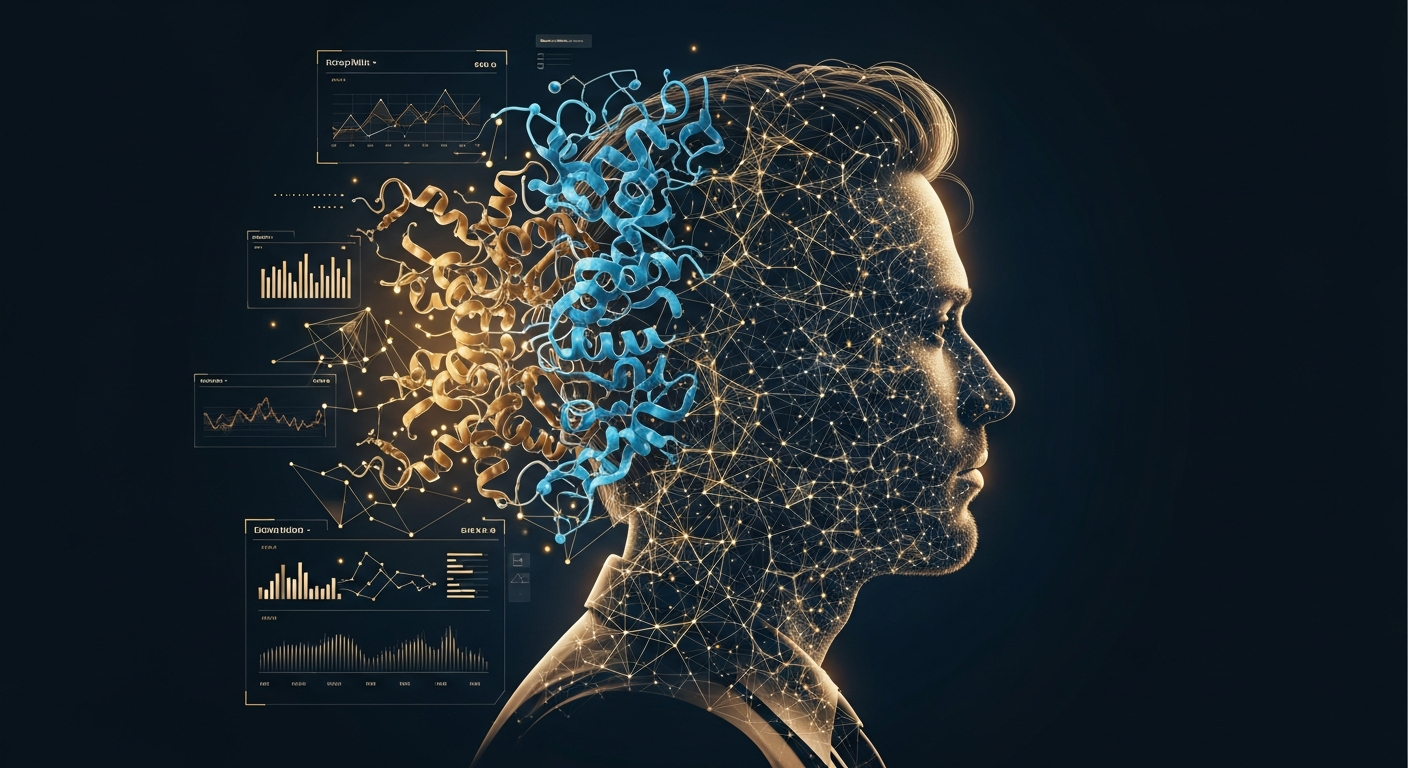
The Chess Prodigy Who Became AI’s Most Dangerous Scientist
While Sam Altman was networking his way through Silicon Valley and Jensen Huang was stacking GPUs, Demis Hassabis was doing something none of them could: winning a Nobel Prize.
Hassabis is the CEO of Google DeepMind, the lab behind AlphaFold, AlphaGo, and Gemini. He’s a chess master, a game designer, a neuroscientist, and now a Nobel Laureate. Unlike most AI CEOs who couldn’t derive a gradient if their stock options depended on it, Hassabis publishes papers, understands the math, and has been obsessing over artificial general intelligence since before “AI” was a LinkedIn buzzword.
This isn’t a puff piece about a tech billionaire. This is a breakdown of what Hassabis actually built, why it matters technically, and what you — as a developer, founder, or anyone building with AI — can steal from his playbook.
From Chess Boards to Game Studios to Brain Labs
Hassabis’s biography reads like someone min-maxed their character stats for raw intelligence and then decided to speedrun every intellectual domain available.
Born 1976 in London to a Greek-Cypriot father and a Chinese-Singaporean mother, Hassabis hit chess master level at age 13 — the second-highest-rated player in the world for his age group. Most child prodigies ride that wave forever. Hassabis got bored.
At 17, he joined Bullfrog Productions — Peter Molyneux’s legendary studio — and co-designed Theme Park, a simulation game that sold millions of copies worldwide. Think about that: a teenager shipping a hit video game in 1994 while most kids his age were figuring out how to talk to girls.
He went to Cambridge for computer science, then founded his own studio, Elixir Studios, which built Republic: The Revolution and Evil Genius. The games were ambitious, complex, and — critically — they forced him to think about how to simulate intelligent behavior in software. Every NPC decision tree, every emergent gameplay system was a mini-experiment in artificial intelligence.
Then came the pivot that nobody expected. Instead of cashing in on games, Hassabis went back to school. He enrolled in a neuroscience PhD at University College London, studying the hippocampus — the brain’s memory and navigation center. His research on how humans imagine future scenarios (episodic future thinking) became landmark publications. He wasn’t studying neuroscience as a hobby. He was reverse-engineering the brain to figure out how to build intelligence from scratch.
Chess taught him search and strategy. Games taught him simulation and reward systems. Neuroscience taught him how biological intelligence actually works. In 2010, he combined all three and co-founded DeepMind with Shane Legg and Mustafa Suleyman.
The trajectory — chess master, game designer, neuroscientist, AI researcher, Nobel winner — is absurd. Most people achieve one of those things and build an entire career around it. Hassabis collected them like side quests.
The Gaming Connection Most People Miss
Here’s something that doesn’t get enough attention: DeepMind’s entire research philosophy is rooted in game design.
This isn’t a metaphor. The lab’s first major breakthrough was teaching a neural network to play Atari games from raw pixels — no rules given, just screen input and a score. The system (DQN) learned to play Breakout, Pong, and Space Invaders at superhuman levels using reinforcement learning. The 2015 Nature paper on this became one of the most cited AI papers in history.
Why games? Because games are the perfect testbed for intelligence. They have clear objectives, measurable performance, increasing complexity, and fast feedback loops. Every game is a constrained universe where you can test whether an agent is actually learning versus just memorizing.
Hassabis understood this intuitively from his years at Bullfrog and Elixir. Game designers think in terms of state spaces (all possible game configurations), reward signals (points, health, progress), and emergent behavior (complex outcomes from simple rules). These are the exact same concepts that underpin reinforcement learning.
AlphaGo’s Monte Carlo tree search? That’s game AI. AlphaZero’s self-play training? That’s emergent behavior from a game loop. Even AlphaFold uses an attention-based architecture that processes amino acid relationships the way a game engine processes entity interactions.
The lesson for developers: Don’t dismiss domain knowledge from “unserious” fields. Hassabis’s gaming background wasn’t a detour — it was the foundation. If you’re building AI systems, understanding game theory, reward design, and simulation thinking will serve you better than memorizing transformer paper citations.
AlphaGo: The Moment AI Proved It Could Think
In March 2016, DeepMind’s AlphaGo beat Lee Sedol — one of the greatest Go players in history — 4 games to 1. If you weren’t paying attention to AI at the time, it’s hard to overstate how shocking this was.
Go has roughly 10^170 possible board positions. For reference, there are approximately 10^80 atoms in the observable universe. You cannot brute-force Go. Chess engines like Stockfish work by searching millions of positions per second, but Go’s branching factor makes that strategy computationally impossible. Every serious AI researcher believed human-level Go was at least a decade away.
AlphaGo combined two techniques in a way nobody had done before:
- Deep neural networks trained on millions of human games to develop “intuition” about which moves look promising
- Monte Carlo tree search (MCTS) to simulate thousands of games from any given position and evaluate which moves lead to wins
The neural network narrowed the search space (like a human player’s intuition about “good shapes”), and MCTS evaluated the filtered options rigorously. It was a blend of System 1 (fast, intuitive) and System 2 (slow, deliberate) thinking — a direct echo of Hassabis’s neuroscience research on how the human brain makes decisions.
But the real bombshell came a year later. AlphaGo Zero achieved superhuman performance at Go without any human training data. It learned entirely through self-play — starting from random moves and playing millions of games against itself. It crushed the original AlphaGo 100-0.
The implication was staggering: the best strategy wasn’t hiding in the corpus of human knowledge. It was somewhere humans had never looked, and AI found it by exploring from scratch.
AlphaZero then generalized this approach to chess and shogi, achieving superhuman performance in all three games within hours of training. A single architecture, learning from nothing, dominating three different strategy games. That’s not narrow AI. That’s the outline of something much bigger.
AlphaFold: Solving Biology’s 50-Year Grand Challenge
If AlphaGo was DeepMind’s proof of concept, AlphaFold is its masterpiece.
Protein folding is one of biology’s most fundamental problems. Every protein is a chain of amino acids that folds into a specific 3D shape, and that shape determines what the protein does. Misfolded proteins cause Alzheimer’s, Parkinson’s, and cystic fibrosis. Understanding protein structure is how you design drugs, engineer enzymes, and decode the machinery of life.
For 50 years, scientists tried to predict how amino acid sequences fold into 3D structures. The gold standard — X-ray crystallography and cryo-electron microscopy — works, but it takes months to years per protein and costs hundreds of thousands of dollars. The biennial CASP competition (Critical Assessment of protein Structure Prediction) tracked computational progress on this problem. For decades, the best algorithms barely moved the needle.
How AlphaFold Actually Works
AlphaFold 2 (the version that essentially solved the problem at CASP14 in 2020) uses a novel architecture called the Evoformer, which processes two types of information simultaneously:
- Multiple sequence alignments (MSAs): Evolutionary data showing how related proteins vary across species. If two amino acids always mutate together, they’re probably physically close in the folded structure.
- Pair representations: Direct relationships between every pair of amino acid residues in the chain.
The Evoformer passes information back and forth between these two representations through attention layers, gradually refining its understanding of how the protein fits together. It then feeds this into a Structure Module that outputs actual 3D coordinates for every atom.
The key insight: evolution has already done billions of years of experiments on protein folding. By reading the evolutionary record (MSAs), AlphaFold leverages nature’s own data to infer structure. It’s not just pattern matching — it’s learning the physics of molecular interaction from evolutionary evidence.
AlphaFold 2 achieved a median GDT (Global Distance Test) score of 92.4 at CASP14, where a score above 90 is considered comparable to experimental methods. It predicted structures in minutes that would take labs months to determine experimentally.
The Numbers That Won a Nobel Prize
- 200+ million protein structures predicted and published in the AlphaFold Protein Structure Database
- 2+ million researchers in 190 countries have used it
- Drug discovery timelines compressed by months to years per candidate molecule
- The entire database is free and open access
Hassabis shared the 2024 Nobel Prize in Chemistry with John Jumper (also DeepMind) and David Baker (University of Washington). A computer scientist winning the Chemistry Nobel tells you exactly where science is headed.
How to Actually Use AlphaFold
If you’re a developer interested in structural biology — or just want to understand how to build on DeepMind’s work — here’s how to get started:
Option 1: AlphaFold Protein Structure Database
Search and download predicted structures at alphafold.ebi.ac.uk. No code required. You can look up any protein by UniProt ID and get the full 3D structure with confidence scores.
Option 2: Run AlphaFold locally or in Colab
AlphaFold’s code is open-source on GitHub. For quick experiments, Google provides a Colab notebook:
# AlphaFold Colab - simplified example workflow
# Full notebook: https://colab.research.google.com/github/deepmind/alphafold

# 1. Install dependencies
!pip install alphafold

# 2. Define your amino acid sequence
target_sequence = "MAAHKGAEHHHKAAEHHEQAAKHHHAAAEHHEKGEHEQAAHHADTAYAHHKHAEEHAAQAAKHDAEHHAPKPH"

# 3. Run structure prediction
# The actual pipeline handles MSA generation, template search,
# and structure module inference
from alphafold.model import model
from alphafold.data import pipeline

# Process features from sequence
features = pipeline.process(target_sequence)

# Run prediction
prediction = model.predict(features)

# Output: 3D coordinates for every atom, plus confidence scores (pLDDT)
print(f"Mean confidence: {prediction['plddt'].mean():.1f}")
Option 3: AlphaFold Server API
For programmatic access without managing infrastructure, use the AlphaFold Server:
# Submit a prediction job via the AlphaFold Server
curl -X POST https://alphafoldserver.com/api/predict \
  -H "Authorization: Bearer YOUR_API_KEY" \
  -H "Content-Type: application/json" \
  -d '{
    "sequences": ["MAAHKGAEHHHKAAEHHEQAAKHHHAAAEHHEKGEHEQAAHHADTAYAHHKHAEEHAAQAAKHDAEHHAPKPH"],
    "model_version": "alphafold_latest"
  }'
The confidence metric to watch is pLDDT (predicted Local Distance Difference Test): scores above 90 mean the structure is highly reliable. Scores between 70-90 are good. Below 50 indicates disordered regions where the protein doesn’t have a fixed structure — which is itself useful biological information.
Gemini: When Research Meets Product Deadlines
AlphaFold won a Nobel. Gemini is supposed to win a market.
When Google merged its Brain team with DeepMind in 2023, Hassabis inherited a dual mandate: keep pushing the boundaries of AI research AND ship a model that competes with GPT and Claude. These goals sometimes align. They often don’t.
Gemini is Google’s multimodal AI model family. The architecture processes text, images, audio, and video natively — not as separate modules bolted together, but as a unified system. Gemini 2.5 Pro, the latest flagship, features a 1 million token context window and strong reasoning capabilities.
Using the Gemini API
For developers, Gemini is accessible through Google’s API. Here’s how to get started:
# Install the Google GenAI SDK
# pip install google-genai

from google import genai

# Initialize the client
client = genai.Client(api_key="YOUR_API_KEY")

# Basic text generation
response = client.models.generate_content(
    model="gemini-2.5-pro",
    contents="Explain how attention mechanisms work in transformers, with a focus on the mathematical formulation."
)
print(response.text)

# Multimodal: analyze an image
from google.genai import types

response = client.models.generate_content(
    model="gemini-2.5-pro",
    contents=[
        types.Part.from_uri(
            file_uri="https://example.com/protein_structure.png",
            mime_type="image/png"
        ),
        "Analyze this protein structure. Identify the secondary structure elements and predict potential binding sites."
    ]
)
print(response.text)

# Structured output with function calling
from google.genai.types import FunctionDeclaration, Tool

analyze_molecule = FunctionDeclaration(
    name="analyze_molecule",
    description="Analyze a molecule's properties",
    parameters={
        "type": "object",
        "properties": {
            "smiles": {"type": "string", "description": "SMILES notation of the molecule"},
            "properties_requested": {
                "type": "array",
                "items": {"type": "string"},
                "description": "List of properties to analyze"
            }
        },
        "required": ["smiles"]
    }
)

tools = [Tool(function_declarations=[analyze_molecule])]

response = client.models.generate_content(
    model="gemini-2.5-pro",
    contents="Analyze the drug molecule aspirin for solubility and binding affinity",
    config=types.GenerateContentConfig(tools=tools)
)
The 1M token context window is Gemini’s killer feature for developers. You can feed entire codebases, long research papers, or hours of video into a single prompt. For scientific applications — Hassabis’s real passion — this means you can have the model analyze an entire research corpus in one shot.
What Developers Can Learn From DeepMind’s Approach
DeepMind doesn’t build like a typical tech company. Studying their methodology reveals patterns that any serious developer or technical leader can apply.
1. Solve the Hard Problem First, Productize Later
Most startups build a product and then look for a problem. DeepMind identified the hardest unsolved problems in science (protein folding, game mastery, mathematical reasoning) and attacked them directly. AlphaFold wasn’t built to be a product — it was built to answer a scientific question. The product (the database, the API, the drug discovery partnerships) followed naturally.
Apply this: Before building another SaaS dashboard, ask yourself: what’s the hardest unsolved problem in your domain? Solving it creates a moat that no amount of UI polish can replicate.
2. Train on Games, Deploy on Reality
DeepMind’s pipeline is consistent: prove the approach works on games (Atari, Go, chess), then adapt it to real-world problems (proteins, weather, materials). Games provide cheap, fast, controlled environments for testing new ideas.
Apply this: Build sandboxed environments for your AI experiments. If you’re developing an AI agent for customer support, first test it in a simulated conversation environment with synthetic users. Get the algorithm right in the sandbox before deploying to production.
3. Cross-Pollinate Ruthlessly
AlphaFold’s attention mechanism borrows from NLP transformers. AlphaGo’s self-play training loop is a game design concept. GraphCast (weather prediction) uses graph neural networks borrowed from molecular dynamics. DeepMind treats every field as a parts bin.
Apply this: Read outside your stack. If you’re a web developer, read robotics papers. If you’re an ML engineer, study game design. The breakthrough ideas live at the intersections.
4. Publish First, Profit Later
DeepMind publishes its research openly. AlphaFold’s code is on GitHub. Their papers are on arXiv. This might seem like giving away competitive advantage, but it achieves three things: it attracts the best researchers (who want to publish), it builds credibility, and it creates an ecosystem of users who depend on your tools.
Apply this: Open-source your non-core innovations. Write about what you learn. The developer who publishes their approach to solving a hard problem attracts better collaborators than the one who hoards knowledge.
Hassabis’s Leadership Philosophy: What Makes DeepMind Different
Running a world-class research lab inside a trillion-dollar corporation is a contradiction most people couldn’t survive. Hassabis has managed it for over a decade. Here’s how.
Long time horizons with clear milestones. Hassabis told his team from day one that the mission was AGI, and that this would take decades. But he breaks the journey into concrete, publishable milestones: beat Atari, beat Go, solve protein folding. Each milestone validates the approach and justifies continued investment.
Hire researchers, not just engineers. DeepMind’s team includes neuroscientists, physicists, mathematicians, and biologists alongside ML engineers. Hassabis actively recruits people who would otherwise be in academia, offering them the resources of a tech giant with the intellectual freedom of a university lab.
Stay hands-on. Hassabis still reads papers weekly, attends research meetings, and contributes to technical direction. In an industry full of CEO-operators who manage by spreadsheet, his technical depth earns respect from his team and ensures strategic decisions are grounded in scientific reality.
Protect the research culture. When Google merged Brain with DeepMind, there were real concerns about DeepMind losing its research-first identity. Hassabis has fought to maintain publication freedom and long-term research bets even as Google pushes for faster product shipping. The tension is real and ongoing — but he’s managed to keep both going.
The management takeaway: If you’re leading a technical team, the worst thing you can do is lose touch with the actual work. You don’t need to write code every day, but you need to understand what your team is building deeply enough to make good strategic calls. Hassabis’s technical credibility is what lets him push back on Google’s product timelines when research needs more time.
DeepMind’s Other Breakthroughs You Should Know About
AlphaFold and AlphaGo get the headlines, but DeepMind’s research portfolio is staggeringly wide:
| Project | What It Does | Why You Should Care |
|---|---|---|
| AlphaCode | Competitive programming at human level | Demonstrates AI can reason about complex algorithmic problems, not just autocomplete |
| AlphaGeometry | Solves International Math Olympiad geometry problems | Mathematical reasoning without training on math — pure deduction |
| AlphaProteo | Designs novel proteins for specific functions | Custom enzyme engineering, therapeutic protein design |
| GraphCast | Weather prediction that outperforms traditional models | 10-day forecasts in under a minute vs. hours on supercomputers |
| GNoME | Discovered 2.2 million new crystal structures | New materials for batteries, superconductors, semiconductors |
| Veo | AI video generation | Google’s answer to Sora — cinematic quality from text prompts |
| Project Astra | Universal AI agent with real-time perception | Sees through phone cameras, processes in real-time, acts on what it sees |
The pattern: DeepMind doesn’t just build AI tools. It uses AI as a lever for scientific discovery. Every project either advances fundamental AI capabilities or applies AI to solve a problem in another scientific domain.
What Hassabis Says Is Coming Next
Hassabis has been more transparent about his AGI timeline than most AI leaders. Based on his public statements and interviews through early 2026:
AGI within the decade. He’s been saying some version of this since 2010, but his confidence has increased. His definition of AGI isn’t “a chatbot that passes the Turing test” — it’s a system capable of performing any cognitive task a human can, including novel scientific discovery.
AI-driven scientific breakthroughs will accelerate. After AlphaFold, Hassabis sees the next decade producing AI systems that can propose hypotheses, design experiments, and interpret results autonomously. He calls this “AI for science” and considers it the most important application of the technology.
Agents, not chatbots, are the future. Project Astra signals DeepMind’s direction: AI that perceives the world, reasons about it, and takes action. Not AI that writes your emails.
Safety through understanding. Unlike the “pause AI” crowd, Hassabis advocates for building safety through deep understanding of how AI systems work — interpretability research, formal verification, and alignment work done inside the labs building frontier models, not by external regulators who don’t understand the technology.
The “Nobel Prize factory” is just getting started. Hassabis has said he wants DeepMind to produce multiple Nobel-caliber scientific breakthroughs. Given the pipeline — materials science, drug discovery, mathematics, climate modeling — this isn’t delusional. It’s a roadmap.
The Tension That Defines Hassabis’s Legacy
Here’s the uncomfortable truth about Hassabis’s position: he’s trying to do two fundamentally different things at once.
Goal 1: Build AGI and use it to advance human scientific knowledge. This requires patience, blue-sky research, tolerance for failure, and long time horizons.
Goal 2: Ship Gemini and make Google competitive with OpenAI and Anthropic in the AI product market. This requires speed, polish, marketing, and quarterly results.
These goals sometimes reinforce each other — Gemini needs to be excellent to fund the research. But they often conflict. Every engineer working on Gemini’s chat interface is an engineer not working on the next AlphaFold. Every dollar spent on GPU clusters for model training could fund a decade of structural biology research.
Hassabis is the rare person who might be able to hold both together. His scientific credibility keeps the researchers engaged. His results keep Google’s executives writing checks. But the tension is real, and it’s the central drama of AI research in the 2020s.
Whether Hassabis succeeds — whether he can build AGI within a corporate structure that ultimately answers to advertising revenue — is one of the most consequential questions in technology. For developers and builders watching from the outside, the smartest play is to use the tools he’s already released, study the approaches his team has published, and build on the foundation DeepMind keeps laying down for free.
The code is open-source. The protein database is free. The Gemini API is accessible. The only question is what you build with it.
FAQ
Did Demis Hassabis really win a Nobel Prize?
Yes. Hassabis shared the 2024 Nobel Prize in Chemistry with John Jumper (Google DeepMind) and David Baker (University of Washington) for computational protein structure prediction and design. It was the first Nobel Prize awarded for AI-driven scientific work.
Is DeepMind the same as Google AI?
In 2023, Google merged its Brain team (part of Google Research) with DeepMind to form Google DeepMind. Hassabis leads the combined organization. So yes, DeepMind is now Google’s primary AI research and development lab.
What is Hassabis’s net worth?
Estimates vary, but when Google acquired DeepMind for approximately $500 million in 2014, Hassabis’s stake was reportedly worth over $100 million. His current net worth, including Google stock compensation and subsequent grants, is estimated at $400-500 million.
Is AlphaFold free to use?
Yes. The AlphaFold Protein Structure Database (maintained by DeepMind and EMBL-EBI) is completely free and open access. Anyone can search for and download predicted protein structures. AlphaFold’s code is also open-source on GitHub.
What games did Hassabis design?
Hassabis co-designed Theme Park (1994) at Bullfrog Productions when he was 17. He later founded Elixir Studios, which developed Republic: The Revolution (2003) and Evil Genius (2004). His gaming background directly influenced DeepMind’s approach to AI through game-playing systems.
Does Hassabis think AI is dangerous?
He takes AI safety seriously but is not an “AI doomer.” He advocates for responsible development, has built safety teams within DeepMind, and supports regulation. His position: AI’s potential benefits (curing diseases, solving climate change) outweigh the risks, but only if development is done carefully with proper safeguards.
How is Hassabis different from other AI leaders?
Most AI CEOs come from business or engineering backgrounds. Hassabis is a researcher-CEO with a neuroscience PhD, published scientific papers, and a Nobel Prize. He’s the only person leading a major AI lab who has deep credentials in both the science of intelligence and the practice of building AI systems at scale.
> Want more like this?
Get the best AI insights delivered weekly.
By subscribing, you agree to our Privacy Policy. You can unsubscribe at any time.
> Related Articles
George Hotz and tinygrad: The Hacker Who Thinks NVIDIA Is a Scam
George Hotz jailbroke the iPhone at 17, reverse-engineered PlayStation, and now he's building a deep learning framework to break NVIDIA's stranglehold on AI. Classic Hotz.
Lina Khan: The Regulator Who Tried to Put a Leash on Big AI
As FTC Chair, Lina Khan launched the most aggressive regulatory campaign against AI companies in US history. Whether she succeeded depends on who you ask.
Percy Liang: The Stanford Professor Holding AI Companies Accountable with Data
Percy Liang built HELM, the benchmark framework that shows how AI models actually perform — not how companies claim they do. Big Tech isn't thrilled.
Tags
> Stay in the loop
Weekly AI tools & insights.