Create an AI Course and Sell It Online: The Educator's Goldmine
The AI education market is booming. Ready to stake your claim? Learn how to craft and sell high-value AI courses online, turning your expertise into a digital goldmine.

Let’s cut the corporate fluff. You’re smart. You know AI is reshaping everything. You also know that expertise, when packaged correctly, is a license to print money. And right now, the biggest, brightest, most obvious goldmine isn’t in mining crypto, but in mining knowledge: specifically, teaching others about AI.
The demand for AI skills is exploding. From prompt engineering to deep learning, from ethical AI to practical application, businesses are scrambling, individuals are panicking, and the education system is… well, it’s playing catch-up. This isn’t a trickle; it’s a deluge. And you, the expert, the educator, the one with the chops, are perfectly positioned to be the gatekeeper of that invaluable knowledge.
This isn’t about “getting rich quick.” It’s about leveraging your intellect, building a real asset, and claiming your stake in the most significant technological shift of our generation. We’re talking about a multi-billion dollar online education market, with AI as its hottest new commodity.
Ready to stop scrolling and start selling? Good. Let’s make some digital gold.
Why is Now the Absolute Best Time to Create an AI Course?

Look, timing is everything. Trying to sell a course on dial-up modem repair in 2026? Good luck. But AI? That’s a different beast entirely. The market isn’t just growing; it’s exploding.
According to Statista, the global e-learning market is projected to reach over $600 billion by 2027. Within that behemoth, AI-specific education is a burgeoning sub-sector. A LinkedIn report from 2023 highlighted AI and machine learning as top skills in demand across industries, with a significant talent gap. Companies are pouring money into upskilling their workforce, and individuals are desperate to remain relevant.
This isn’t just hype. It’s a fundamental shift in the job market and global economy. Those who understand AI will lead; those who don’t will be left behind. Your course isn’t just a product; it’s a lifeline for many, and a strategic advantage for others.
What Makes a Truly Valuable AI Course Stand Out in a Crowded Market?

It’s not enough to just dump information. Your course needs to be a beacon of clarity and utility in a sea of noise. Here’s what differentiates a mediocre AI course from a truly impactful, high-value offering:
Is Your Content Actionable and Project-Based?
Forget theoretical lectures that put people to sleep. AI is a practical field. Your course should be packed with hands-on projects, real-world case studies, and actionable exercises.
- Prompt Engineering: Don’t just explain syntax; give prompts for generating specific types of content, code, or images, and then have students refine them.
- Machine Learning: Provide datasets and guide students through building and evaluating models, from data cleaning to deployment.
- Ethical AI: Present dilemmas and facilitate discussions or short assignments on how to mitigate bias or ensure fairness in AI systems.
People pay for transformation, not just information. They want to do AI, not just know about AI.
Is Your Curriculum Up-to-Date and Forward-Thinking?
AI moves at warp speed. A course on a deprecated library or an outdated model is worthless.
- Stay Current: Regularly update content to reflect the latest advancements in models (GPT-4, Claude 3, etc.), frameworks (PyTorch, TensorFlow), and tools.
- Predict Trends: Help students understand not just what AI is, but where it’s going. Discuss emerging architectures, ethical considerations, and societal impacts.
- Focus on Fundamentals: While keeping up with trends is vital, solid foundational knowledge (linear algebra, calculus, statistics, programming) remains crucial. Balance cutting-edge applications with robust basics.
Does Your Course Target a Specific Niche or Problem?
“Learn AI” is too broad. “Learn to build a custom AI chatbot for customer service” or “Master Midjourney for stunning visual content creation” is specific and appealing.
- Identify a Pain Point: What specific problem can your AI expertise solve for your target audience? (e.g., marketers struggling with content generation, developers needing to integrate AI APIs, business leaders wanting to understand AI strategy).
- Define Your Audience: Are you teaching beginners, intermediate developers, or executives? Tailor your language, examples, and complexity accordingly.
- Solve a Specific Problem: A niche course often commands higher prices because it offers a direct solution to a defined challenge.
Which Platforms Should You Use to Host and Sell Your AI Course?
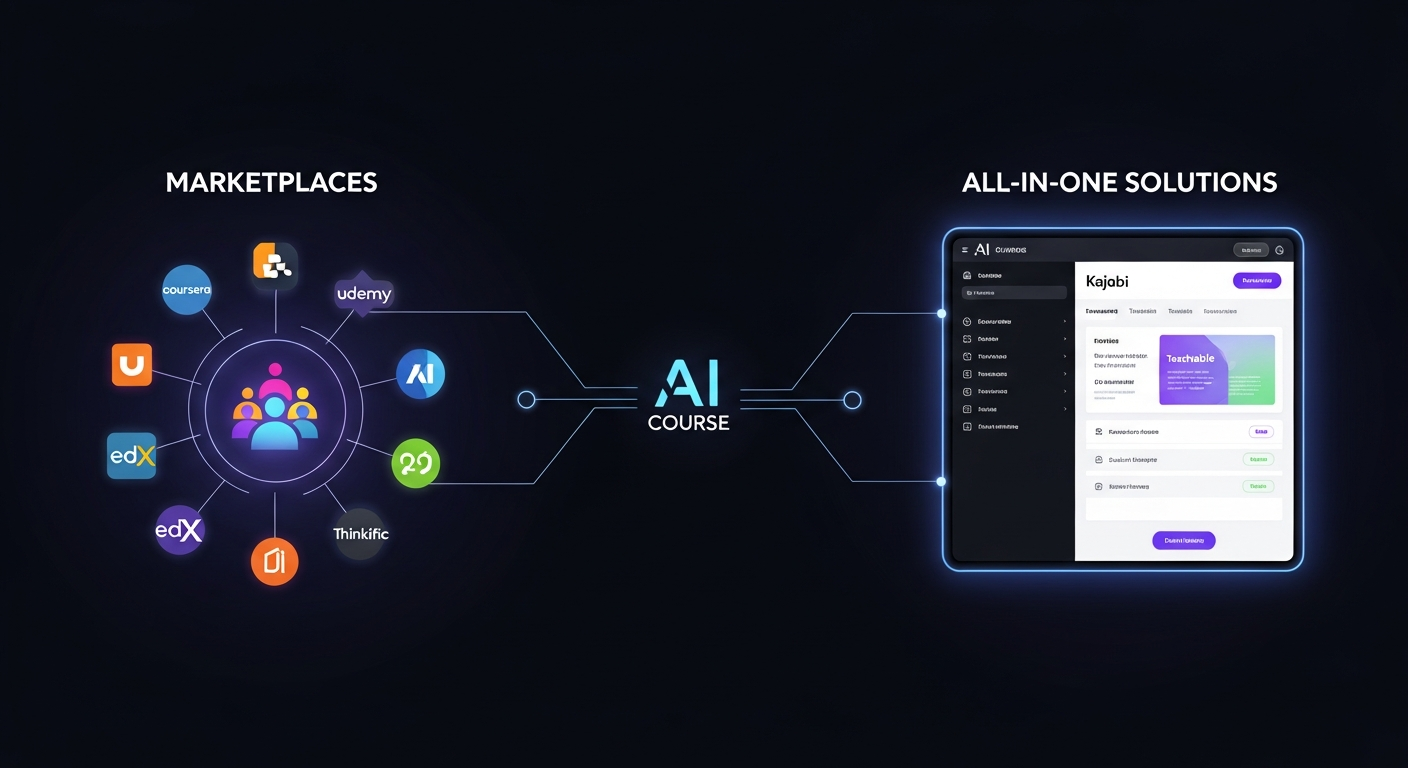
This is where the rubber meets the road. You’ve got killer content; now you need a killer storefront and delivery system. There are two main types of platforms: marketplaces and all-in-one solutions.
Marketplace Platforms: Udemy, Coursera, edX
These platforms offer massive built-in audiences. You create the course, upload it, and they handle the marketing (to their existing users), payment processing, and hosting.
- Pros: Huge reach, minimal marketing effort on your part, often a recognizable brand name.
- Cons: Less control over pricing (they often run aggressive sales), lower revenue share (typically 25-50%, sometimes lower if they bring the student), less branding control, fierce competition with other instructors.
Udemy: Known for its vast catalog and frequent sales. Instructors retain a higher percentage (97%) if they bring the student to Udemy, but significantly less (37-50%) if Udemy’s marketing brings the student. Coursera/edX: Often partner with universities and established institutions. Getting your course approved can be more rigorous, but it carries significant prestige. Revenue share models vary but are often lower for individual creators unless part of a special program.
All-in-One Platforms (Course Creation Software): Thinkific, Teachable, Kajabi
These platforms give you your own branded academy. You have full control over pricing, branding, student data, and marketing.
- Pros: 100% revenue on sales (after platform fees), full branding control, direct access to student data, integrate with your marketing stack.
- Cons: You are solely responsible for marketing and driving traffic. Requires more effort to build an audience.
Let’s break down some of the top contenders:
| Feature/Platform | Thinkific | Teachable | Kajabi |
|---|---|---|---|
| Best For | Content creators focused purely on courses, looking for robust course features. | Educators prioritizing ease of use and student engagement. | Entrepreneurs wanting an all-in-one business solution beyond just courses. |
| Pricing (Approx. Monthly) | Free (limited), Basic ($49), Pro ($99), Premier ($499) | Free (limited), Basic ($39), Pro ($119), Business ($249) | Basic ($149), Growth ($199), Pro ($399) |
| Transaction Fees | 0% on paid plans (Stripe/PayPal fees apply) | 5% on Basic, 0% on Pro/Business (Stripe/PayPal fees apply) | 0% (Stripe/PayPal fees apply) |
| Key Features | Unlimited courses & students, advanced course builder, communities, memberships, quizzes, assignments. | Unlimited courses & students, student management, quizzes, drip content, integrated email marketing. | Courses, websites, blogs, email marketing, CRM, sales funnels, coaching, podcasts, communities. |
| Branding Control | High - custom domain, customizable site. | High - custom domain, customizable site. | Very High - comprehensive website builder, custom domain. |
| Marketing Tools | Integrations with popular marketing apps, email reporting. | Integrations, basic email marketing. | Advanced email marketing, pipelines/funnels, landing pages, CRM. |
| Payment Options | Stripe, PayPal, custom payment gateways. | Stripe, PayPal, Teachable Payments. | Stripe, PayPal, custom payment gateways. |
Note: Prices are approximate and subject to change. Always check the official websites for the most current pricing and features.
Which Platform is Right for You?
- Starting Out / Testing the Waters: A marketplace like Udemy can be a good low-risk entry point to validate your course idea and get initial feedback, despite the lower revenue share.
- Building Your Brand & Business: If you’re serious about building a long-term education business with your own brand and full control, an all-in-one platform like Thinkific, Teachable, or Kajabi is the way to go.
- Thinkific is excellent if your primary focus is on delivering a fantastic course experience with robust features and you’re comfortable managing marketing separately.
- Teachable offers a great balance of ease of use and powerful features for course creators, making it a popular choice.
- Kajabi is for the full-stack entrepreneur who wants to run their entire online business (website, blog, email, courses, coaching) from one platform, albeit at a higher price point.
Choose wisely. This isn’t just about hosting; it’s about your entire business ecosystem.
How Should You Price Your High-Value AI Course for Maximum Impact and Profit?
Pricing isn’t about plucking a number out of thin air. It’s a strategic decision that reflects value, targets your audience, and maximizes your revenue.
Should You Opt for a One-Time Fee or a Subscription Model?
-
One-Time Fee:
- Pros: Simplicity, perceived immediate value, encourages impulse buys. Great for standalone, comprehensive courses.
- Cons: Limits recurring revenue, requires continuous new student acquisition.
- Typical Range: From $99 for an introductory module to $1,000+ for a comprehensive, project-heavy masterclass.
-
Subscription Model:
- Pros: Predictable recurring revenue, fosters a community, encourages ongoing engagement. Excellent for continuously updated content or a suite of courses.
- Cons: Requires constant content updates, higher churn risk if value isn’t consistently delivered.
- Typical Range: $19-$99/month, or $199-$999/year for access to a library of courses or a membership.
Can Tiered Pricing Boost Your Sales and Appeal to Different Budgets?
Absolutely. Tiered pricing (Bronze, Silver, Gold, or Basic, Pro, VIP) allows you to capture a wider audience by offering different levels of access and support.
- Basic Tier: Core course content, self-paced. (e.g., $199)
- Pro Tier: Basic content + private community access, Q&A sessions, bonus modules, templates. (e.g., $499)
- VIP Tier: Pro content + 1:1 coaching calls, personalized project feedback, direct access to instructor. (e.g., $999+)
This strategy acknowledges that different students have different needs and budgets, and it allows you to monetize your time and expertise more effectively.
How Can Value-Based Pricing Justify a Premium Price Tag?
Don’t price based on what your competitors charge or what you think people will pay. Price based on the value your course delivers.
- What’s the ROI for the student? If your course helps someone land a job paying $20,000 more, or saves a business thousands in operational costs, then a $500 or even $1,000 price tag is a no-brainer.
- Highlight transformation: Focus on the tangible results and skills gained. “Become an AI-powered marketer” vs. “Learn AI tools.”
- Scarcity and Urgency: Limited-time offers, cohort-based learning, or early-bird discounts can create urgency and justify higher initial prices.
How Do You Market Your AI Course to Attract the Right Students?

Building a killer course is only half the battle. You need to get eyeballs on it – the right eyeballs. This isn’t rocket science, but it requires consistent effort.
Can Content Marketing and SEO Drive Organic Traffic?
Yes, unequivocally. This is your long game.
- Blog Posts: Write high-quality, keyword-rich articles on topics related to your course. (e.g., “Top 5 AI Tools for Content Creation,” “Understanding Large Language Models: A Beginner’s Guide”).
- YouTube Tutorials: Create short, valuable video tutorials or explainers that tease your course content. Show, don’t just tell.
- Lead Magnets: Offer free AI-related resources (e.g., “AI Prompt Cheatsheet,” “Beginner’s Guide to Python for AI”) in exchange for email addresses. This builds your list.
- SEO Optimization: Use relevant keywords in your course titles, descriptions, and landing pages. Think about what potential students are searching for.
What Role Do Social Media and Community Building Play in Course Promotion?
A massive one. People buy from people they know, like, and trust.
- LinkedIn: The professional network is ideal for AI education. Share insights, participate in relevant groups, and highlight student successes.
- Twitter/X: Engage in AI conversations, share news, and offer quick tips.
- Reddit/Discord: Find relevant subreddits or Discord servers (e.g., r/MachineLearning, AI-focused communities) where your target audience hangs out. Provide value, answer questions, and occasionally, subtly promote your course. Don’t spam.
- Build a Community: Create your own Slack, Discord, or private Facebook group around your niche. Foster discussions, provide support, and position your course as the ultimate solution for those looking to deepen their knowledge.
Are Email Marketing and Paid Advertising Worth the Investment?
Absolutely. These are your direct sales channels.
- Email Marketing: Your email list is your most valuable asset. Nurture it with valuable content, case studies, and exclusive offers. Use it to announce new courses, updates, and promotions. An engaged email list converts at a much higher rate than cold traffic.
- Paid Advertising (Google Ads, LinkedIn Ads, Facebook/Instagram Ads): Target specific demographics and interests.
- Google Ads: Target people actively searching for AI courses or solutions to AI-related problems.
- LinkedIn Ads: Precisely target professionals by job title, industry, or skills.
- Facebook/Instagram Ads: Reach a broader audience based on interests, behaviors, and lookalike audiences.
- Start small, test your ad copy and targeting, and scale what works.
How Can Partnerships and Affiliates Expand Your Reach?
Don’t go it alone. Leverage others’ audiences.
- Influencer Collaborations: Partner with AI influencers, podcasters, or bloggers for guest appearances, sponsored content, or joint webinars.
- Affiliate Programs: Offer a commission to others who promote your course. This is a performance-based marketing strategy where you only pay when a sale is made.
- Corporate Training: Approach companies directly. Many are desperate for AI training for their teams and prefer structured, expert-led courses.
Verified Success: Who’s Actually Making a Killing in Online AI Education?

We don’t deal in hypotheticals here. Real people are making real money by teaching AI online.
Consider the success stories often highlighted by platforms like Thinkific and Teachable. For instance, Thinkific frequently features creators like Dr. Carrie Anne Philbin from the “Crash Course Computer Science” series, who built an educational empire. While not exclusively AI, her model of delivering high-quality, accessible tech education resonates. Many individual developers and data scientists, often anonymous for privacy, leverage these platforms to teach specific AI concepts, from Python for ML to advanced neural networks, generating significant income.
Udemy has numerous instructors whose courses consistently rank among the best-sellers. Kirill Eremenko, for example, a Data Scientist, has multiple highly-rated courses on Machine Learning, AI, and Data Science, with hundreds of thousands of students enrolled across his offerings. While specific income figures are proprietary, the sheer volume of enrollments at price points ranging from $10 to $200 (before discounts) indicates substantial earnings. Another prominent Udemy instructor, Jose Portilla, a Data Scientist and Head of Data Science at Pierian Training, has courses like “Python for Data Science and Machine Learning Bootcamp” that have attracted over a million students, demonstrating the immense demand for practical AI and data skills.
These educators aren’t just selling courses; they’re building brands, communities, and often, entire businesses around their expertise. They focused on delivering immense value, staying current, and effectively reaching their target audience. Their success isn’t an anomaly; it’s a blueprint.
Conclusion: Your Expertise is the New Gold
The AI revolution isn’t just coming; it’s here, and it’s creating an unprecedented demand for knowledge. Your expertise in AI isn’t just a skill; it’s a valuable asset that can be packaged, priced, and sold to a hungry global audience.
This isn’t a passive income fantasy where money magically appears. It requires work: creating exceptional content, choosing the right platform, strategic pricing, and relentless marketing. But the payoff? A scalable, profitable business built on your intellect, empowering others, and securing your financial future.
Stop waiting for permission. The market is ready. The tools are available. Your knowledge is the gold. Go dig it.
Frequently Asked Questions
What’s the biggest mistake new AI course creators make?
The biggest mistake is creating a course that’s too broad or too theoretical. Students crave actionable, project-based learning that solves a specific problem or teaches a tangible skill. Focus on “how to do X with AI” rather than just “what is X in AI.” Also, neglecting marketing is a critical error; a great course won’t sell itself.
How much time should I expect to spend creating and marketing an AI course?
Course creation can take anywhere from 100 to 500+ hours, depending on complexity, length, and production quality. Marketing is an ongoing effort, requiring at least 5-10 hours per week initially, and potentially more as you scale. This is a business, not a hobby, so expect to invest significant time and effort, especially in the first 6-12 months.
Do I need to be a programming expert to teach AI?
Not necessarily. While many AI roles require programming (Python is dominant), there’s a huge demand for courses on non-coding aspects of AI. This includes prompt engineering for LLMs, ethical AI considerations, AI strategy for business leaders, AI tools for creatives (e.g., Midjourney, Stable Diffusion), and no-code/low-code AI applications. Identify your unique AI expertise and teach that.
How do I keep my AI course content up-to-date with rapid technological changes?
Plan for iterative updates. Design your course in modules or sections that can be easily updated. Regularly review industry news, model releases, and framework changes. Consider a subscription model or offering “update packs” for existing students. Emphasize fundamental concepts that have a longer shelf life, alongside cutting-edge applications.
Can I really make a full-time income selling AI courses online?
Yes, absolutely. As evidenced by many successful instructors on platforms like Udemy, Coursera, Thinkific, and Teachable, it is entirely possible to build a substantial, even full-time, income. However, it requires a high-quality product, effective marketing, consistent effort, and often, a diversified offering of courses or related services. It’s a business, and like any business, success is earned, not guaranteed.
What are the legal considerations for selling online courses?
Key legal considerations include ensuring your content doesn’t infringe on intellectual property rights (e.g., using copyrighted material without permission), having clear terms and conditions for students, privacy policies for data collection (GDPR, CCPA compliance), and disclaimers about results or guarantees. It’s always advisable to consult with a legal professional for specific guidance.
Sources
> Want more like this?
Get the best AI insights delivered weekly.
By subscribing, you agree to our Privacy Policy. You can unsubscribe at any time.
> Related Articles
Token Budget SLOs for LLM Apps: Control Cost Without Breaking Quality
Turn token spend into an operating target. Budget by workflow, reserve output capacity, detect context growth, and degrade gracefully before costs surprise you.
AI Etsy Business: Sell AI-Generated Products
Most AI Etsy sellers fail because they upload pretty junk. Here's how to build a real product line with AI, realistic margins, and no policy faceplant.
AI for Real Estate: How Smart Investors Use AI
AI can scan markets faster than any landlord, but it still buys dumb deals if you feed it lazy assumptions. Here's the investor playbook that actually holds up.
Tags
> Stay in the loop
Weekly AI tools & insights.