Anthropic's September Misuse Report Shows Cybercrime Becoming Agent-Orchestrated
Anthropic's latest threat report describes operators delegating broad intrusion goals to AI, while independent PaperCut reporting shows why corroboration matters.
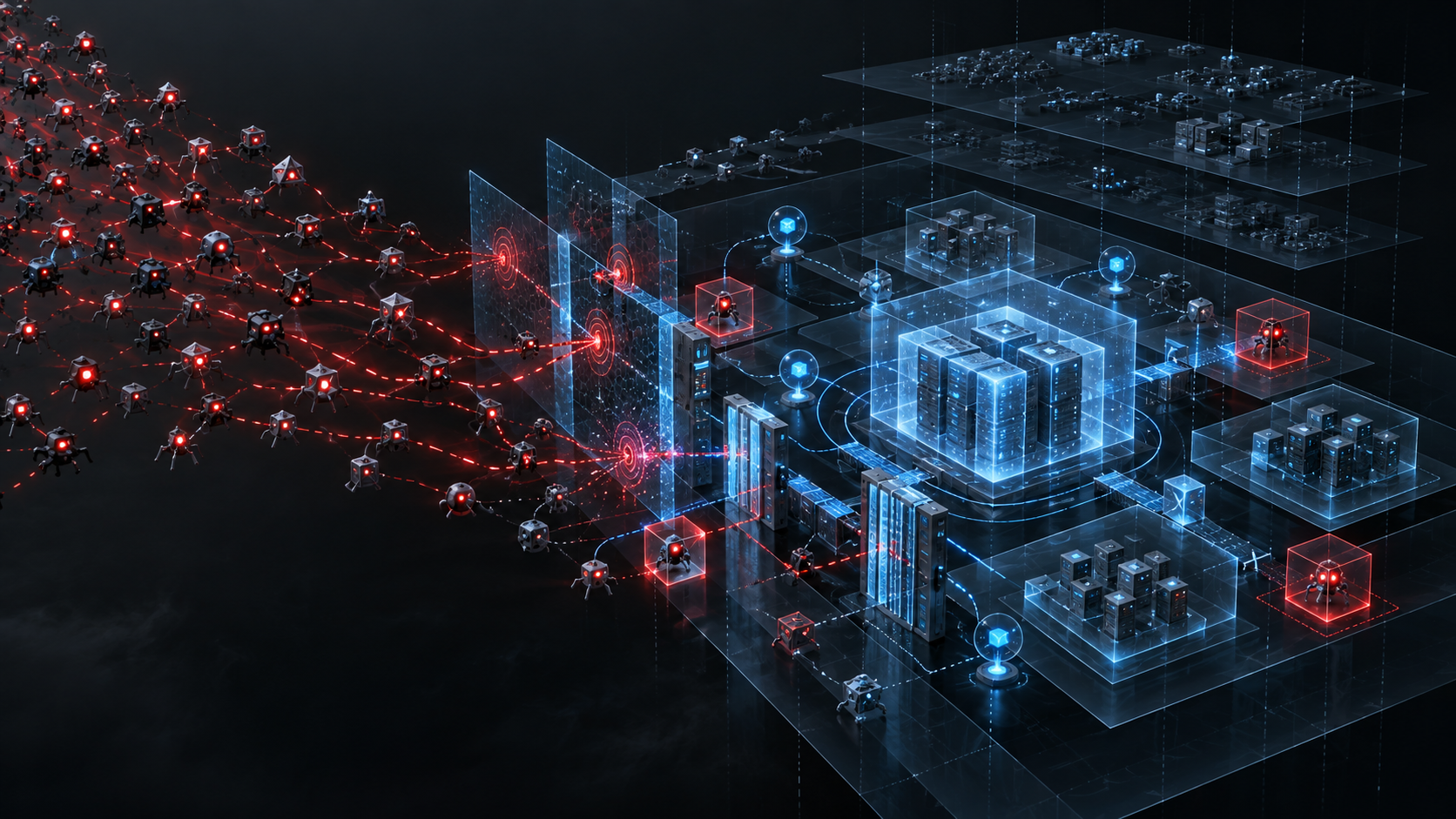
Anthropic’s September 2026 threat-intelligence report marks a change in how AI-enabled attacks are described. The company is not only reporting criminals asking a chatbot for code. It describes operators assigning broad goals, allowing models to inspect environments, author and execute scripts, summarize results, and repeat the process. Anthropic uses the phrase “vibe hacking” for this supervisory pattern.
The sensational interpretation is that autonomous hackers have arrived. The more accurate reading is narrower: parts of intrusion work can now be delegated and parallelized, while humans still select targets, provide access, monetize stolen data, and adapt when systems resist. Defenders should respond to the change in speed and scale without accepting every attribution claim uncritically.
What happened
Anthropic published the report in September and said it detected and banned accounts linked to ShinyHunters associates. The company says it coordinated with authorities, industry partners, and victims. Its public summary describes AI use across intrusions and data theft, including goal-directed sequences rather than isolated code generation.
Separately, GreyNoise reported an August 31 campaign against PaperCut NG/MF involving CVE-2026-81578 and CVE-2026-82078. GreyNoise attributed AI-assisted development, testing, and exploitation to a likely Russian-speaking actor. That case gives defenders a concrete infrastructure target—patched print-management servers and exposed credentials—rather than a vague argument about AI risk.
These reports overlap in theme but are not the same evidence. Anthropic has provider telemetry that outside researchers cannot independently inspect. GreyNoise has network observations and its own analytical methods. Neither source should be treated as a court judgment, and the degree of model autonomy is harder to verify than the existence of malicious traffic or compromised systems.
Why it matters
Automation changes the economics of attacks. A human operator can ask several agents to enumerate targets, adjust scripts, or summarize results while focusing on decisions that still require judgment. Even if each agent is imperfect, parallelism can reduce the cost of testing many paths.
That increases pressure on patch latency and identity hygiene. When exploitation workflows compress from days to hours, a patch that “will be installed next week” may be functionally late. When credentials are stolen, fixing the original vulnerability does not revoke the access already obtained.
The defensive answer is not an AI-versus-AI slogan. Asset inventory, internet-exposure reduction, rapid patching, credential rotation, least privilege, and useful logs remain the controls that determine blast radius. AI can help triage alerts, but an automated summary cannot compensate for an unknown server or a domain-admin credential that never expires.
Evidence
The strongest evidence here is layered. Anthropic’s web report and downloadable PDF are primary sources for what Anthropic says it observed on its service. The Hacker News thread documents public technical skepticism, including questions about how a provider distinguishes direct state use from intermediaries or resellers. GreyNoise provides a separate account tied to named vulnerabilities and observable infrastructure.
The existence of disagreement is valuable. Attribution combines technical indicators, language, infrastructure, timing, and provider telemetry; it is rarely proven by a single artifact. Claims such as “hundreds of agents” should therefore be reported as the researcher’s finding, not transformed into a universal measurement of attacker capability.
The vulnerabilities themselves are more actionable than the branding. Organizations running PaperCut should consult the vendor’s current advisories, confirm versions, review external exposure, inspect logs, and rotate credentials that may have been reached. The exact model used by an intruder does not change those steps.
Practical takeaway
Security teams should update incident playbooks for compressed timelines. Measure the time from public disclosure to inventory, patch, validation, and credential review. Pre-authorize emergency containment for known internet-facing systems so responders are not waiting for a meeting while automated scanners are active.
Build detections around behavior: unusual administrative changes, unexpected script execution, high-rate enumeration, new persistence, mass data access, and abnormal authentication. Model names are unreliable indicators. Attackers can switch services, route through resellers, or use locally hosted models.
AI providers also need abuse controls that work across multi-step sessions. A single prompt can look benign while a sequence reveals intent. That makes rate patterns, tool use, target concentration, and outcome signals important, while also raising privacy and false-positive concerns. Transparent reporting should explain what was observed, what was inferred, and what remains uncertain.
Limitations
Provider threat reports are not neutral academic datasets. Anthropic selects cases, controls much of the telemetry, and has commercial and policy reasons to emphasize both capability and mitigation. GreyNoise likewise publishes an analytical account rather than raw evidence sufficient for every reader to reproduce the attribution.
Public reporting cannot tell us the base rate: how many attempted agentic campaigns fail, how many use other providers, or how much human labor remains hidden. It also cannot prove that AI caused the compromise rather than accelerating a campaign that would have occurred anyway.
Final verdict
The report is credible evidence that attackers are integrating models into real workflows, not proof of fully autonomous cybercrime. The operational lesson is immediate anyway: shorten defensive response time and reduce the privileges available after a breach. Debate the attribution, but patch the server and rotate the credential.
Sources
> Want more like this?
Get the best AI insights delivered weekly.
By subscribing, you agree to our Privacy Policy. You can unsubscribe at any time.
> Related Articles
From Quantum Labs to Cyber Campaigns: The Agent Control Plane Is the Real Product
Recent lab automation, managed-agent, and threat reports point to one conclusion: permissions, verifiers, and recovery now matter as much as the model.
OpenAI's Agents API Turns the Codex Harness Into Managed Infrastructure
OpenAI now offers its Codex agent harness as an API, moving durable sessions, orchestration, and sandboxes into a managed production layer.
AI Inference Routing: How Smart Teams Cut Cost Without Wrecking Quality
Your AI bill does not need another heroic model. Inference routing sends easy work to cheap models and saves premium brains for prompts that earn it.
Tags
> Stay in the loop
Weekly AI tools & insights.