The Reasoning Model Wars: GPT-5 Reasoning, DeepSeek R2, and the Open-Source Surprise
Reasoning-trained models — the kind that think for 30 seconds before answering — are the biggest shift of 2026. DeepSeek R2 caught up to frontier labs at 1/20th the cost. Here's what changed and what it means for builders.
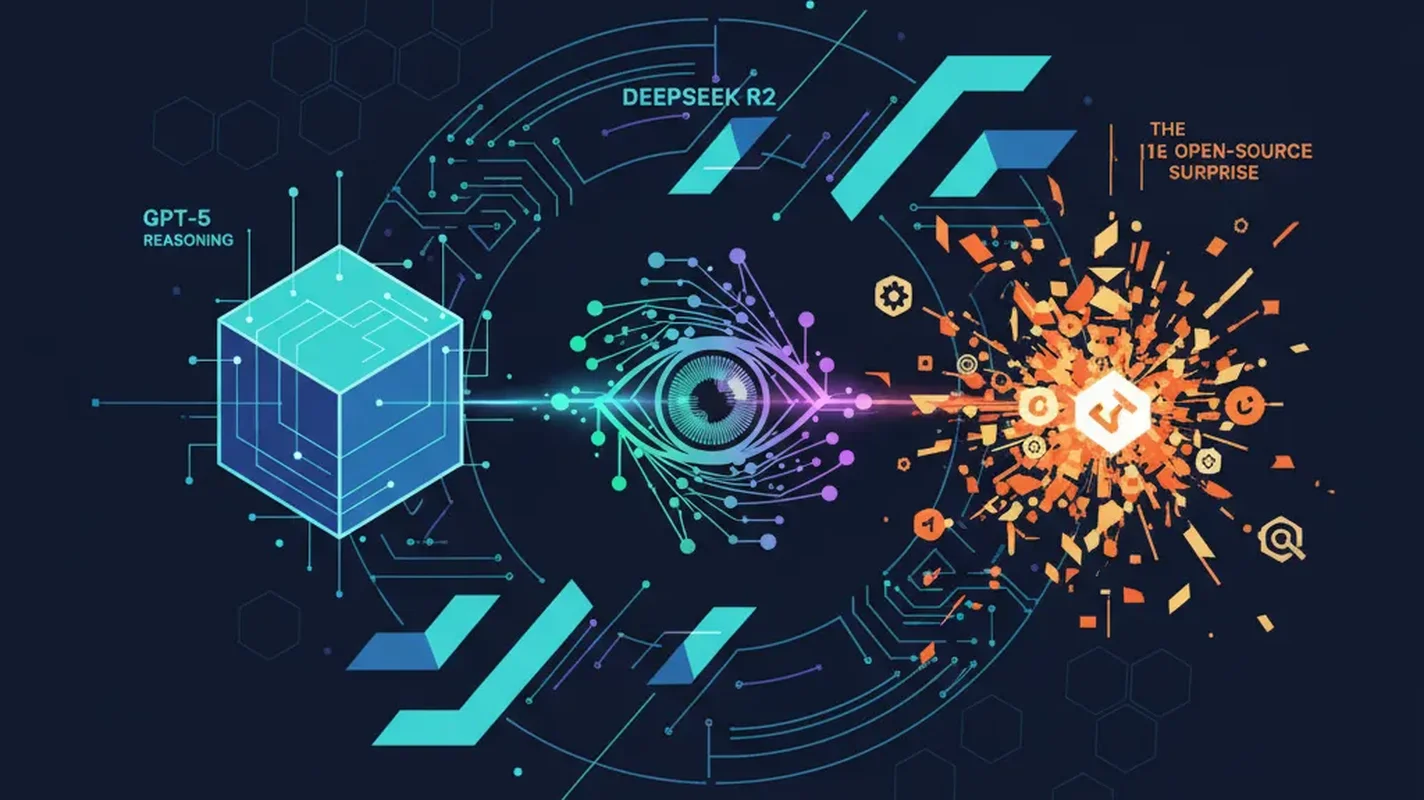
The Shift That Actually Matters in 2026
The headline AI story of 2026 isn’t a new frontier model. It’s the rapid commoditization of reasoning — the capability that used to separate GPT-4 from o1, and o1 from everyone else.
A year ago, reasoning-trained models were exclusively OpenAI territory. Six months ago, Anthropic and Google matched them. This quarter, DeepSeek released R2, a fully open-weight reasoning model that matches GPT-5 reasoning on most public benchmarks at about 5% of the cost, and can run on a single 8xH100 node.
The reasoning model war is over. Everyone has them. The interesting questions now are which one to use, how to use them correctly, and what broke in the way we used to prompt LLMs.
Quick Recap: What “Reasoning” Actually Means
A reasoning model isn’t smarter by architecture — under the hood it’s still a transformer. What changed is the training recipe. OpenAI’s o1 pioneered large-scale reinforcement learning against verifiable rewards: the model generates long chains of thought, and training signal flows back based on whether the final answer is correct on math problems, coding tasks, and logic puzzles.
The result is a model that, at inference time, generates hundreds or thousands of “thinking tokens” before its final answer — working through problems like a human would on scratch paper. For hard problems this produces dramatically better results. For easy problems it burns tokens unnecessarily.
Crucially, reasoning is a test-time compute tradeoff. You can always spend more thinking tokens for better answers, up to a ceiling set by the base model’s knowledge. This broke the old assumption that bigger models always win.
The Contenders in April 2026
| Model | Provider | Status | Strong Points |
|---|---|---|---|
| GPT-5 reasoning | OpenAI | Closed API | AIME, FrontierMath, competitive math |
| Claude 4.6 Extended Thinking | Anthropic | Closed API | Agentic multi-step, long-context reasoning |
| Gemini 2.5 Deep Think | Closed API | Multimodal reasoning, scientific tasks | |
| DeepSeek R2 | DeepSeek | Open weights (MIT) | Cost-efficiency, math, open research |
| Qwen3-Reasoning | Alibaba | Open weights | Strong on coding, multilingual |
| Llama 4 Reasoning | Meta | Open weights | Fine-tuning friendly, wide hardware support |
Five of the six are credible for production workloads. The surprising story is that four of the six are open weight, and two of those (DeepSeek R2 and Qwen3) are within striking distance of frontier on standard reasoning benchmarks.
DeepSeek R2: The Story of the Quarter
DeepSeek first shocked the field in early 2025 with R1, which matched o1 on reasoning benchmarks at a tiny fraction of the training compute. R2, released in March 2026, extends that lead. According to the published technical report, R2 was trained for under $6M in compute and released with full weights, training code, and a permissive license.
On AIME 2026, R2 scores approximately 91% — within 3 points of GPT-5 reasoning. On FrontierMath it scores around 31% — below GPT-5’s 38% but above Claude 4.6’s extended thinking. On GPQA Diamond, R2 is essentially tied with frontier closed models.
The reaction from Western labs has been telling. Anthropic, OpenAI, and Google all accelerated their own reasoning roadmaps after R1. After R2, multiple labs have quietly shifted resources toward post-training RL because that’s now clearly where the leverage is.
What R2 Actually Costs To Run
R2 is a 671B parameter mixture-of-experts model with about 37B active parameters per token. It fits in:
- 8 x H100 80GB nodes for full precision
- 4 x H100 for FP8 quantized (minor quality loss)
- A single H200 node for aggressive quantization
Compare that to GPT-5 reasoning, which you can only access through OpenAI’s API at $2.50/M input tokens plus reasoning token fees. Running R2 yourself on rented hardware works out to roughly $0.10-$0.15 per million tokens — about 20x cheaper at steady state.
For startups that need reasoning but can’t justify frontier API bills, this is a massive unlock.
Claude 4.6 Extended Thinking: The Agentic Angle
Anthropic took a different path. Claude 4.6’s extended thinking mode is more conservative in how much it thinks — usually hundreds to a few thousand reasoning tokens rather than tens of thousands. It loses to GPT-5 and DeepSeek R2 on pure math competitions.
But on agentic reasoning — multi-step tool use, software engineering, long-context code navigation — Claude’s extended thinking dominates. The reason is that Anthropic trained its reasoning on realistic coding and agent tasks, not just olympiad math.
If your workload is “agent that uses tools to solve real tasks,” Claude’s extended thinking is typically the best choice. If your workload is “closed-form math or logic puzzle,” GPT-5 or DeepSeek R2 beats it.
How Reasoning Models Broke Old Prompting Habits
A year of working with reasoning models has forced builders to unlearn a lot of prompt engineering.
-
Stop writing “think step by step.” Reasoning models already do this internally. Adding CoT prompts can actually degrade their performance because it constrains the structure of their hidden reasoning.
-
Stop writing few-shot examples for hard problems. In-context examples help base models but can confuse reasoning models, which have learned their own solution strategies.
-
Start writing problem statements like you’d write them for a skilled human. Clear objective, clear constraints, clear format for the answer. Let the model figure out the approach.
-
Start measuring cost in seconds, not tokens. Reasoning models can spend 30-180 seconds on a single answer. At scale this changes architecture: you need async queues, not synchronous API calls.
-
Don’t use reasoning models for easy tasks. They’re expensive and slow. Route easy queries to a cheap non-reasoning model and hard queries to a reasoning one. Frontier labs now sell hybrid models (Claude 4.6, GPT-5) that do this internally, but explicit routing is often cheaper.
Benchmarks Are Saturating
The other story of the quarter: standard reasoning benchmarks are running out of headroom. AIME is approaching human expert ceilings. GPQA Diamond is within a few points of saturation. MMLU has been useless for frontier comparisons for over a year.
FrontierMath remains the main bellwether — problems so hard that Fields medalists struggle with them. GPT-5 leads here, but even GPT-5 is under 40%. The benchmark was designed to resist saturation and is doing its job.
For builders this means: public benchmarks are increasingly useless for picking a model. Build your own private eval set on your actual workload. Every serious AI team does this now, and the gap between public benchmark rankings and real-world performance rankings is often substantial.
What Comes Next
Three likely developments for the rest of 2026:
-
Reasoning + tool use convergence: the model thinks, calls a tool, thinks again. GPT-5 and Claude 4.6 already do this; open-source will follow within a quarter.
-
Inference-time scaling wars: labs will compete on how much compute you can profitably spend at inference, with pricing tiers based on thinking budget.
-
RL post-training democratization: recipes that let anyone turn a base model into a reasoning model on a modest budget. The bar for “I trained my own reasoning specialist” keeps dropping.
The short version: reasoning used to be a moat. In 2026 it’s a feature. The moat is now who can deploy it cheaply and integrate it into real agent workflows. That race is just starting.
Practical Guidance For Builders
If you’re shipping an AI product in 2026, a few operational implications follow from the commoditization of reasoning:
- Route queries by difficulty. Most user queries don’t need reasoning. Build a cheap classifier (even a small LLM call) that decides whether to use a reasoning model or a fast one. Teams doing this report 60-80% cost reduction without quality loss.
- Cache reasoning outputs aggressively. Reasoning tokens are expensive and often deterministic given the same input. A simple prompt + output cache keyed on the user’s question is a huge win.
- Use async architectures. If any of your queries go to a reasoning model, your UX needs to handle 30-second responses gracefully. Streaming the “thinking” text to the user — as ChatGPT and Claude both do — makes long waits tolerable.
- Consider open-weight reasoning for high-volume workloads. DeepSeek R2 running on your own GPUs is dramatically cheaper than any frontier API at scale, and the capability gap is narrow enough to justify the migration cost for many use cases.
- Invest in private evaluation. Public reasoning benchmarks are saturating and contaminated. Your own eval set is now the only trustworthy comparison.
The teams that treat reasoning as just another tool — not a magic wand — are the ones shipping reliable, affordable AI products this year.
Sources
> Want more like this?
Get the best AI insights delivered weekly.
By subscribing, you agree to our Privacy Policy. You can unsubscribe at any time.
> Related Articles
Agentic Coding's New Bottleneck Is Review Evidence, Not More Parallelism
Whiteboard visualizes intent, Archify maps systems, and TODO Flow preserves task and review state. Together they show a tool category forming around one problem: proving what coding agents changed and why it is safe to merge.
CLM-8B Chooses the Next Action Instead of Writing the Next Sentence
Contrastive Language Models separate state and action encoders so repeated candidate actions can be cached and ranked quickly. The release is promising, but its headline coding scores describe verifier-assisted pipelines—not a standalone coding agent.
Whiteboard Turns AI-Generated Code Into a Reviewable System Map
The open-source Code OSS desktop app links agent-drawn architecture, semantic diffs, and decision logs back to source code. Its bet is that understanding—not generation—is now the coding bottleneck.
Tags
> Stay in the loop
Weekly AI tools & insights.