AI Copyright Lawsuits: Where Things Stand in 2026 (It's a Mess)
In 2026, the AI copyright battlefield is a legal quagmire. Major lawsuits pitting creators against tech giants are far from settled, reshaping the future of AI and human creativity.
Welcome to 2026. If you thought the legal landscape around AI and copyright would be clearer by now, you’re either an eternal optimist or haven’t been paying attention. Two years into the Great AI Copyright Wars, the dust hasn’t settled. It’s thicker than ever, obscuring the path forward for creators, tech companies, and anyone trying to make sense of who owns what in the age of algorithmic creation.
The legal battles we’re witnessing aren’t just squabbles over money; they’re existential fights over the very definition of creativity, intellectual property, and fair use in a world where machines can ingest the entirety of human culture in a blink. By 2026, we’ve seen some initial skirmishes, procedural motions, and a whole lot of lawyerly posturing. Definitive rulings? Not so much. But the trajectory is becoming clearer, and it’s a bumpy ride.
The core conflict remains: Can AI companies freely ingest vast swaths of copyrighted material – books, art, music, code – to train their models without permission or compensation, under the umbrella of “fair use” and “transformative” creation? Or is this simply industrial-scale theft, undermining the very incentive for human creation? Let’s dive into the trenches of the major battles.
Are News Publishers Winning the War Against AI Scrapers?
When OpenAI launched ChatGPT, it kicked off a gold rush. When The New York Times sued OpenAI and Microsoft in December 2023, it kicked off a legal earthquake. By 2026, this case isn’t just a headline; it’s a litmus test for the future of journalism and AI.
What’s the Latest in The New York Times v. OpenAI?
As of early 2026, The New York Times v. OpenAI is still deep in discovery, with mountains of documents being exchanged and depositions underway. Don’t expect a quick resolution; these are multi-year sagas. However, some key motions have given us glimpses into the legal strategies and the court’s initial leanings.
The Times’ initial complaint was blunt: OpenAI and Microsoft “copied, distributed, displayed, performed, and otherwise infringed The Times’s copyrights” by training their models on millions of Times articles. They detailed instances where ChatGPT would “hallucinate” or directly reproduce significant portions of Times content, sometimes verbatim, without attribution or licensing. The Times argues this directly competes with and undermines their subscription model, their very livelihood. They’re not just suing for past infringement, but for the future market for licensing their content to AI companies.
OpenAI’s defense has been equally robust, leaning heavily on the “fair use” doctrine, particularly the “transformative” nature of AI training. Their arguments, which have been refined in early court filings, broadly state:
- Transformative Use: Training an AI model, they argue, isn’t about reproducing the original work, but about extracting patterns, language structures, and factual information to create new and different outputs. The model doesn’t store copies of articles; it learns from them.
- Publicly Available Data: Much of the data was already publicly accessible on the internet, which, in their view, makes it fair game for learning. They also pointed out that the Times’ own Terms of Service allowed for indexing and caching by search engines – a point the Times vehemently disputes as applying to mass AI training.
- Lack of Market Harm: OpenAI suggests that their models don’t replace Times articles but offer summaries or new ways to access information, potentially even driving traffic back to the Times. This argument, however, feels increasingly weak as AI models become more capable of generating comprehensive answers.
- Security Vulnerabilities: OpenAI has also contended that many of the Times’ examples of verbatim reproduction were the result of “jailbreaking” the models, or specific prompts designed to elicit copyrighted content, rather than typical usage.
Where We Are in 2026: While no final verdict has been rendered, the court has likely ruled on several motions to dismiss. It’s plausible that the court has allowed significant portions of the Times’ claims to proceed, especially those related to direct output infringement and the potential for market harm. The “transformative use” argument for training is still a complex beast, but the instances of output reproducing copyrighted content are harder for AI companies to defend. We’re seeing more internal pressure on AI companies to filter outputs and potentially even credit sources, a direct result of these lawsuits.
Implications for Journalism: This case is pivotal. If the Times ultimately prevails, it could establish a precedent that AI companies must license content for training, fundamentally altering the economics of AI development and potentially creating a new revenue stream for publishers. If OpenAI largely wins, it could further erode the financial stability of news organizations, as AI models become primary information sources, bypassing traditional media. By 2026, some smaller news outlets have already thrown in the towel, citing AI as a significant factor in declining traffic and ad revenue, while others are trying to adapt by offering premium AI licensing deals.
Can AI Companies Freely Train on Billions of Images?
The visual arts community has been equally vocal, and Getty Images, the Goliath of stock photography, was one of the first to draw a line in the sand. Their lawsuit against Stability AI, filed in early 2023, set the stage for a broader fight over visual content.
Where Does Getty Images v. Stability AI Stand?
The Getty Images v. Stability AI case, spanning both the UK and US courts, has also been a slow burn through the legal system. As of 2026, we’re likely beyond initial motions, possibly heading towards summary judgment or even early settlement discussions in some jurisdictions.
Getty’s core claims are straightforward: Stability AI, in developing its Stable Diffusion model, “unlawfully copied and processed millions of images protected by copyright” from Getty’s extensive library without permission or compensation. The most damning evidence presented by Getty were images generated by Stable Diffusion that contained distorted but recognizable Getty Images watermarks, indicating direct ingestion of their protected content. They also argued trademark infringement due to the corrupted watermarks.
Stability AI’s defense mirrors OpenAI’s on fair use, asserting that:
- Transformative Learning: The AI doesn’t store or reproduce the images; it learns the relationships between pixels and concepts. The outputs are new creations, not copies.
- No Direct Infringement: The model isn’t distributing copyrighted works. Any generated output that resembles a copyrighted work is coincidental or the user’s fault.
- Technical Arguments: They argue that the model’s training process is a complex statistical operation, not a simple act of copying for redistribution. The watermark remnants, they claim, are artifacts of the training data and not indicative of malicious intent or direct copying.
Where We Are in 2026: This case has seen more procedural wrangling due to the dual jurisdictions. In the US, the case is moving forward, likely past initial discovery. The “watermark” argument has been particularly challenging for Stability AI. Courts are generally more receptive to evidence of direct reproduction or clear artifacts of copyrighted material within AI outputs or even latent spaces. It’s possible that by 2026, a court might have issued a preliminary ruling or a strong signal regarding the “watermark” claims, potentially favoring Getty. This could force AI image generators to implement stricter filtering mechanisms or acknowledge the need for licensed data.
Implications for Artists & Photographers: A win for Getty could establish a powerful precedent, forcing AI image generators to license training data or face significant liability. This would be a massive boon for artists and photographers, potentially creating a new market for their work. Conversely, a loss for Getty would reinforce the idea that AI companies can freely use copyrighted images for training, leaving visual creators with little recourse. By 2026, many artists are either trying to license their portfolios to AI companies directly or aggressively opting out of training datasets, a complex and often fruitless endeavor given the vastness of existing models. The debate over whether “style” can be copyrighted is also heating up, with no clear answers.
Is AI Stealing the Soul of Music?
The music industry, known for its aggressive defense of intellectual property, was never going to sit idly by. By 2026, a chorus of lawsuits from major labels and individual artists has amplified the legal noise surrounding AI music generation.
What’s Happening with AI and Music Copyright?
Unlike the relatively clear-cut instances of text or image reproduction, music presents unique challenges. The lawsuits here are often multi-pronged, targeting both the training of AI models on copyrighted songs and the potential for AI to generate infringing new works.
Major Label Cases (e.g., UMG, Sony, Warner vs. Anthropic/others): Filed in late 2023, these cases allege that AI companies like Anthropic (with its Claude model) are training their models on vast libraries of copyrighted song lyrics, compositions, and potentially even recordings. The core arguments include:
- Training Infringement: That the act of copying and processing copyrighted musical works for training constitutes direct copyright infringement.
- Output Infringement: That the AI models, when prompted, can generate lyrics or even melodic lines that are substantially similar to existing copyrighted works. UMG, in particular, provided examples of Anthropic’s Claude generating lyrics strikingly similar to songs by artists like Mariah Carey and The Beach Boys.
- Unjust Enrichment: That AI companies are profiting from the unauthorized use of copyrighted material.
Artist-Led Lawsuits (e.g., Sarah Silverman and others vs. OpenAI/Meta for books): While not strictly music, these cases by authors like Sarah Silverman, Richard Kadrey, and Christopher Golden against OpenAI and Meta (for LLaMA) are highly relevant. They allege that their copyrighted books were ingested without permission to train these large language models. The principle is the same: unauthorized use of creative works for commercial AI development. By 2026, these cases are likely in discovery or early motions, focusing on proving that specific copyrighted works were indeed part of the training data.
The “Style” Debate: A particularly thorny issue in music (and art) is the concept of “style.” Can an AI that generates a song “in the style of Taylor Swift” be infringing? Copyright protects specific expressions, not general styles. However, if an AI is trained on an artist’s entire catalog and can generate new, original-sounding songs that are indistinguishable from that artist’s work, without direct copying of specific melodies or lyrics, the legal lines blur considerably. By 2026, this remains one of the most hotly contested and unresolved areas.
Where We Are in 2026: The music industry cases are complex. Proving that an AI model trained on a specific song is harder than showing a direct output infringement. However, the examples of AI generating highly similar lyrics are a strong point for the plaintiffs. It’s plausible that by 2026, some of these cases might be moving towards settlement, especially if AI companies see the writing on the wall regarding the need for licensed music data. The sheer volume of potential infringements, coupled with the music industry’s history of aggressive enforcement, makes this a high-stakes arena.
Implications for Musicians & Labels: A victory for the music industry would likely lead to a new licensing paradigm for AI training data, potentially opening up a significant revenue stream for artists and labels. It would also empower artists to control how their work is used by AI. However, if AI companies largely prevail, it could unleash a flood of AI-generated music, potentially devaluing human-created works and making it harder for new artists to break through without the backing of AI. By 2026, many artists are experimenting with AI tools while simultaneously advocating for stronger protections, a complex dance between innovation and preservation.
What’s the Real Battleground for AI Copyright?
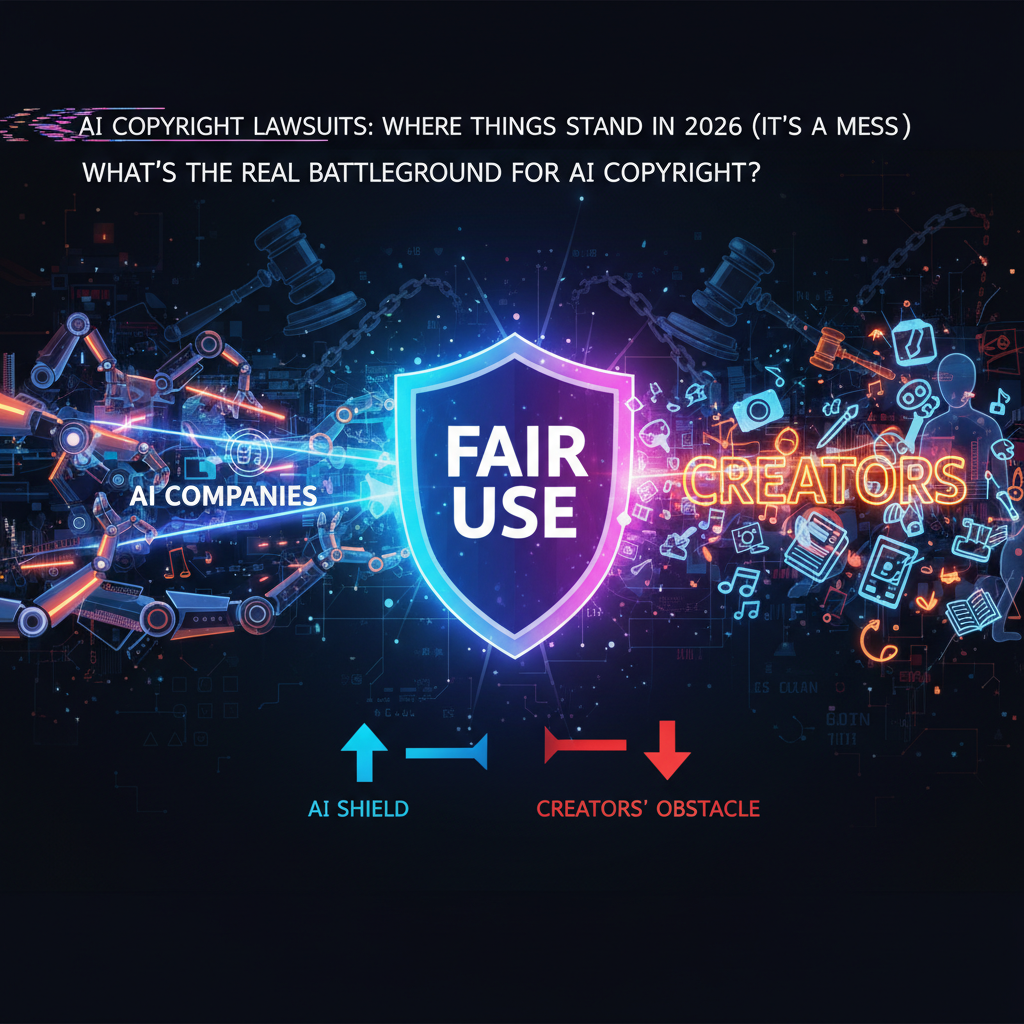
At the heart of every single one of these lawsuits is the concept of “fair use.” It’s the AI companies’ primary shield, and the creators’ biggest obstacle.
Is AI Training “Fair Use” or Just Mass Theft?
“Fair use” is a legal doctrine in US copyright law that allows limited use of copyrighted material without acquiring permission from the rights holders. It’s often invoked for criticism, comment, news reporting, teaching, scholarship, or research. The determination of whether a use is fair depends on four factors:
- The purpose and character of the use: Is it commercial or non-profit educational? Is it transformative (adding new meaning or purpose) or merely derivative (repackaging the original)?
- The nature of the copyrighted work: Is it factual or creative? Published or unpublished?
- The amount and substantiality of the portion used: How much of the original work was copied? Was the “heart” of the work taken?
- The effect of the use upon the potential market for or value of the copyrighted work: Does the new use harm the market for the original work, or for potential licenses?
AI companies argue their training is highly transformative. They don’t copy works to resell them directly; they use them as raw material to train a neural network to generate new works. They argue the AI model learns underlying patterns and concepts, much like a human artist or writer learns from consuming vast amounts of content. This, they claim, is a “purpose and character” that is distinct and transformative.
Creators, however, argue that this is a massive commercial endeavor, not non-profit research. They contend that the sheer scale of copying (billions of works) is unprecedented, and the outputs, even if “new,” directly compete with and devalue their original work, thus harming the market. They point to instances where the AI outputs are substantially similar, or even verbatim copies, demonstrating that the “heart” of their work is being taken.
How Are Courts Interpreting “Transformative Use” for AI?
This is where the legal system is truly struggling. Prior “transformative use” cases, like Campbell v. Acuff-Rose Music (the 2 Live Crew “Oh, Pretty Woman” parody), involved a human creating a specific, new work that commented on or critiqued the original. AI is different. The “transformation” happens inside a black box, a statistical model, not in a human’s creative act.
By 2026, courts are grappling with:
- The “Black Box” Problem: How do you prove that a specific copyrighted work contributed to a specific AI output? AI companies argue it’s impossible, like trying to trace a single drop of water in an ocean. Plaintiffs are using forensic analysis of AI outputs and internal company documents to try and demonstrate direct lineage.
- The Scale of Copying: Previous fair use cases involved limited copying. AI models ingest practically everything. Does scale change the fair use calculus? Many legal scholars argue it must.
- Market Substitution: This is often the most critical factor. If AI-generated content directly replaces the need for human-created content, thereby harming creators’ ability to earn a living, courts are generally less likely to find fair use. This is a strong point for the NYT and Getty.
- Licensing Alternatives: If a licensing market exists or could reasonably exist for AI training data, courts may be less inclined to find fair use, as it would undermine that market. The existence of companies like Shutterstock offering AI training licenses complicates the “no market” argument.
By 2026, no single court has issued a definitive, high-level ruling that completely redefines fair use for AI. Instead, we’re seeing cautious, incremental decisions on specific motions. Some courts are showing a willingness to consider the unique nature of AI, while others are trying to shoehorn AI into existing frameworks, leading to unpredictable outcomes. This lack of clarity is precisely why the “mess” persists.
Key Arguments & Outcomes (Projected 2026)
| Case | Plaintiff Claim | Defendant Claim | Projected 2026 Status |
|---|---|---|---|
| NYT v. OpenAI | Mass infringement; Market harm | Fair use; Transformative | Discovery; Motions proceed |
| Getty v. Stability AI | Unauthorized use; Watermarks | Fair use; Technical learning | Discovery; Watermark key |
| Music Industry (General) | Training theft; Output infringement | Fair use; Style, not copy | Early settlements possible |
What Does This Mean for You in 2026?
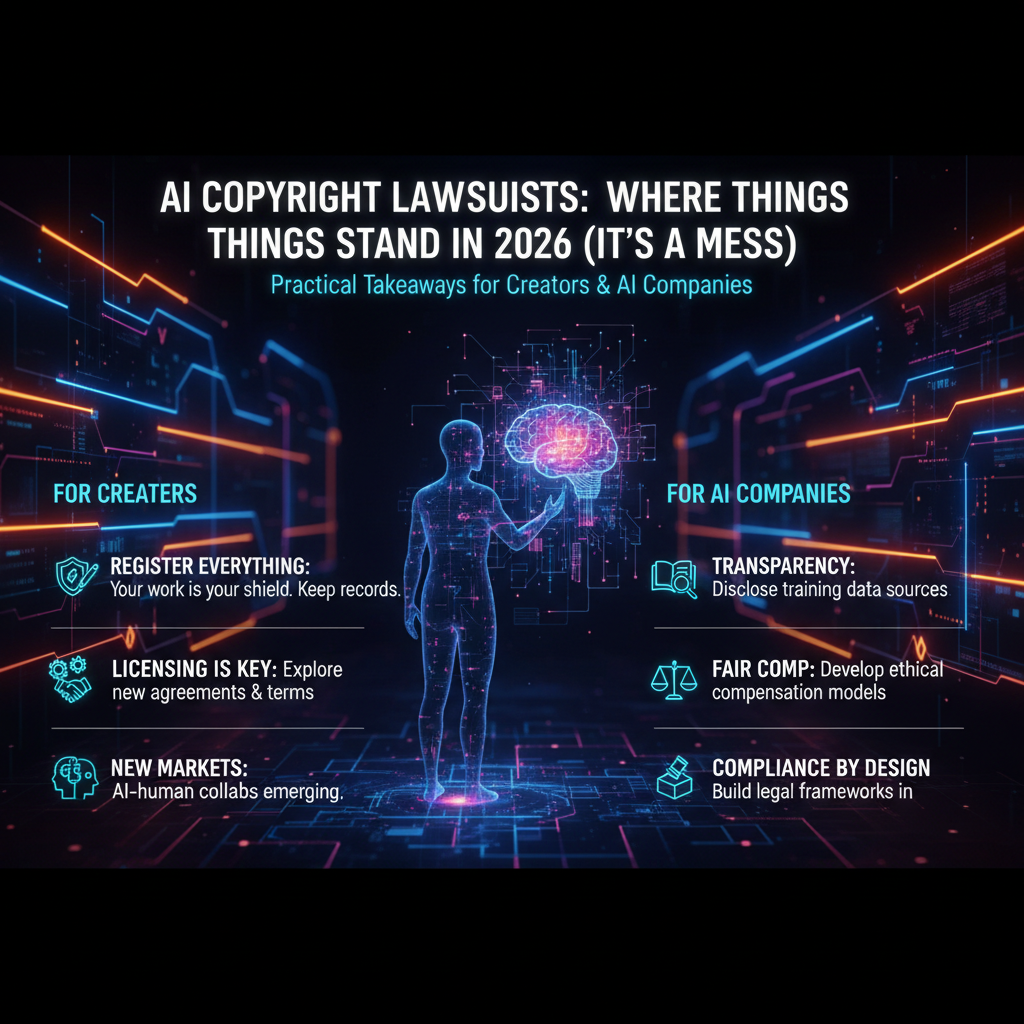
The ongoing legal battles, while frustratingly slow, are setting the stage for future interactions between humans and machines. Here are some practical takeaways for creators and AI companies.
Advice for Content Creators & Artists:
You’re on the front lines, and your work is the battleground. Don’t assume the legal system will instantly protect you.
- Register Your Copyrights: This is non-negotiable. Without federal registration (in the US), your ability to sue for statutory damages and attorney’s fees is severely limited. It’s your primary shield.
- Monitor AI Output: Use AI detection tools (imperfect as they are) and actively search for instances where your work, or work in your distinctive style, is being reproduced or closely imitated by AI models. Document everything.
- Explore Licensing & Opt-Outs: Some platforms and AI companies are beginning to offer licensing deals or opt-out mechanisms. While imperfect, investigate these. Band together with other creators to negotiate stronger terms.
- Advocate for Clearer Laws: Join artists’ unions, advocacy groups, and industry associations. Your collective voice is crucial in pushing for legislative changes that better address AI’s impact on intellectual property.
- Embrace New Avenues: While fighting for your rights, also consider how you can leverage AI tools ethically in your own creative process, or find new markets that value human-only creation.
Advice for AI Companies & Developers:
The wild west era is over. Regulators and courts are watching. Proactive measures now can save you billions later.
- Prioritize Licensed Data: The writing is on the wall. Relying solely on “publicly available” data for training is a ticking time bomb. Invest in licensing agreements with major content holders. This is expensive but necessary for long-term viability.
- Implement Robust Content Filtering: Develop and deploy advanced filtering mechanisms to prevent models from reproducing copyrighted content, both during training and in output generation. This includes pre-training data scrubbing and post-generation checks.
- Increase Transparency: Be more transparent about your training data sources, even if it’s high-level. This builds trust and can help your fair use arguments by showing good faith.
- Prepare for Legal Challenges & Settlements: Assume lawsuits are coming. Allocate legal budgets. Be open to settlement discussions, especially for legacy models trained on vast, unconsented datasets. The cost of a few major losses could be catastrophic.
- Innovate Ethically: Focus on developing AI models that augment human creativity rather than simply mimicking or replacing it. This often leads to more defensible and commercially viable products in the long run.
The Looming Shadow of Legislation:
While courts are deliberating, legislative bodies are slowly, painstakingly trying to catch up. By 2026:
- US Copyright Office: Continues to issue guidance and conduct studies, indicating a growing awareness and potential for future legislative action. However, the US legislative process is notoriously slow.
- EU AI Act: Came into force in early 2026. While primarily focused on risk and safety, it includes provisions around transparency for training data, requiring AI providers to summarize the copyrighted material used. This is a significant step towards accountability.
- Global Patchwork: Expect a fragmented global landscape, with different countries adopting varying approaches. This will create compliance headaches for international AI companies.
The pace of legal and legislative change is glacial compared to the lightning speed of AI development. This mismatch is a core reason why the “mess” persists.
Conclusion
As we navigate 2026, the AI copyright lawsuits haven’t delivered the definitive answers many hoped for. Instead, they’ve exposed the profound chasm between existing legal frameworks and rapidly evolving technology. The battles initiated by The New York Times, Getty Images, and the music industry are not just about who wins or loses; they are about fundamentally redefining intellectual property for the digital age.
The stakes are impossibly high. For creators, it’s about the future of their livelihood and the value of human ingenuity. For AI companies, it’s about the very foundation upon which their powerful technologies are built. While the legal mess continues, one thing is certain: the outcome of these cases will shape the creative economy, the AI industry, and even our understanding of what it means to create, for decades to come. Don’t expect clarity soon, but do expect a fascinating, often frustrating, evolution of the law.
Frequently Asked Questions
Q1: Will AI companies have to pay for all training data in the future?
A1: Not for all data, but likely for most copyrighted data, especially for commercial models. The trend indicates a shift towards licensing.
Q2: Can I use AI to generate images/text without infringing copyright?
A2: Yes, but with caution. If the AI output is substantially similar to existing work, or if the model was trained illegally, you could still be liable. Always check.
Q3: What’s the biggest challenge for courts in these cases?
A3: Applying outdated copyright law (especially “fair use”) to novel AI technology, particularly the “black box” nature of AI training and the unprecedented scale of data ingestion.
Q4: Is there a global consensus on AI copyright?
A4: No, not yet. Laws vary by country. The EU AI Act is a significant step, but a global harmonized approach is far off.
Q5: Will these lawsuits kill AI innovation?
A5: Unlikely. They will likely change AI innovation, pushing companies towards ethical data sourcing, licensing, and more transparent, defensible models.
Q6: What should I do as a creator to protect my work?
A6: Register your copyrights, monitor AI for misuse of your work, advocate for stronger laws, and explore licensing opportunities.
Sources
- The New York Times Company v. OpenAI, Inc. et al. (Complaint, Dec 2023)
- Getty Images (US), Inc. v. Stability AI Ltd. (Complaint, Feb 2023)
- Universal Music Group, et al. v. Anthropic PBC (Complaint, Oct 2023)
- Artists' Rights Alliance (ARA) on AI & Copyright
- U.S. Copyright Office Guidance (March 2023)
> Want more like this?
Get the best AI insights delivered weekly.
By subscribing, you agree to our Privacy Policy. You can unsubscribe at any time.
> Related Articles
Agentic Coding's New Bottleneck Is Review Evidence, Not More Parallelism
Whiteboard visualizes intent, Archify maps systems, and TODO Flow preserves task and review state. Together they show a tool category forming around one problem: proving what coding agents changed and why it is safe to merge.
CLM-8B Chooses the Next Action Instead of Writing the Next Sentence
Contrastive Language Models separate state and action encoders so repeated candidate actions can be cached and ranked quickly. The release is promising, but its headline coding scores describe verifier-assisted pipelines—not a standalone coding agent.
Whiteboard Turns AI-Generated Code Into a Reviewable System Map
The open-source Code OSS desktop app links agent-drawn architecture, semantic diffs, and decision logs back to source code. Its bet is that understanding—not generation—is now the coding bottleneck.
Tags
> Stay in the loop
Weekly AI tools & insights.