AI Chip Wars: NVIDIA vs AMD vs Intel vs Custom Silicon — Who's Actually Winning?
NVIDIA dominates the AI chip market, but AMD, Intel, and custom silicon are finally hitting back. We cut through the hype to reveal who's winning and what it means for your projects.
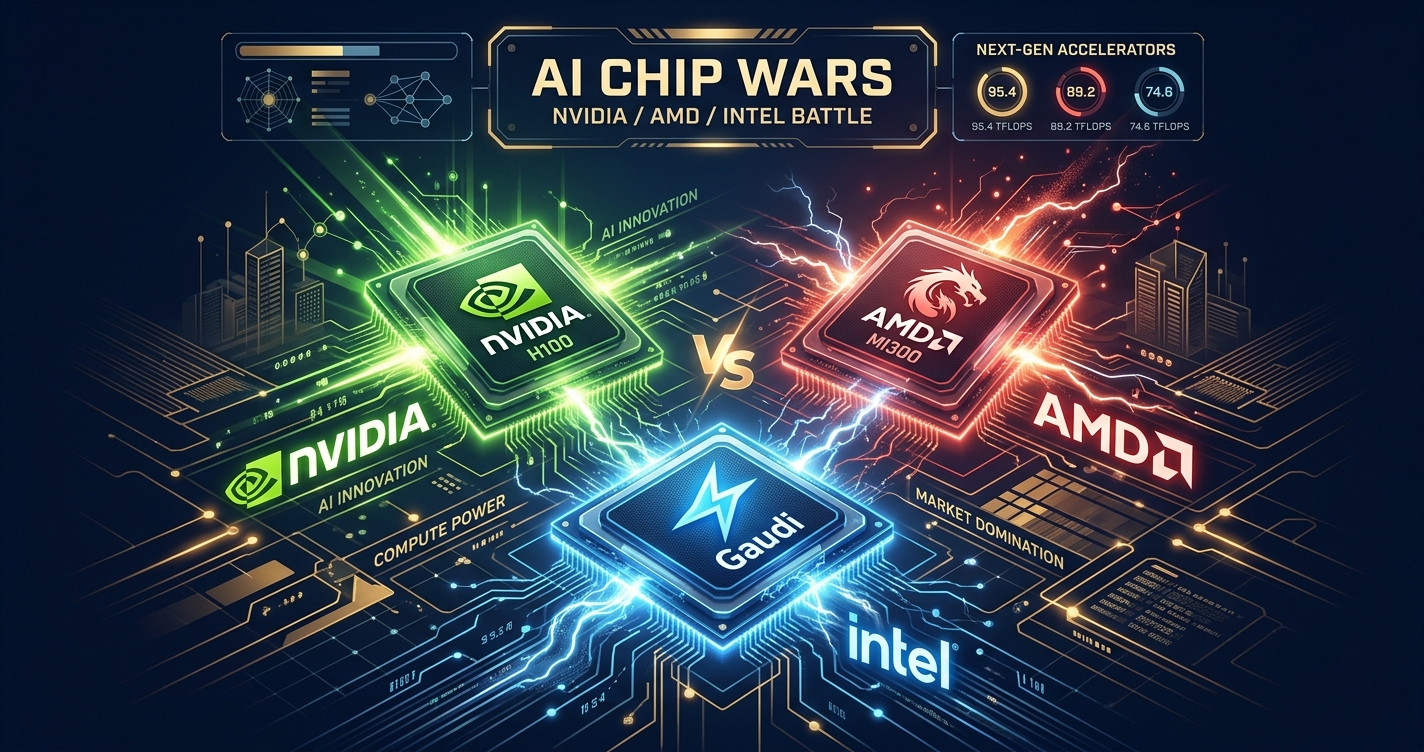
Let’s cut the corporate fluff. The AI revolution isn’t just about algorithms and fancy chatbots; it’s fundamentally a hardware game. And right now, one company holds the keys to the kingdom: NVIDIA. But the landscape is shifting. AMD is finally swinging back, Intel’s making some noise, and the hyperscalers—Google, Amazon, Microsoft—are busy forging their own silicon weapons.
This isn’t a friendly neighborhood bake-off. This is a bare-knuckle brawl for the trillion-dollar AI market. Who’s actually winning? Who’s just making a lot of noise? And more importantly, what does any of this mean for your AI ambitions? Let’s dive in.
Why Does NVIDIA Own the AI Market (And How Did They Do It)?
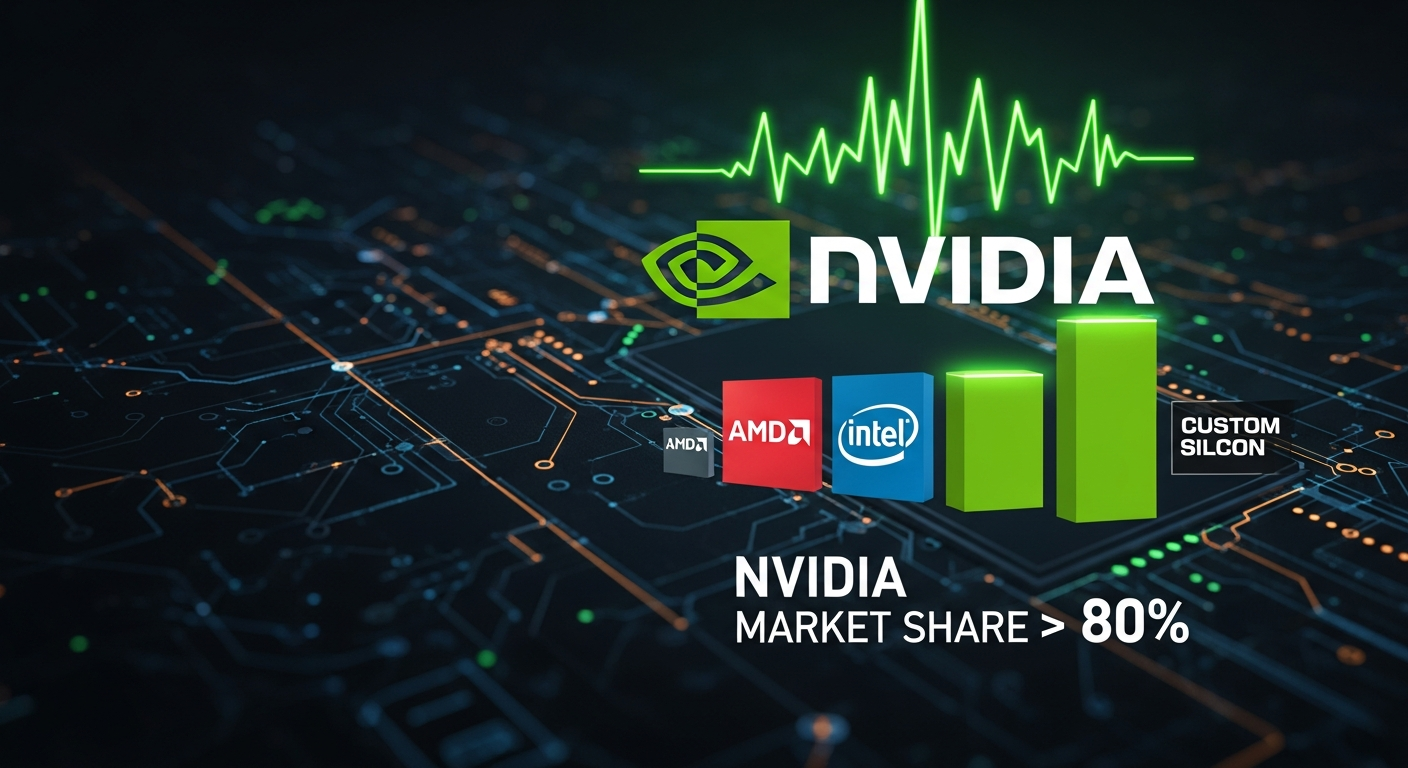
NVIDIA isn’t just winning; they’re dominating with the kind of market share numbers that would make a monopolist blush. Estimates consistently place their share of the AI accelerator market north of 80%, sometimes even pushing 90%. This isn’t an accident. It’s a testament to decades of strategic foresight and, frankly, a bit of luck.
What Makes NVIDIA’s CUDA Ecosystem So Unbeatable (For Now)?
The secret sauce isn’t just the hardware; it’s the software. NVIDIA’s CUDA platform, launched way back in 2006, is the bedrock of their empire. It’s a parallel computing platform and programming model that allows developers to use NVIDIA GPUs for general-purpose processing. This means:
- Unparalleled Developer Mindshare: Almost every AI researcher, every startup, every major tech company has built their models and tools on CUDA. It’s the lingua franca of AI development. Abandoning it means rewriting colossal amounts of code and re-training vast numbers of engineers. That’s a non-starter for most.
- Vast Libraries and Frameworks: CUDA isn’t just a compiler; it’s an entire ecosystem of optimized libraries (cuDNN, cuBLAS), frameworks (PyTorch, TensorFlow, JAX all leverage CUDA), and tools. This makes development faster, more efficient, and less prone to errors.
- Performance Leadership: NVIDIA GPUs, especially their Hopper (H100) and Blackwell (B200, GB200) architectures, are engineering marvels. The H100, for instance, boasts:
- Tensor Cores: Specialized processing units designed for AI matrix operations, crucial for deep learning.
- Transformer Engine: Dynamically chooses between FP8 and FP16 precisions to accelerate transformer models (the backbone of LLMs) without sacrificing accuracy.
- NVLink: High-speed interconnect technology that allows multiple GPUs to communicate at mind-boggling speeds (up to 900 GB/s for H100), essential for scaling large models across many accelerators.
- HBM3 Memory: Up to 80GB of fast HBM3 memory per GPU, providing massive bandwidth (3.35 TB/s for H100), critical for feeding data-hungry AI models.
The H100 PCIe version can cost anywhere from $25,000 to $40,000+ per card, depending on supply and vendor. The SXM version, designed for denser server configurations, is even pricier. While the sticker shock is real, companies pay it because, currently, nothing else offers the same combination of raw performance, software maturity, and ecosystem support. It’s a premium product with a premium price, and the market is still begging for more.
Can AMD’s MI300X Really Challenge the Green Giant?
AMD has been in the GPU game for decades, but their AI play has historically been… underwhelming. That’s changing, or at least, they’re making a damn good show of it with the Instinct MI300X. This isn’t just a souped-up gaming card; it’s a purpose-built AI accelerator designed to go head-to-head with NVIDIA’s H100.
What’s Inside the MI300X and Why Should You Care?
The MI300X is a beast, leveraging AMD’s chiplet design philosophy:
- Massive Memory: One of its headline features is its memory capacity. A single MI300X can pack up to 192GB of HBM3 memory, significantly more than the H100’s 80GB. For large language models (LLMs) that struggle to fit into GPU memory, this is a huge advantage, potentially allowing larger models or batch sizes on fewer cards.
- High Bandwidth: It delivers impressive memory bandwidth, crucial for feeding data to its compute units efficiently.
- CDNA 3 Architecture: This is AMD’s dedicated architecture for data center GPUs, distinct from their gaming RDNA architecture. It’s optimized for AI workloads, offering strong FP8 and FP16 performance.
- Integrated CPU/GPU (MI300A): While the MI300X is GPU-only, AMD also offers the MI300A, which integrates a Zen 4 CPU and CDNA 3 GPU on a single package. This “APU” design can reduce latency and simplify system design for certain workloads.
Performance-wise, AMD claims the MI300X offers a compelling value proposition, often citing better performance per dollar or higher memory capacity for LLM inference. For example, AMD has demonstrated the MI300X running models like Falcon 40B on a single GPU, which is challenging for H100 due to memory constraints.
Is ROCm Ready to Take on CUDA?
Here’s the rub: hardware is only half the battle. AMD’s answer to CUDA is ROCm (Radeon Open Compute platform). ROCm is open-source, flexible, and has been steadily improving. It supports key AI frameworks like PyTorch and TensorFlow, and AMD has put significant effort into improving its ease of use and compatibility.
However, it’s still playing catch-up. The developer community is smaller, the ecosystem isn’t as mature, and the sheer volume of optimized libraries and examples available for CUDA is a formidable barrier. For many, the “it just works” factor of CUDA outweighs the potential cost savings or open-source appeal of ROCm.
Pricing for the MI300X is not publicly disclosed but is expected to be competitive, likely aiming for a better price-performance ratio than the H100, potentially in the $20,000-$30,000 range per card, depending on configuration and volume. AMD’s strategy is clear: offer a powerful alternative, especially for memory-bound LLM workloads, at a more attractive price point, and chip away at NVIDIA’s software moat.
Is Intel’s Gaudi 2/3 a Serious Contender or Just Noise?
Intel, the CPU behemoth, arrived late to the AI accelerator party. Their initial efforts were somewhat disjointed, but with the acquisition of Habana Labs in 2019, they got serious. The result is the Gaudi line of AI accelerators, now in its third iteration.
What’s Intel Gaudi’s Unique Angle?
Gaudi chips are not GPUs. They are Host Processing Units (HPUs), specifically designed for deep learning. Their architecture focuses on efficiency for training and inference:
- Tensor Processor Cores (TPCs): Gaudi chips feature a large number of programmable TPCs optimized for matrix math and vector operations, alongside a configurable General Matrix Multiply (GEMM) engine.
- On-chip Networking (RoCE): A key differentiator is the integrated 100 Gigabit Ethernet (RoCE v2) ports directly on the chip. This reduces the need for external network interface cards (NICs) and lowers latency for multi-accelerator training, making scaling more efficient.
- SRAM Cache: Each TPC has its own local SRAM cache, reducing reliance on slower off-chip memory access.
- Habana SynapseAI Software: Intel’s software stack for Gaudi is called SynapseAI. It’s designed to be easy to integrate with existing AI frameworks like PyTorch and TensorFlow, providing optimized kernels for the Gaudi architecture.
The Gaudi 2 offers competitive performance, often matching or exceeding NVIDIA’s A100 (its predecessor) in certain training benchmarks, particularly for computer vision models. The recently announced Gaudi 3 aims squarely at the H100, promising significant gains in training throughput and inference latency, especially for LLMs. Intel claims Gaudi 3 will offer up to 4x better inference throughput and 2x better training throughput compared to the H100 for specific models.
Can Intel’s Pricing Strategy Change the Market?
Intel’s most potent weapon in this fight might be price. While they don’t publish exact retail prices, Gaudi accelerators are generally positioned to be significantly more cost-effective than NVIDIA’s offerings. Reports and cloud provider listings suggest Gaudi 2 systems can be offered at a fraction of the cost of H100 systems, potentially below $10,000-$15,000 per card in some configurations. This makes them highly attractive to organizations looking to scale AI training without breaking the bank.
The challenge for Intel, like AMD, is the software ecosystem. While SynapseAI is robust, it’s not CUDA. Developers need to ensure their models and pipelines are compatible, and while Intel provides migration tools and support, it’s still an additional hurdle. However, for organizations building new AI infrastructure or those heavily focused on cost-efficiency, Intel Gaudi presents a compelling, often overlooked, alternative.
Why Are Google, Amazon, and Microsoft Building Their Own AI Chips?

The elephant in the room for NVIDIA, AMD, and Intel is the hyperscalers themselves. Google, Amazon, and Microsoft aren’t just buying chips; they’re designing their own. Why? Because when you operate at their scale, even small efficiencies translate into billions of dollars in savings and significant strategic advantages.
Google’s TPUs: The OG Custom AI Accelerator
Google was arguably the first to go all-in on custom AI silicon with its Tensor Processing Units (TPUs). Launched internally in 2016 and later made available via Google Cloud, TPUs are purpose-built ASICs (Application-Specific Integrated Circuits) optimized for TensorFlow workloads.
- Focus on Specificity: TPUs are designed from the ground up to excel at the matrix multiplications and convolutions that dominate deep learning. This specialized design allows for extreme efficiency and performance for Google’s internal workloads (Search, Photos, Translate, YouTube, etc.).
- Scalability: Google’s TPU Pods can connect thousands of TPUs, providing immense compute power for training massive models.
- Generations: Google has iterated through several generations (v1, v2, v3, v4, v5e), each offering significant improvements in performance and efficiency. The TPU v5e, for instance, is designed for both training and inference at scale, offering a cost-effective solution for cloud customers.
For Google, TPUs reduce reliance on external vendors, allow for tighter integration with their software stack, and provide a competitive edge in their cloud offerings.
AWS Inferentia & Trainium: Amazon’s Cloud-First Strategy
Amazon Web Services (AWS) is the largest cloud provider, and they’re building their own silicon to optimize their vast AI infrastructure.
- AWS Inferentia: Designed specifically for inference workloads. Inferentia chips are optimized for high throughput and low latency, making them ideal for deploying pre-trained models at scale (e.g., powering Alexa, Amazon.com recommendations). They offer significant cost savings for inference compared to general-purpose GPUs.
- AWS Trainium: Built for training deep learning models. Trainium is designed to be highly scalable and cost-effective for large-scale training jobs within the AWS ecosystem.
Both Inferentia and Trainium are tightly integrated into AWS services, offering developers a seamless experience within the AWS environment. They provide AWS customers with more choices, potentially lower costs, and specific optimizations for cloud-native AI development.
Microsoft’s Maia & Cobalt: Azure’s New Muscle
Microsoft, a massive investor in OpenAI and a key player in the AI race, recently unveiled its own custom chips:
- Microsoft Azure Maia AI Accelerator: This is Microsoft’s answer to NVIDIA’s H100, purpose-built for AI workloads, specifically for large language models and other generative AI tasks. Maia is designed to power services like Microsoft Copilot and optimize the performance of OpenAI’s models running on Azure.
- Microsoft Azure Cobalt CPU: While not an AI accelerator, Cobalt is an Arm-based CPU custom-designed for general-purpose workloads in Azure. It complements Maia by providing efficient compute for the surrounding infrastructure.
Maia’s goal is similar to Google’s and Amazon’s: to optimize performance, reduce costs, and ensure a stable supply chain for their rapidly expanding AI services. While initially focused on internal use, it’s highly probable these chips will eventually be offered to Azure customers, providing another strong alternative to traditional vendors.
Who’s Actually Winning the AI Chip War Right Now? (Hint: It’s Complicated)
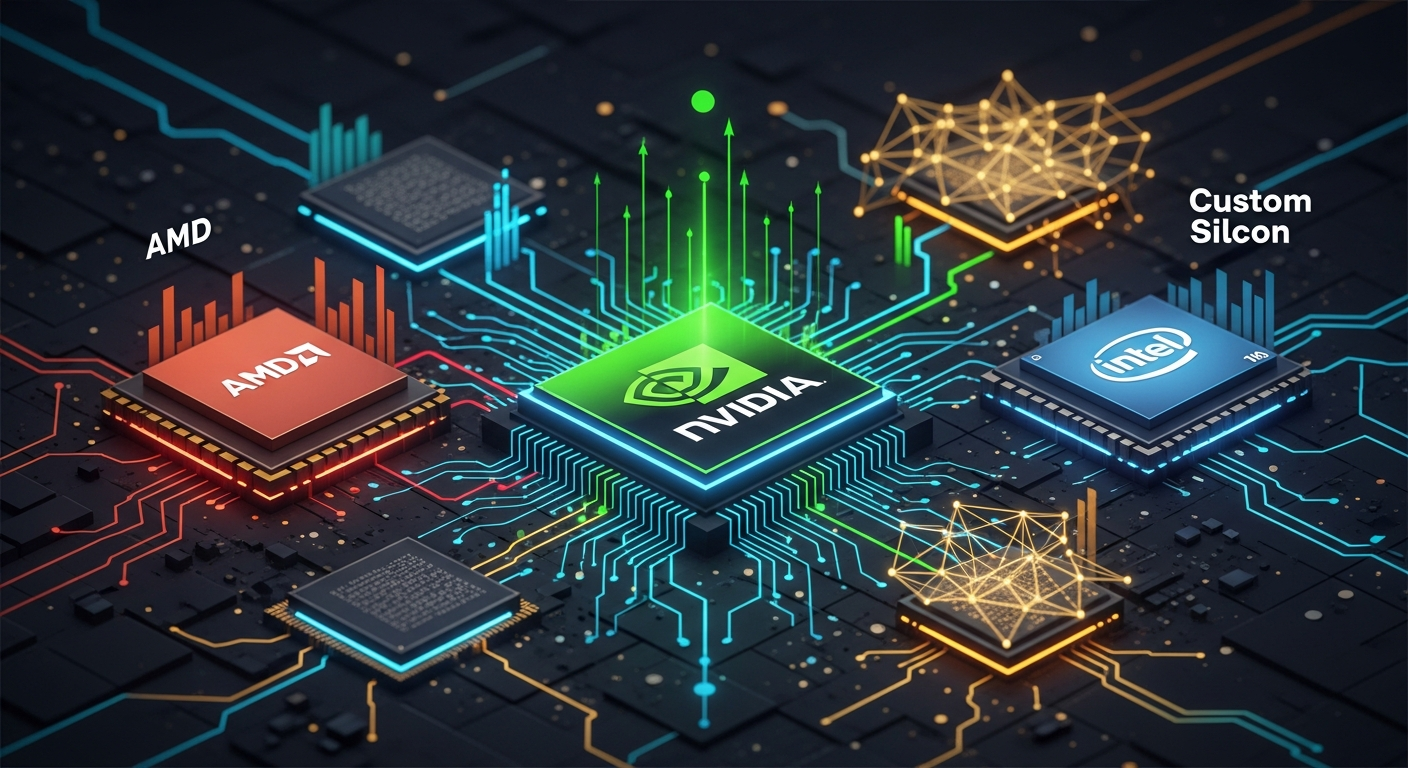
If “winning” means market share and revenue today, NVIDIA is crushing it. Their ecosystem lock-in, combined with their relentless innovation and supply chain prowess (despite recent shortages), makes them the undisputed champion. But the war is far from over, and the definition of “winning” is evolving.
Here’s a snapshot of the major players:
| Feature/Metric | NVIDIA H100 (PCIe) | AMD Instinct MI300X | Intel Gaudi 3 | Google TPU v5e (Cloud) |
|---|---|---|---|---|
| Architecture | Hopper (GPU) | CDNA 3 (GPU) | HPU (Deep Learning Accelerator) | ASIC (Tensor Processing Unit) |
| Memory Capacity | 80GB HBM3 | 192GB HBM3 | 128GB HBM3e | Varies per slice (e.g., 16GB HBM per v5e chip) |
| Memory Bandwidth | 3.35 TB/s | 5.2 TB/s | 3.7 TB/s | High, optimized for TPU Pods |
| FP8 Performance | 1,979 TFLOPS (Tensor Cores) | Up to 2.6 PFLOPS (peak) | 1,835 TFLOPS (peak) | High (bfloat16 focus, but supports int8) |
| Ecosystem | CUDA (Dominant) | ROCm (Growing, open-source) | Habana SynapseAI (Optimized for Gaudi) | TensorFlow, JAX (Tightly integrated with Google Cloud) |
| Typical Price | $25,000 - $40,000+ | ~$20,000 - $35,000 (estimated, competitive) | ~$10,000 - $20,000 (estimated, aggressive) | Cloud-based pricing (per hour/usage) |
| Primary Strength | Unmatched performance, software maturity, ecosystem. | Memory capacity, competitive price-performance. | Price-performance, integrated networking, efficiency. | Extreme scalability, cost-efficiency for Google Cloud. |
| Primary Challenge | High cost, supply constraints, ecosystem lock-in. | ROCm maturity, developer mindshare, catching up. | Ecosystem adoption, overcoming NVIDIA’s lead. | Cloud-locked, specific software stack. |
(Note: Performance metrics are peak theoretical values and real-world performance varies greatly by workload. Pricing is estimated street price for individual PCIe cards or comparable systems, subject to change and volume discounts.)
What About Supply Chain and Ecosystem Lock-in?
Supply chain is a huge factor. NVIDIA’s ability to consistently deliver (even if demand outstrips supply) has been critical. Their relationships with TSMC and other partners are ironclad. Competitors face the daunting task of securing advanced process node capacity.
Ecosystem lock-in remains NVIDIA’s strongest moat. While everyone is building bridges to PyTorch and TensorFlow, the vast ocean of custom CUDA code, optimized libraries, and developer expertise is hard to replicate. This isn’t just about technical compatibility; it’s about human capital.
However, the custom silicon trend by hyperscalers is a direct threat to everyone. If Google, Amazon, and Microsoft can build chips that are “good enough” for their internal needs at a fraction of the cost, they’ll do it. This reduces their reliance on external vendors and keeps massive amounts of spending in-house. It’s not about them selling chips to the broader market (yet), but about them not buying from others.
So, What Does This Mean for Your AI Projects?
This isn’t just an academic debate for chip nerds. The choices you make about hardware will directly impact your project’s performance, cost, and long-term viability.
When Should You Just Stick with NVIDIA?
- If budget isn’t your primary concern, or you need absolute peak performance and the broadest software compatibility: NVIDIA H100 (or the upcoming Blackwell) is still the gold standard.
- If you have an existing CUDA-heavy codebase or a team deeply familiar with the NVIDIA ecosystem: The cost of switching might outweigh any potential hardware savings.
- If you’re doing cutting-edge research or developing highly complex models where every ounce of performance matters: NVIDIA’s continuous innovation is hard to beat.
- Practical Takeaway: For most startups and teams without massive infrastructure budgets, cloud instances with NVIDIA GPUs (H100, A100) are still the safest, most accessible, and most productive option, despite the higher per-hour cost.
When Should You Seriously Consider AMD or Intel?
- If cost-efficiency and price/performance are critical: This is where AMD MI300X and Intel Gaudi 2/3 shine. They are actively trying to undercut NVIDIA on price while offering competitive performance for many workloads.
- For specific memory-bound LLM workloads: AMD’s MI300X with its massive 192GB of HBM3 memory could be a major change for inference or fine-tuning very large models on fewer cards.
- If you’re building new infrastructure from the ground up and have the engineering bandwidth to optimize for ROCm or SynapseAI: The potential long-term cost savings could be significant.
- If you’re running training workloads that align well with Gaudi’s architecture: Intel has demonstrated strong price-performance for many standard training tasks.
- Practical Takeaway: Don’t dismiss these alternatives out of hand. Run benchmarks for your specific workloads. The initial effort to port might pay dividends in reduced operational costs, as seen in some third-party case studies where companies have achieved significant TCO reductions by diversifying their hardware. For example, some cloud providers offering Gaudi instances have reported customers achieving 2-3x better price-performance for specific large model training tasks compared to previous-generation NVIDIA GPUs.
When Should You Leverage Hyperscaler Custom Silicon?
- If you’re already deeply embedded in a specific cloud ecosystem (AWS, Google Cloud, Azure): Using their custom silicon (TPUs, Inferentia, Trainium, Maia) often provides the most cost-effective and highly integrated solution for both training and inference within that cloud.
- If your workloads align perfectly with their specialized design: For example, Google TPUs are fantastic for TensorFlow-centric training, while Inferentia excels at high-volume inference.
- Practical Takeaway: If your primary operational model is cloud-native, explore the custom silicon options offered by your cloud provider. They’re often cheaper and better integrated than general-purpose GPUs for their intended use cases.
Conclusion: The War Rages On
The AI chip war is far from decided. NVIDIA currently holds the crown, but the challengers are stronger than ever. AMD is making a legitimate play for LLM workloads, Intel is aggressively pursuing the price-performance segment, and the hyperscalers are building their own formidable arsenals.
This competition is a net positive for everyone. It drives innovation, pushes down prices (eventually), and offers developers more choices. The future of AI will likely involve a heterogeneous mix of hardware, where the “best” chip isn’t a single answer, but rather the one best suited for a specific workload, budget, and ecosystem. So, do your homework, benchmark relentlessly, and choose wisely. Your AI future depends on it.
Frequently Asked Questions
## What is the biggest challenge for NVIDIA’s competitors?
The biggest challenge for NVIDIA’s competitors, primarily AMD and Intel, is overcoming the CUDA ecosystem lock-in. NVIDIA’s CUDA platform has been the dominant software layer for AI development for over a decade, leading to unparalleled developer mindshare, vast libraries, and optimized frameworks. While competitors like AMD (with ROCm) and Intel (with SynapseAI) are investing heavily in their software stacks, convincing developers to switch or support multiple platforms remains a significant hurdle.
## Are custom AI chips like Google TPUs available for anyone to buy?
No, generally, custom AI chips like Google TPUs, AWS Inferentia/Trainium, and Microsoft Maia are not sold as standalone hardware products for direct purchase. Instead, they are primarily offered as cloud services within their respective cloud platforms (Google Cloud, AWS, Azure). Users can provision instances or clusters powered by these custom chips, paying for their usage on an hourly or consumption basis, rather than owning the physical hardware.
## How does the cost of AI chips impact AI development?
The high cost of advanced AI chips significantly impacts AI development by creating a barrier to entry for smaller organizations and individuals. It drives up the operational expenses for training and deploying large models, making efficient hardware utilization and optimization crucial. This cost factor also fuels the demand for more affordable alternatives, cloud-based services, and the development of smaller, more efficient models (like “small language models” or SLMs) that can run on less expensive hardware.
## What is the difference between an AI GPU and an HPU?
An AI GPU (Graphics Processing Unit), like NVIDIA’s H100 or AMD’s MI300X, is a general-purpose parallel processor that was initially designed for graphics rendering but has been adapted and optimized for AI workloads. They are highly flexible and excel at a wide range of tasks. An HPU (Host Processing Unit), like Intel’s Gaudi series, is a purpose-built AI accelerator designed specifically for deep learning tasks (training and inference). HPUs often feature specialized cores and on-chip networking optimized for matrix operations and data flow, potentially offering greater efficiency for targeted AI workloads compared to general-purpose GPUs, but with less flexibility for other computing tasks.
## Will the AI chip market become more diversified in the future?
Yes, it is highly likely that the AI chip market will become more diversified in the future. While NVIDIA currently holds a dominant position, the aggressive competition from AMD and Intel, coupled with the significant investments by hyperscalers in custom silicon, will lead to a broader array of choices. We can expect to see increased specialization, with different chips optimized for specific workloads (e.g., training vs. inference, specific model types), price points, and ecosystem integrations. This diversification will ultimately benefit consumers and developers by fostering innovation and driving down costs.
Sources
> Want more like this?
Get the best AI insights delivered weekly.
By subscribing, you agree to our Privacy Policy. You can unsubscribe at any time.
> Related Articles
Agentic Coding's New Bottleneck Is Review Evidence, Not More Parallelism
Whiteboard visualizes intent, Archify maps systems, and TODO Flow preserves task and review state. Together they show a tool category forming around one problem: proving what coding agents changed and why it is safe to merge.
CLM-8B Chooses the Next Action Instead of Writing the Next Sentence
Contrastive Language Models separate state and action encoders so repeated candidate actions can be cached and ranked quickly. The release is promising, but its headline coding scores describe verifier-assisted pipelines—not a standalone coding agent.
Whiteboard Turns AI-Generated Code Into a Reviewable System Map
The open-source Code OSS desktop app links agent-drawn architecture, semantic diffs, and decision logs back to source code. Its bet is that understanding—not generation—is now the coding bottleneck.
Tags
> Stay in the loop
Weekly AI tools & insights.